


Page 29 - ARUBA TODAY
P. 29
A29
                                                                                     PEOPLE & ARTS Monday 13 March 2017


                  Book explores trends through fate of Ohio glass manufacturer


            ANDREW WELSH-HUGGINS         in  poverty,  according  to  social  contract,  capitalism   Smith  appreciated  the  in-
             Associated Press            the  most  recent  U.S.  Cen-  and what we want capital-  depth  history  of  Anchor
            COLUMBUS,  Ohio  (AP)  —     sus  data.  Per  capita  and  ism to do for us.”          Hocking  in  “Glass  House.”
            A book that examines the     household incomes are be-    “Glass   House”     follows   He doesn’t dispute that the
            history  of  a  longtime  glass   low the state level. The city  “Dreamland”  by  Sam  Qui-  company  no  longer  sup-
            manufacturing  company       school district got a “D’’ for  nones, a history of the opi-  ports  the  community  the
            and  the  corresponding      achievement  on  the  most  oid epidemic with chapters    way  it  did  before  private
            changes  of  an  American    recent state report card.    on Portsmouth and Colum-     equity firms got involved.
            city  is  the  latest  best-seller   A  few  years  later,  reading  bus, and “Hillbilly Elegy” by   But  Smith  disagrees  with
            to  explore  economic  and   about  changes  at  Anchor  J.D. Vance, his memoir and    the book’s suggestion that
            social  trends  in  the  coun-  Hocking,  Alexander  real-  working  class  study  based   the city has fallen on hard
            try through the lens of Ohio   ized that threads for a book  on  growing  up  in  Middle-  times,  though  it’s  worth
            communities.                 he’d  been  contemplating  town  as  an  Appalachian      noting   his   predecessor
            “Glass House: The 1% Econ-   on trends in America were  transplant.                    resigned  two  months  af-
            omy  and  the  Shattering    right in front of him.       Alexander’s    book    has   ter  being  sentenced  to
            of the All-American Town”    “The  book  is  not  about  ruffled  a  few  feathers  in   90  days  house  arrest  after
            focuses  on  Lancaster  in   Lancaster. It’s really about  Lancaster,  where  leaders   pleading guilty to failing to
            central Ohio and the glass   the United States of Amer-   boast  of  the  city’s  annual   file state tax returns for two
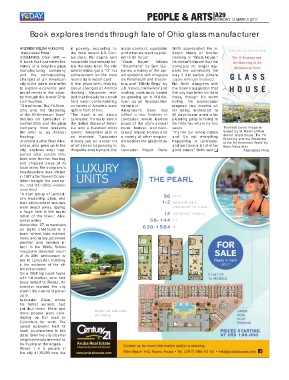
            company  most  residents     ica  and  a  hundred  other  music  festival,  well-main-  years.                      This book cover image re-
            still  refer  to  as  Anchor   towns,”  Alexander  said  in  tained  historic  homes  and   “It’s  not  our  whole  history   leased by St. Martin’s Press
            Hocking.                     an  interview.  “Lancaster  a variety of other employ-    and  it’s  not  everything   shows “Glass House: The 1%
                                                                                                                                Economy and the Shattering
            Journalist author Brian Alex-  is  really  just  an  avatar  for  ers besides the glass indus-  happening  in  Lancaster,   of the All-American Town” by
            ander, who grew up in the    what’s been happening to  try.                            and we have a lot of other   Brian Alexander.
            city,  explores  what  hap-  things like employment, the  Lancaster   Mayor    Dave    good assets,” Smith said.q               Associated Press
            pened  after  outside  firms
            took over Anchor Hocking
            and  chipped  away  at  its
            local roots. The company’s
            headquarters  was  closed
            in 1987 after Newell Corpo-
            ration bought the compa-
            ny, and 300 office workers
            were fired.
            “A core group of Lancast-
            er’s  leadership  class,  and
            their all-important spouses,
            were  swept  away,  ripping
            a  huge  hole  in  the  social
            fabric  of  the  town,”  Alex-
            ander writes.
            Alexander,  57,  remembers
            an  idyllic  childhood  in  a
            town  where  kids  roamed
            freely and safely, jobs were
            plentiful  and  families  in-
            tact.  In  the  1940s,  Forbes
            magazine  devoted  much
            of  its  30th  anniversary  is-
            sue to Lancaster, dubbing
            it  the  epitome  of  the  all-
            American town.
            On a 2008 trip back home
            with  his  mother,  who  had
            since retired to Florida, Al-
            exander  realized  the  city
            wasn’t the one he’d grown
            up in.
            Lancaster  Glass,  where
            his  father  worked,  had
            just  shut  down.  More  and
            more  people  were  com-
            muting  up  the  road  to
            Columbus  for  work.  The
            opioid  epidemic  had  hit
            hard,  as  elsewhere  in  the
            state. Even the city’s better
            neighborhoods seemed to
            be fraying at the edges.
            About  1  in  5  people  in
            the city of 39,000 now live

