


Page 31 - ARUBA TODAY
P. 31
A31
                                                                                     PEOPLE & ARTS Wednesday 5 april 2017
               ‘Guess Who’s Coming to Dinner’ legacy debated on anniversary


            MARK KENNEDY                 a  movie  like  that.’  I  think   way. The film just captured
             AP Entertainment Writer     we  did  need  a  movie  like   a change that was starting
            NEW  YORK  (AP)  —  Fif-     that.”                       to take place.”
            ty  years  ago,  Katharine  Houghton played a young       Columbia Pictures wanted
            Houghton found herself on  white  woman  studying  in     to  shut  down  the  produc-
            her first big movie set mak-  Hawaii  who  brings  home   tion, arguing it couldn’t get
            ing  something  that  made  an  accomplished  African-    insurance  for  Tracy,  who
            plenty  of  people  deeply  American  doctor  and  in-    was  gravely  ill  (he  would
            worried.                     forms her parents — played   die just days after shooting
            Houghton     and    co-star  by Katharine Hepburn and     wrapped).  Hepburn  and
            Sidney  Poitier  were  play-  Spencer  Tracy  —  that  she   Kramer agreed to put their
            ing  lovers  in  “Guess  Who’s  intends to marry him. Cha-  salaries  in  escrow  in  case
            Coming  to  Dinner,”  a  ro-  os  ensues  as  her  liberal   Tracy  couldn’t  finish  and
            mantic  comedy  directed  parents  grapple  with  the     another  actor  needed  to
            by  Stanley  Kramer.  Shoot-  concept of interracial mar-  be hired.
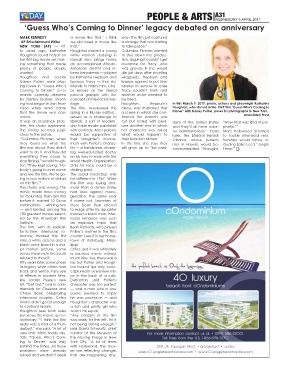
            ing had begun in San Fran-   riage.                       Houghton,       Hepburn’s    In this March 9, 2017, photo, actress and playwright Katharine
            cisco  when  word  came  The  film,  re-released  this    niece,  was  frustrated  that   Houghton, who starred in the 1967 film “Guess Who’s Coming to
            that  the  movie  was  can-  spring in a Blu-ray edition ,   a scene in which she con-  Dinner” with Sidney Poitier, poses for photographs in New York.
            celed.                       served  as  a  challenge  to   fronted  her  parents  was                                          Associated Press
            It  was  an  insurance  prob-  liberals,  a  sort  of  modern-  cut  but  noted  with  plea-  dent  of  the  United  States  ‘Wow that was kind of pro-
            lem,  the  studio  explained.  day fable made palatable   sure another one in which    and  they’ll  all  have  color-  phetic.’”
            The  timing  seemed  suspi-  with comedy. Most parents    her  character  was  asked   ful  administrations.”  Years  More  Hollywood  attempts
            cious to the actors.         would  be  supportive  of    what  would  happen  to      later,  the  biracial  Barack  to  tackle  interracial  rela-
            “Columbia  Pictures,  when  their  daughter’s  involve-   their biracial children.     Obama,  whose  parents  tionships  would  follow,  in-
            they  found  out  what  the  ment with Poitier’s charac-  In  the  film,  she  says  they   met  in  Hawaii,  would  be-  cluding Spike Lee’s “Jungle
            film was about, they didn’t  ter — a handsome, charm-     will  grow  up  to  “be  presi-  come president. “I thought,  Fever,” q
            want to do it. And they did  ing,  well-educated  doctor
            everything  they  could  to  on his way to work with the
            stop filming,” recalls Hough-  World Health Organization.
            ton. “They kept saying, ‘No-  Only  his  race  could  be  a
            body’s going to ever come  sticking point.
            and see this film. We’re go-  The  social  backdrop  was
            ing to lose millions of dollars  far  different  in  1967.  While
            on this film.’”              the  film  was  being  shot,
            The studio was wrong. The  more  than  a  dozen  states
            movie made more money  had  laws  against  misce-
            for Columbia than any film  genation.  The  same  year
            before it, earned 10 Oscar  it  came  out,  Secretary  of
            nominations — winning two  State  Dean  Rusk  offered
            — and landed among the  to resign after his daughter
            100 greatest movies select-  married a black man. Inter-
            ed  by  the  American  Film  racial  romance  was  such
            Institute.                   an  explosive  topic  that
            The  film,  with  its  radical-  Beah Richards, who played
            for-its-time  interracial  ro-  Poitier’s mother in the film,
            mance,  marked  the  first  couldn’t see it in her home-
            time a white actress and a  town  of  Vicksburg,  Missis-
            black actor kissed in a ma-  sippi.
            jor  motion  picture.  Some  Critics said it was ultimately
            movie theaters in the South  a  cautious  movie  without
            refused to show it.          much bite. Yes, there was a
            Fifty years later, some cheer  kiss but Poitier and Hough-
            its legacy while others look  ton  locked  lips  only  once,
            back and wince. Fans see  captured in a rearview mir-
            its  effects  in  modern  films,  ror  in  the  back  of  a  cab.
            like  Jordan  Peele’s  new  Detractors  said  Poitier’s
            hit, “Get Out,” and in com-  character was too perfect
            mercials  for  Cheerios  and  — and a man who in one
            Chase  Bank  celebrating  scene  seemed  to  imply
            interracial  couples.  Critics  he  was  post-race  —  and
            think it didn’t go far enough  Houghton’s character was
            to confront racism.          a  rich  and  pretty  girl  who
            Houghton  sees  both  sides  wasn’t his equal.
            but views the movie as rev-  “Any  criticism  of  the  film
            olutionary.  “I  think  the  film  was really for the left, for it
            really was a kind of a thun-  not being daring enough,”
            derbolt,” she said. “A lot of  said  David  Schwartz,  chief
            very chic critics today say,  curator  at  the  Museum  of
            ‘Oh,  “Guess  Who’s  Com-    the  Moving  Image  in  New
            ing  to  Dinner”  was  way  York  City.  “A  lot  of  times
            behind the times. All those  with  Hollywood,  the  mov-
            problems  were  already  ies  are  reflecting  changes
            solved and we didn’t need  that  are  happening  any-

