


Page 100 - Empires of Medieval West Africa
P. 100
t h e  m ande  p eople  of  the  m ali  Empire


                        The jeliw’s own security depended on their rulers’ political power
                    and social prestige. As a result, the stories they told tended to be biased
                    in favor of their employer’s ancestors, at the expense of their rivals and
                    enemies.


                    dugha, chief Jeli of
                    ManSa SulayMan’S courT
                    The best description of a jeli from the medieval period comes from Ibn
                    Battuta, an Arab historian who visited the Mali Empire in 1352–1353
                    and described its court (as quoted in Levtzion and Hopkins’s Corpus
                    of  Early  Arabic  Sources  for  West  African  History).  Standing  ready  to
                    address the people with whatever the mansa wished to communicate
                    was Dugha, his chief spokesman.
                        As chief of the jeliw, Dugha was one of the best-dressed people at jeliw, Dugha was one of the best-dressed people at jeliw
                    the Mali court. He wore a turban, fine garments of silk brocade, and
                    boots with spurs. From his waist hung a sword in a golden sheath, and


                            CONNECTIONS

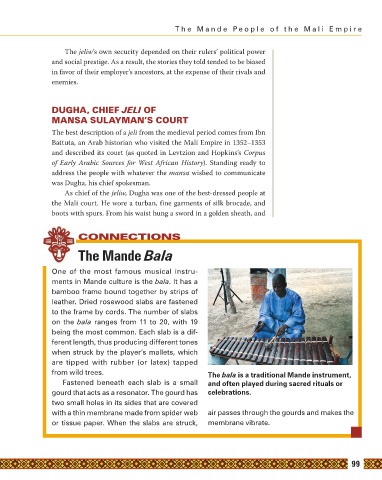
                            The Mande Bala

                    one  of  the  most  famous  musical  instru-
                    ments in mande culture is the bala. it has a
                    bamboo frame bound together by strips of
                    leather. dried rosewood slabs are fastened
                    to the frame by cords. the number of slabs
                    on the bala ranges from 11 to 20, with 19
                    being the most common. Each slab is a dif-
                    ferent length, thus producing different tones
                    when struck by the player’s mallets, which
                    are  tipped  with  rubber  (or  latex)  tapped
                    from wild trees.                            The bala is a traditional Mande instrument,
                       fastened beneath each slab is a small    and often played during sacred rituals or
                    gourd that acts as a resonator. the gourd has   celebrations.
                    two small holes in its sides that are covered
                    with a thin membrane made from spider web   air passes through the gourds and makes the
                    or tissue paper. when the slabs are struck,   membrane vibrate.

