


Page 28 - Demo samer flip book
P. 28
Investopedia.com – the resource for investing and personal finance education.
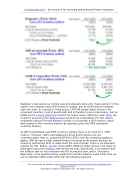
Walgreen's represents our normal case and arguably shows the "best practice" in this regard: the company uses LIFO inventory costing, and its LIFO reserve increases year over year. In a period of rising prices, LIFO will assign higher prices to the consumed inventory (cost of goods sold) and is therefore more conservative. Just as COGS on the income statement tends to be higher under LIFO than under FIFO, the inventory account on the balance sheet tends to be understated. For this reason, companies using LIFO must disclose (usually in a footnote) a LIFO reserve, which when added to the inventory balance as reported, gives the FIFO-equivalent inventory balance.
As GAP Incorporated uses FIFO inventory costing, there is no need for a "LIFO reserve." However, GAP's and Walgreen's gross profit margins are not commensurable--that is, comparing FIFO to LIFO is not like comparing apples to apples. GAP will get a slight upward bump to its gross profit margin because its inventory method will tend to undercount the cost of goods. There is no automatic solution for this. Rather, we can revise GAP's COGS (in dollar terms) if we make an assumption about the inflation rate during the year. Specifically, if we assume that the inflation rate for the inventory was R% during the year, and if "Inventory Beginning" in the equation below equals the inventory balance under FIFO, then we can re-estimate COGS under LIFO with the following equation:
This tutorial can be found at: http://www.investopedia.com/university/financialstatements/ (Page 28 of 66)
Copyright © 2004, Investopedia.com - All rights reserved.


