


Page 30 - Demo samer flip book
P. 30
Investopedia.com – the resource for investing and personal finance education.
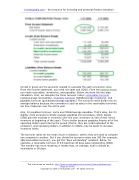
Circled in green are the accounts needed to calculate the cash conversion cycle. From the income statement, you need net sales and COGS. From the balance sheet, you need receivables, inventories, and payables. Below, we show the two-step calculation. First, we calculate the three turnover ratios: receivables turnover (sales/average receivables), inventory turnover (COGS/average inventory), and payables turnover (purchases/average payables). The turnover ratios divide into an average balance because the numerators (such as sales in the receivables turnover) are flow measures over the entire year.
Also, for payables turnover, some use COGS/average payables. That's okay, but it's slightly more accurate to divide average payables into purchases, which equals COGS plus the increase in inventory over the year (inventory at end of year minus inventory at beginning of the year). This is better because payables finance all of the operating dollars spent during the period (that is, they are credit extended to the company). And operating dollars, in addition to COGS, may be spent to increase inventory levels.
The turnover ratios do not mean much in isolation; rather, they are used to compare one company to another. But if you divide the turnover ratios into 365 (for example, 365/receivables turnover), you get the "days outstanding" numbers. Below, for example, a receivable turnover of 9.6 becomes 38 days sales outstanding (DSO). This number has more meaning; it means that, on average, Kohl's collects its receivables in 38 days.
This tutorial can be found at: http://www.investopedia.com/university/financialstatements/ (Page 30 of 66)
Copyright © 2004, Investopedia.com - All rights reserved.


