


Page 17 - MNLGA Free State Winter 2025
P. 17
Stormwater and Water Quality Compliance

        Trees, shrubs, graminoids, and other herbaceous plants
        are a crucial, cost-effective component of municipal
        separate storm sewer system (MS4) plans. Maryland,
        along with other states, encourages the use of native
        plants because they are adapted to local growing
        conditions, preserve the state's natural heritage, and
        support significantly more local wildlife than non-
                          3,4
        native ornamentals . At the county and city level,
        preference for natives is often reflected in recently revised
        Landscaping Manuals that require a certain percentage
        of native woodies (and sometimes perennials) for new
        construction and municipal projects. Cohesive state-
        level and municipal planting ordinances are increasingly
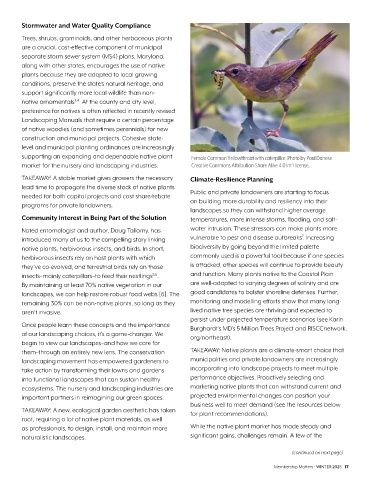
        supporting an expanding and dependable native plant     Female Common Yellowthroat with caterpillar. Photo by Paul Danese
        market for the nursery and landscaping industries.      Creative Commons Attribution-Share Alike 4.0 Int’l license.

        TAKEAWAY: A stable market gives growers the necessary   Climate-Resilience Planning
        lead time to propagate the diverse stock of native plants
                                                                Public and private landowners are starting to focus
        needed for both capital projects and cost share/rebate
                                                                on building more durability and resiliency into their
        programs for private landowners.
                                                                landscapes so they can withstand higher average
        Community Interest in Being Part of the Solution        temperatures, more intense storms, flooding, and salt-

        Noted entomologist and author, Doug Tallamy, has        water intrusion. These stressors can make plants more
                                                                                                     7
        introduced many of us to the compelling story linking   vulnerable to pest and disease outbreaks . Increasing
        native plants, herbivorous insects, and birds. In short,   biodiversity by going beyond the limited palette
        herbivorous insects rely on host plants with which      commonly used is a powerful tool because if one species
        they’ve co-evolved, and terrestrial birds rely on those   is attacked, other species will continue to provide beauty
                                                    5,6
        insects–mainly caterpillars–to feed their nestlings .   and function. Many plants native to the Coastal Plain
        By maintaining at least 70% native vegetation in our    are well-adapted to varying degrees of salinity and are
        landscapes, we can help restore robust food webs [6]. The   good candidates to bolster shoreline defenses. Further,
        remaining 30% can be non-native plants, so long as they   monitoring and modelling efforts show that many long-
        aren’t invasive.                                        lived native tree species are thriving and expected to
                                                                persist under projected temperature scenarios (see Karin
        Once people learn these concepts and the importance
                                                                Burghardt’s MD’s 5 Million Trees Project and RISCCnetwork.
        of our landscaping choices, it’s a game-changer. We
                                                                org/northeast).
        begin to view our landscapes–and how we care for
        them–through an entirely new lens. The conservation     TAKEAWAY: Native plants are a climate-smart choice that
        landscaping movement has empowered gardeners to         municipalities and private landowners are increasingly
        take action by transforming their lawns and gardens     incorporating into landscape projects to meet multiple
        into functional landscapes that can sustain healthy     performance objectives. Proactively selecting and
        ecosystems. The nursery and landscaping industries are   marketing native plants that can withstand current and
        important partners in reimagining our green spaces.     projected environmental changes can position your
                                                                business well to meet demand (see the resources below
        TAKEAWAY: A new, ecological garden aesthetic has taken
                                                                for plant recommendations).
        root, requiring a lot of native plant materials, as well
        as professionals, to design, install, and maintain more   While the native plant market has made steady and
        naturalistic landscapes.                                significant gains, challenges remain. A few of the

                                                                                                  (continued on next page)

                                                                                             Membership Matters • WINTER 2025   17

