


Page 18 - MNLGA Free State Winter 2025
P. 18
GOING NATIVE (Continued)

        impediments to widespread adoption of native plants     educational articles to support gardening success;
        include confusion about what’s native, a shortage of    photos and descriptions of 300+ featured plants; plant
        native plant materials (especially for large projects),   lists for specific site conditions; aquatic plants suitable for
        timeline mismatches between plant specifiers and        ponds; advice on managing invasive species; planting
        growers, and the faulty perception that native plants are   approaches in the face of climate change; an index of
        too wild and don’t perform well in the built environment.   plants native to the MD Piedmont; planting strategies
        A great deal of progress has been made in tackling these   from nature writer Nancy Lawson; and tips for dealing
        issues, but there’s still much work to be done. Below are   with deer. The MNPP team has many more exciting
        some tools to help address these challenges.            resources in the works for 2026 and beyond, including
        Resources to Support Growers and Nurseries to Sell      next year’s release of the Coastal Plain guide.
        Native Plants                                           As an Extension Specialist, I look forward to working with

        Whether you are new to natives or a seasoned native     and learning alongside all of you. I am keen to exchange
        plant professional, the Maryland Native Plant Program   ideas and brainstorm ways that the MNPP can best
        (MNPP) is here to support you! The MNPP is a collaboration   support your efforts to grow, sell, and use native plants
        between University of MD Extension, MD Department of    in natural areas, as well as residential and commercial
        Agriculture (MDA), MD Department of Natural Resources,   landscapes. Please reach out to me at lkuder@umd.edu if
        and the MD Native Plant Society. Our express goal is to   you’d like to connect and learn more. A
        help increase the demand for, use of, and availability of   References
        native plants in MD. In 2025, three new resources were   1. Khachatryan, H., Hodges, A. W., Hall, C. R., & Palma, M. A. (2020).
        created for professionals and the general public alike:   Production and marketing practices and trade flows in the United
        (1) the MD Commercial Native Plant List (go.umd.edu/    States green industry, 2018. South. Coop. Ser. Bull, 421, 2020-2021.
        CommercialMDNativePlantList), (2) MDA’s Best Native     2. Kingsley, J., Diekmann, L., Egerer, M. H., Lin, B. B., Ossola, A., &
                                                                Marsh, P. (2022). Experiences of gardening during the early stages
        Plant Certification Program for wholesalers and retailers
                                                                of the COVID-19 pandemic. Health & place, 76, 102854. https://doi.
        (go.umd.edu/NativePlantCertProgram), and (3) the        org/10.1016/j.healthplace.2022.102854
        MD Native Plant Guide, Piedmont Region (go.umd.edu/
                                                                3. Maryland Department of the Environment. (2000). Maryland
        MDPiedmontGuide).                                       Stormwater Design Manual, Volume II. Maryland.gov. Supplemented
                                                                by the Supplement 1, MDE, May 2009.
        Hard copies of the Piedmont guide are available at
                                                                4. Tartaglia, E. S., & Aronson, M. F. (2024). Plant native: comparing
        the MD Native Plant Society’s online store, select Master
                                                                biodiversity benefits, ecosystem services provisioning, and plant
        Gardener events, and participating nurseries. The       performance of native and non-native plants in urban horticulture.
        Piedmont guide is the first in a series of three plant guides   Urban Ecosystems, 27(6), 2587-2611.
        covering the EPA’s Level II ecoregions in Maryland: Coastal   5. Tallamy, D. W., Narango, D. L., & Mitchell, A. B. (2021). Do non-native
        Plain, Piedmont, and Mountain. The new Guide includes:   plants contribute to insect declines?. Ecological Entomology, 46(4),
                                                                729-742.
                                                                6. Narango, D. L., Tallamy, D. W., & Marra, P. P. (2018). Nonnative plants
                                                                reduce population growth of an insectivorous bird. Proceedings of the
                                                                National Academy of Sciences, 115(45), 11549-11554.

                                                                7. Sara Via. (2023). The effects of climate change in Maryland.
                                                                University of Maryland Extension. Retrieved October 26, 2025, from
                                                                https://extension.umd.edu/resource/effects-climate-change-maryland/


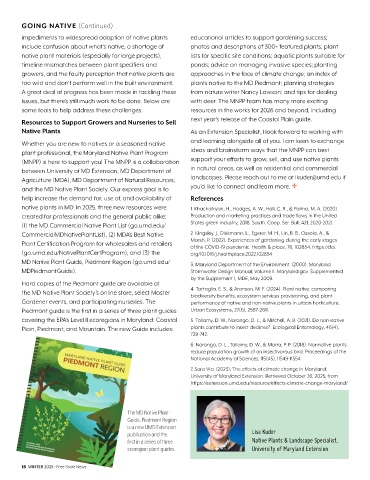
                                           The MD Native Plant
                                           Guide, Piedmont Region
                                           is a new UMD Extension
                                           publication and the                      Lisa Kuder
                                           first in a series of three               Native Plants & Landscape Specialist,
                                           ecoregion plant guides.                  University of Maryland Extension


        18  WINTER 2025 • Free State News

