


Page 6 - Apollo - Flanged Series Y-Strainers
P. 6
FLANGED SERIES Y-STRAINERS


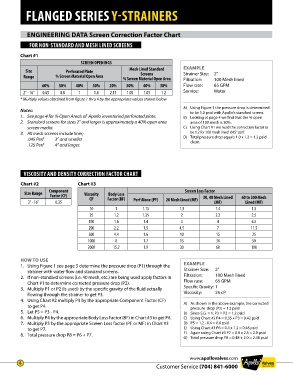
            ENGINEERING DATA Screen Correction Factor Chart

             FOR NON-STANDARD AND MESH LINED SCREENS

          Chart #1
                                   SCREEN OPENINGS
            Size            Perforated Plate           Mesh Lined Standard    EXAMPLE
                                                            Screens
           Range        % Screen Material Open Area  % Screen Material Open Area  Strainer Size:  2”
                                                                                          100 Mesh lined
                                                                              Filtration:
                   60%    50%    40%    30%    20%    50%    40%    30%       Flow rate:   65 GPM
           2" - 16"  0.65  0.8    1     1.4    2.15   1.05   1.05   1.2       Service:    Water
          * Multiply values obtained from figure 1 thru 4 by the appropriate values shown below
                                                                              A)  Using Figure 1 the pressure drop is determined
          Notes:                                                                 to be 1.0 psid with Apollo’s standard screen.
          1.  See page 4 for % Open Area’s of  Apollo inventoried perforated plate.  B)  Looking at page 4 we find that the % open
          2.  Standard screens for sizes 2” and larger is approximately a 40% open area      area of 100 mesh is 30%.
             screen media.                                                    C)  Using Chart #1 we read the correction factor to
          3.  All mesh screens include liner;                                    be 1.2 for 100 mesh lined .045” perf.
             .045 Perf   3” and smaller                                       D)  Total pressure drop equals 1.0 x 1.2 = 1.2 psid
                                                                                 clean.
             .125 Perf   4” and larger.


           VISCOSITY AND DENSITY CORRECTION FACTOR CHART

          Chart #2                Chart #3
                      Component                                               Screen Loss Factor
           Size Range               Viscosity  Body Loss
                      Factor (CF)                                                     30, 40 Mesh Lined   60 to 300 Mesh
             2” - 16”   0.35          CP      Factor (BF)  Perf Alone (PF)  20 Mesh Lined (MF)  (MF)    Lined (MF)
                                      10         1           1.15           1.3            1.4            1.5
                                      25         1.2         1.25            2             2.2            2.5
                                      100        1.6         1.4             3              4             6.5
                                      200        2.2         1.5            4.5             7             11.5
                                      500        4.4         1.6            10             15             25
                                      1000       8           1.7            15             30             50
                                      2000      15.2         1.9            30             60             100

          HOW TO USE
          1.  Using Figure 1 see page 5 determine the pressure drop (P1) through the    EXAMPLE
             strainer with water flow and standard screens.                   Strainer Size:   2”
          2.  If non-standard screens (i.e. 40 mesh, etc.) are being used apply factors in   Filtration:   100 Mesh lined
             Chart #1 to determine corrected pressure drop (P2).              Flow rate:   65 GPM
          3.  Multiply P1 or P2 (is used) by the specific gravity of the fluid actually    Specific Gravity: 1
             flowing through the strainer to get P3.                          Viscosity:   25 cP
          4.  Using Chart #2 multiply P3 by the appropriate Component Factor (CF)
             to get P4.                                                       A)  As shown in the above example, the corrected
                                                                                 pressure  drop (P2) = 1.2 psid

          5.  Let P5 = P3 - P4.                                               B)  Since S.G. = 1, P3 = P2 = 1.2 psid
          6.  Multiply P4 by the appropriate Body Loss Factor (BF) in Chart #3 to get P6.  C)  Using Chart #2 P4 = 0.35 x P3 = 0.42 psid
          7.  Multiply P5 by the appropriate Screen Loss factor (PF or MF) in Chart #3   D)  P5 = 1.2 - 0.4 = 0.8 psid
             to get P7.                                                       E)  Using Chart #3 P6 = 0.4 x 1.2 = 0.48 psid
          8.  Total pressure drop P8 = P6 + P7.                               F)  Again using Chart #3 P7 = 0.8 x 2.5 = 2.0 psid
                                                                              G)  Total pressure drop P8 = 0.48 + 2.0 = 2.48 psid


                                                                                www.apollovalves.com
         6
                                                                  Customer Service (704) 841-6000

