


Page 406 - Brass, Composite and Thermoplastic Fittings and Valves
P. 406
Catalog 3501E

     General Technical  Manufacturing Techniques


            Parker Extruded fittings
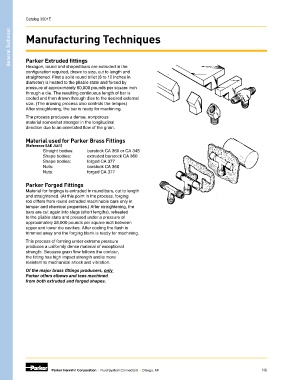
            Hexagon, round and shaped bars are extruded in the
            configuration required, drawn to size, cut to length and
            straightened. First a solid round billet (8 to 12 inches in
            diameter) is heated to the pliable state and forced by
            pressure of approximately 80,000 pounds per square inch
            through a die. The resulting continuous length of bar is
            cooled and then drawn through dies to the desired external
            size. (The drawing process also controls the temper.)
            After straightening, the bar is ready for machining.
            The process produces a dense, nonporous
            material somewhat stronger in the longitudinal
            direction due to an orientated flow of the grain.


            Material used for Parker Brass Fittings
            (Reference SAE J461)
                   Straight bodies:   barstock CA 360 or CA 345
                   Shape bodies:     extruded barstock CA 360
                   Shape bodies:     forged CA 377
                   Nuts:             barstock CA 360
                   Nuts:             forged CA 377

            Parker Forged Fittings
            Material for forgings is extruded in round bars, cut to length
            and straightened. (At this point in the process, forging
            rod differs from round extruded machinable bars only in
            temper and chemical properties.) After straightening, the
            bars are cut again into slugs (short lengths), reheated
            to the pliable state and pressed under a pressure of
            approximately 25,000 pounds per square inch between
            upper and lower die cavities. After cooling the flash is
            trimmed away and the forging blank is ready for machining.
            This process of forming under extreme pressure
            produces a uniformly dense material of exceptional
            strength. Because grain flow follows the contour,
            the fitting has high impact strength and is more
            resistant to mechanical shock and vibration.
            Of the major brass fittings producers, only
            Parker offers elbows and tees machined
            from both extruded and forged shapes.


                       Parker Hannifin Corporation  |  Fluid System Connectors  |  Otsego, MI                  N6

