


Page 121 - Demo
P. 121
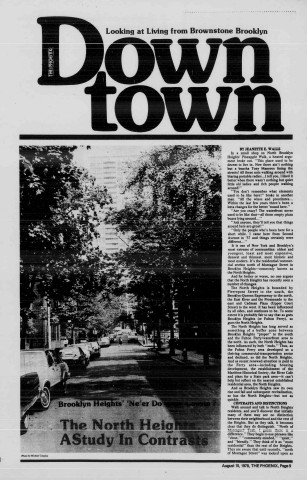
'*&**..AStudy In Contr(Photo by Michael Cuiccio)BY JEANETTE E. WALLSIn a small shop on North Brooklyn Heights%u2019 Pineapple Walk, a heated argument broke out. %u201c This place used to be decent to live in. Now there ain%u2019t nothing but a buncha Tony Maneros lining the streets! All these nuts walking around with blaring portable radios...I tell you, I liked it better when there wasn%u2019t nothing but quiet little old ladies and rich people walking around!%u201d%u201c You don%u2019t remember what elements used to be like here!%u201d broke in another man. %u201c All the winos and prostitutes... Within the last few years there%u2019s been a lotta changes for the better %u2019round here.%u201d%u201c Are you crazy? The waterfront never used to be like that%u2014all them empty pizza boxes lying around...%u201d%u201c Ask anyone, they%u2019ll tell you that things around here are great! %u201d%u201c Only the people who%u2019s been here for a short while. I came here from Second Avenue in %u201957 and things certainly were different...%u201dIt is one of New York and Brooklyn%u2019s most extreme of communities: oldest and youngest, least and most expensive, densest and thinnest, most historic and most modern. It%u2019s the residential/commercial section north of Montague Street in Brooklyn Heights%u2014commonly known as the North Heights.And for better or worse, no one argues that the North Heights has recently seen a number of changes.The North Heights is bounded by Pierrepont Street to the south, the Brooklyn-Queens Expressway to the north, the East River and the Promenade to the east and Cadman Plaza (Upper Court Street) to the west. It has been influenced by all sides, and continues to be. To some extent it is probably fair to say that as goes Brooklyn Heights (or Fulton Ferry), so goes the North Heights.The North Heights has long served as something of a buffer zone between Brooklyn Heights %u201cproper%u201d to the south and the Fulton Ferry/waterfront area to the north. As such, the North Heights has been influenced by both %u201cends.%u201d Thus, as the Fulton Ferry area developed as a thriving commercial-transportation sector and declined, so did the North Heights. And as recent renewed attention is paid to the Ferry area%u2014including housing development, the establishment of the Maritime Historical Society, the River Cafe and plans for a State park area%u2014it can%u2019t help but reflect on the nearest established residential area, the North Heights.And as Brooklyn Heights saw its own rise and fall and subsequent revitalization, so has the North Heights%u2014but not as quickly.CONTRASTS AND DISTINCTIONSWalk around and talk to North Heights' residents, and you%u2019ll discover that initially many of them may see no distinction between their neighborhood and the rest of the Heights. But as they talk, it becomes clear that they do distinguish. %u201c North ofA M ~ a V ^ - L I _______ At_____ _ mvusuguw t A VMU. A gUVM U1VXV 10 &difference.%u201d They begin to use phrases like %u201c close,%u201d %u201ccommunity-minded,%u201d %u201c quiet,%u201d and %u201cfriendly.%u201d They think of it as %u201c more residential%u201d than the rest of the Heights. They are aware that until recently, %u201c north of Montague Street%u201d was looked upon asAugust 10,1978, THE PHOENIX, Page 9


