


Page 123 - Demo
P. 123
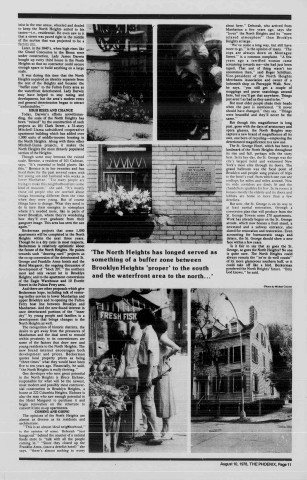
inist in the true sense, wheeled and dealed to keep the North Heights suited to his tastes%u2014i.e., residential. He even saw to it that a street was paved right in the middle of the section that was projected to be aiU W lU i JLater, in the 1840%u2019s, when high-rises like the Grand Concourse in the Bronx were under construction, Lady James Darwin bought up every third house in the North Heights so that no contractor could secure enough space to build anything on a large scale.It was during this time that the North Heights acquired an identity separate from the rest of the Heights and became the %u201c buffer zone%u201d to the Fulton Ferry area as the waterfront deteriorated. Lady Darwin may have helped to stay razing and development, but the area%u2019s modest rents and general deterioration began to attract %u201c undesirables.%u201dHIGH RISES AND CHANGEToday, Darwin%u2019s efforts notwithstanding, the scale of the North Heights has been %u201c ruined%u201d by the construction of such projects as 101 Clark Street, a 31-story Mitchell Llama subsidized cooperative apartment building which has added over 1,000 units of middle-income housing in the North Heights. Along with three other Mitchell-Llama projects, it makes the North Heights the most densely populated section of the Heights.Though some may bemoan the ruined scale, Bernice, a resident of 101 Cadman, says, %u201c It%u2019s essential to build places like this.%u201d Bernice is in her twenties and has lived there for the past several years with her young son and husband who works in lower M anhattan. %u201c Too many people are trying to make this neighborhood into some kind of m useum ,%u201d she said. %u201c It%u2019s mostly those old people who are worried about things becom ing different from the time when they were young. But of course things have to change. What they need to do is turn their energies to someplace where it%u2019s needed more, like in parts of lower Brooklyn, where they%u2019re wondering how they%u2019ll ever graduate from their gangster image. This area again.%u201dBeckerman projects that some 1,000 apartments will be completed in the North Heights within the next three years. Though he is a dry cynic in most respects, Beckerman is relatively optimistic about the future of the North Heights. He points towards such %u201c drawing card%u201d projects as the co-op conversion of the deteriorated St. George and Franklin Arms hotels and the Hotel Margaret; the ongoing discussion of development of %u201cblock 207,%u201d the northern most and only vacant lot in Brooklyn Heights; and to the apartment conversions of the Eagle Warehouse and 10 Everitt Street in the Fulton Ferry area.And there are other proposals which give Beckerman hope, including talk of restoring trolley service to lower Manhattan and upper Brooklyn and re-opening the Fulton Ferry boat line between Brooklyn and Manhattan. And the new-found interest in once deteriorated portions of the %u201c inner city%u201d by young people and families is a development that brings changes to the North Heights as well.The recognition of historic districts, the desire to get away from the pressures of Manhattan and the dual need to within proximity to its conveniences are some of the factors that draw new and young residents to the North Heights. The new found interest encourages both development and prices. Beckerman quotes local property prices as being %u201cthree times%u201d what they would have been five to ten years ago. Financially, he said, %u201cthe North Heights is really thriving.%u201dOne developer who sees great potential in the North Heights is Bruce Eichner, responsible for what will be the newest, most modern and possibly most controversial construction in Brooklyn Heights, a house at 222 Columbia Heights. Eichner is also the man who saw enough potential in the Hotel Margaret to purchase it and begin renovation on the structure to convert it into co-op apartments.COMING AND GOINGThe opinions of the North Heights are almost as diverse as its residents and architecture.%u201c This is an almost ideal neighborhood,%u201d is the opinion of some. Deborah %u201c iust hangs out%u201d behind the counter of a natural foods store to %u201ctalk with all the people coming in.%u201d %u201c Since they closed up the Franklin Arms, (once a derelict hotel)%u201d she says, %u201cthere%u2019s almost nothing to worryT h e North H eights has longed served assom ething of a buffer zone betw eenBrooklyn H eights %u2019proper* to the southand the w aterfront area to the n o rth ...%u2019about here.%u201d Deborah, who arrived from Manhattan a few years ago, says she %u201cloves%u201d the North Heights and its %u201c more relaxed atm osphere%u201d than Brooklyn Heights at large.%u201c We've come a long way, but still have more to go,%u201d is the opinion of many. %u201cThe cops are always down on Montague Street,%u201d is a common complaint. %u201c A few years ago a terrified woman came screaming towards me%u2014she had just been raped. That sort of thing wasn%u2019t too uncommon then,%u201d said Roger Schillizzi, Vice-president of the North Heights Merchants Association and owner of a locksmith shop on Pineapple Walk. Now, he says, %u201c you still get a couple of muggings and purse snatchings around here, but you%u2019ll get that anywhere. Things just aren%u2019t as bad as they used to be.%u201dBut most older people shake their heads when the past is mentioned. %u201c It never should have changed,%u201d they say. %u201c Things were beautiful and they%u2019ll never be the same.%u201dBut though this magnificence is long past, gone with the days of aristocracy and opera glasses, the North Heights may capture a new brand of magnificence all its own, one born of recycling%u2014employing the deteriorated magnificence to a new use.The St. George Hotel, which has been a landmark of the North Heights throughout its rise and fall, perhaps tells the story best. In its hey-day, the St. George was the city%u2019s largest hotel and welcomed New York%u2019s most elite through its doors. The grand ballroom was the focal point of Brooklyn and people sang praises of trips to the hotel's roof, from which one can see rooftops for miles and miles around. Now its wide corridors are dimly lit and the chandeliers sparkles for few. In its rooms it houses mostly the elderly and its doors and lobbies are home to more than a few derelicts.But now, the St. George is on its way to at least partial renovation, through a conversion plan that will produce from the St. George Towers some 270 apartments. Work has already begun on the St. George arcade, which now houses a fruit stand, a newstand and a subway entrance, also slated for renovation and restoration. Even accounting for bureaucratic snags and delays, the St. George should show a new face within a few years.Is it fair to say that as goes the St. George, so goes the North Heights? No one is quite sure. The North Heights could always remain the %u201c ne%u2019er do well cousin%u201d of its more glamorous southern half, or it could take off like a bird. Beckerman pondered the North Heights%u2019 future. %u201c Only God knows,%u201d he said.(Photos by Michael Cuiccio)August 10,1978, THE PHOENIX, Page 11


