


Page 389 - Demo
P. 389
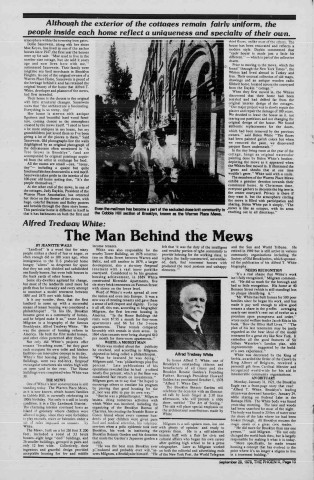
people inside each home reflect a uniqueness and specialtv of their own.atmosphere within the towering iron gates.Dollie Sauerwein, along with her \Mae Keyes, has lived in one of the anchor houses since 1947, the first year the houses were up for sale. %u201c Mae used to live in the number nine cottage, but she sold it years ago and now lives here with m e,%u201d commented Sauerwein. Their family were longtime sea food merchants in Brooklyn Heights. As one of the original owners of a Warren Place Home, Sauerwein is proud of the heritage behind it and has retained the original beauty of the home that Alfred T. White, developer and planner of the mews, had first intended.Their home is the closest to the original with little structural changes. Sauerwein notes that %u201c the architecture is fascinating. Everything is so teeny, tiny!%u201dHer home is strewn with antique figurines and beautiful hard wood furniture, coming closest to the atmosphere created by the mews itself. %u201c I used to have a lot more antiques in my house, but my grandchildren just loved them so I%u2019ve been giving a lot of the pieces to them,%u201d Said Sauerwein. Old photographs line the walls (highlighted by an original photograph of the delicatessen often mentioned in %u201c A Tree Grows in Brooklyn%u201d , (and are accompanied by original paintings acquired from the artist in exchange for food.All the rooms are small %u2014yes, %u201c teeny, tiny%u201d %u2014 including a quaint but quite functional kitchen decorated in a red motif. Sauerwein takes pride in the interior of the 100-year old home noting that, %u201c It%u2019s the people themselves,%u201dAt the other end of the mews, in one of the cottages, Judy Daykin, President of the Warren Place Association, has centered her decor on the theme o f the circus, with huge, colorful Barnum and Bailey posters and heralds through the three story home. This particular home is different in itself in that it has bathrooms on both the first andthird floors, unlike most of tho others T^e house has been renovated and reflects a modern style. Daykin commented that %u201c each house is made just a little bit different. %u201d %u2014 which is part of the collective charm.Prior to moving to the mews, which the found %u201c through the New York Times%u201d , the Whites had lived abroad in Turkey and Iran. Their unusual collection of old maps, drawings and an antique wooden radio filltheir home, located across the courtyard from the Daykin %u201c cottage.%u201dWhen they first moved in, the Whites discovered that their home had been restyled and had drifted far from the original interior design of the cottages. %u201c Our major project was to slowly repair the plaster and repair the damage of 100 years. We decided to leave the house as it, not tearing out partitions and not changing the original design of the house. We found authentic replacements for the doors, which had been removed by the previous owners.%u201d said Helen White %u201c The floors had been painted garish colors but when we removed the paint, we discovered parquet floors underneath.%u201dIn the tiny living room at the rear of the cottage, hangs an original watercolor painting done by Helen White%u2019s brother, depicting the mews as it appeared when the Whites first moved in. It illustrated the \at one time wouldn%u2019t grow,%u201d White said with a smile.The members of the Warren Place Mews exhibit a genuine devotion towards their communal home. At Christmas time, everyone gathers to decorate the big tree in the center courtyard. Privacy is there if they want it, but the atmosphere circling the mews is filled with participation and sharing. Helen White put it simply, %u201c The Even the mailman has become a pert of the secluded dose-knit community in %u2022mewlf is like an octopus, with its arms the Cobble Hill section of Brooklyn, known as the Warren Place Mews. reach,ng out ln a%u201c directlor>s%u2019A l f r e d T r e d w a v W h i t e :The M an Behind the M ew sBY JEANETTE WALLS\people strikes a chord o f fear or anger, or often enough did so 100 years ago, when immigration to the U.S produced home hungry %u201c aliens%u201d so desperate for space that they not only divided and subdivided one family homes, but even built houses in the back yards of other homes.Some city-dwellers agitated for change, but most of the landlords cared more for profit than for humanity and every attempt to construct a model tenement between 1850 and 1875 met with failure.Is it any wonder, then, that the first landlord to come up with a successful means of tenant housing was considered a philanthropist? %u201c In his life, Brooklyn became great as a community of homes, and he helped make it so,%u201d wrote Joseph Milgram in a biography of the famous Brooklynite, Alfred Tredway White. %u201c He was the pioneer of housing reform in America. He built the first model homes, and other cities patterned after them.%u201dNot only did White%u2019 s projects offer tenants %u201c breathing room ,%u201d but they gave each occupant his own toilet and kitchen facilities-an innovative concept in its day. White's first housing project, the Home Buildings, were two red-brick, fireproof rectangular structures six stories high with an open yard in the rear. The Home Buildings were completed when White was 30.THE MEWSOne of White%u2019s later constructions is still standing today. The Warren Place Mews, as it is now known, which houses families in Cobble Hill, is currently celebrating its 100th birthday. Not only is it still in lovely condition, it is a City Landmark District. The charming interior courtyard hosts an island of greenery where children were allowed to play, since they were forbidden to play on roofs, stairs or balconies under a%u2014.1 %u2014 : _________ t %u2014 t,_____ x _. t__.OKrK L u i v o O i l I U 1 U I U J


