


Page 716 - Demo
P. 716
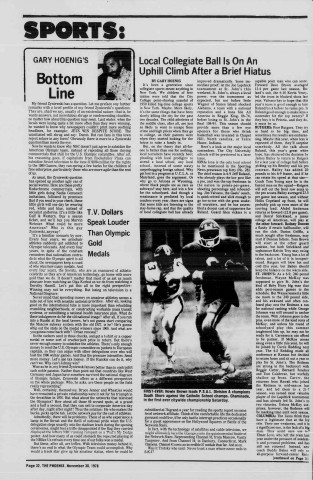
SPORTS:GARY HOENIG'SBottomLineMy friend Zyniewski has a question. Let me preface any further remarks with a brief profile of my friend Zyniewski%u2019s questions. They are, shall we say, usually of an existential nature; that is, he wants answers, not incredulous shrugs or condescending chuckles, no matter how absurd his question may seem. Last winter, when the locals were losing quite a bit more often than they were winning, he wanted to know why newspapers couldn%u2019t print more soothing headlines, for example: JETS WIN DESPITE SCORE. The uninitiated will shrug and say: Dumb. But can fans in this town reject solace in any form? Obviously there is more to a Zyniewski question than meets the eye.Now he wants to know why NBC doesn%u2019t just agree to subsidize the American Olympic team, instead of repeating all those cloying commercials that shill for the U.S. Olympic committee. After all, his reasoning goes, if capitalists from Rockefeller Plaza can subsidize Soviet television to the tune of $100-million for the rights to the 1980 Games, they can spring a few bucks for the children of free enterprise, particularly those who are more agile than the rest of us.As usual, the Zyniewski question has opened up another ugly can of social worms. Here are these pretty Kodachrome commercials, with little girls doing Nadia Comaneci imitations, followed by promises that if you send in your check, these little girls will one day be wearing red, white and blue, instead of socialist uniforms. It%u2019s a little like Gulf & Western. Buy a season ticket, and we%u2019U buy you Marvin Webster. What could be more American? Who is this guy Zyniewski, anyway?It%u2019s a familiar scenario by now.Every four years, we armchair athletes suddenly get addicted to Olympic telecasts. And every four years, in spite of the constant reminders that nationalism contradicts what the Olympic spirit is all about, the newspapers keep a count of who wins how many medals. And every four years, the Soviets, who are as enamored of athletic celebrity as they are of American technology, go home with more gold than we do. It doesn%u2019t matter that most of us get as much pleasure from watching an Olga Korbut as we do from watching a Dorothy Hamill. Let%u2019s put this all in the right perspective: Winning may not be everything. But losing on television is a National Disgrace.Never mind that spending money on amateur athletes seems a mite out of line with sensible national priorities. After all, looking good on the international tube is more important than rebuilding crumbling neighborhoods, or constructing workable mass transit systems, or subsidizing a national health insurance plan. What do these indulgences do for the old national image? After all, if you run into a Russki at the local tavern, he%u2019s not gonna start comparing the Moscow subway system with the old IRT, is he? He%u2019s gonna whip out the stats on the medal winners since 1960. And what are you gonna come back with? Urban renewal?So the suckers send in those checks, and get a t-shirt or a copper medal or some sort of cracker jack prize in return. But there%u2019s never enough money to subsidize the athletes. There%u2019s only enough money to send the U.S. Olympic committee on junkets to European capitals, so they can argue with other delegations over who will host the 1996 winter games. And thus the pressure intensifies. Send more money. Let%u2019s use tax money. If the Russkis can do it, why can%u2019t we. Why can%u2019t Johnny win?Wise as he is, my friend Zyniewski knows better than to contradict such noble passion. Rather than point out that countries like West Germany and Japan have somehow survived the national disgrace of Olympic failure, Zyniewski offers us a different perspective on the whole package. Who, he asks, are these people on the field really representing?Well, certainly, themselves. Bruce Jenner and Wheaties would have remained a private relationship were it not for his triumph in the decathlon in 1976. But what about the networks that televised the Olympics? How about all those 60 second spots, at a grand and a half a second, that they can sell to corporate America day after day, night after night? Thus the solution: He who makes the bucks, picks up the tab. Let the network pay for the cast of athletes.Admittedly, there will be problems. Those of us who experience a lump in the throat and the thrill of national pride when the U.S. delegation steps smartly onto the stadium track during the opening ceremonies, might feel a trifle disappointed if the flag they carriedHisnlavpd thp lpttprQ NRP nmnino ramnont nn o TViof%u2019o My rV\\rl/roposter. And how many of us could stomach the repeated playing of the NBSee Us refrain every time one of our folks won a medal.But these, after all, are trifles. With television money behind it, there%u2019s no end to what the Olympic Team could accomplish. Why would a track star give up his amateur status, when he could beT.V. DollarsSpeak LouderThan OlympicGoldMedalsLocal Collegiate Ball Is On AnUphill Climb After a Brief Hiatuscapable point man who can score. Forward Dave Brown averaged 13.4 per game last season. Ruland%u2019s sub, the 6-10 Kevin Vesey, led the team in blocked shots last year. Valvano has to hope that this year%u2019s team is good enough to lure Ruland back before he turns pro. Is Ruland good enough to make Iona a contender for the top twenty? If they buy it in Peioria, and they do, it must be so.RUTGERS: Poor Rutgers. They try so hard to be big time, and sometimes the results are embarassing. Maybe this year, when less is expected of them, they%u2019ll surprise somebody. All the talk about Ruland, this year%u2019s great white hope, has obscured the decision by James Bailey to return to Rutgers for a last year of college ball before picking up his Bentley and his pro contract. Bailey has added 20 pounds to his 6-9 frame, and if he can retain his speed at that size%u2014 Coach Tom Young says he is the fastest man on the squad%u2014Rutgers will sell out the front row seats to the pro scouts.Bailey averaged 23.5 per game last season, and without Hollis Copeland up front, he will probably pick up even more of the scoring load. Abdel Anderson returns at forward (12.8 per game), and Darryl Strickland, a junior college all American, will play at the other forward. Rodney Duncan a flashy if erratic ballhandler, will run the club. Darius Griffin, a much sought after freshman, may start if Duncan falters. Tom Brown will start at the other guard position, but both Strickland and sophomore Kelvin Troy may swing to the backcourt. Young has a lot of talent, and a lot of it is inexperienced. Rutgers will blow hot and cold this year, but Bailey should balance on the warm side.. JOHN%u2019S: As a 6-9, 240 pound freshman, Wayne McKoy was supposed to give St. John%u2019s the kind of Baby Huey big man that adds post-season games to the schedule. But Wayne leaned a little too much to the 240 pound side, and his awkward and often confused play cost the Redmen a run for national ranking while George Johnson was still around to anchor the team. With Johnson gone to the pros, even more of the load rests of McKoy, and unless his round of schoolyard play this summer toughened him up, he may not be ready for it. Carnesecca can afford to be patient. If McKoy comes along even a little this year, he will be joined by Curtis Redding next year. The 6-5 Redding made all conference at Kansas but decided to return home and sit out a year to play for St. John%u2019s. The Redmen are strong in the backcourt with Reggie Carter, Bernard Rencher and Tom Calabrese, but woefully shallow up front. Carter, the returnee from Hawaii who joined the Redmen in mid-season last year, and led them to a 21-7 season, was named most valuable player of the Lapchick tournament and has already led St. John%u2019s to two victories. Unless McKoy surprises, however, the Redmen will be marking time until next season. COLUMBIA: The Lions think they have a legitimate shot at the Ivy title. Their one weakness, and it is a significant one, is the lack of a big man. Thev could sure use 6-7Elmer Love, who left the team last year under the pressure of academic and personal problems, and has still not returned Instead, new coach Buddy Baker will rely on all-purpose forward-center Ricky [continued on Page 26iBYGARYHOENIGIt's been a generation since collegiate sports meant anything in New York. We children of free tuition were told that the City College point-shaving scandal of 1950 killed big-time college sports in New York. Maybe. More likely, it%u2019s the same things that have been slowly killing the city for the past two decades. The child-atheletes of the middle class, after all, are just as likely to want to escape from crime and high prices when they go to college, as their parents were when they started looking for the house to raise a family in.But, on the theory that all-forone is better than one for nothing, local recruiters have recently been pleading with local prodigies to attend a local school, any local school, instead of some nasty carpetbagging foreign school. Why get lost in a program at U.C.L.A. or Maryland, goes the argument. Or why go to Arizona or Wyoming, where black people are as rare as subways? stay here, and win a few for the schoolyard. And though a renaissance is predicted by local coaches every year, there are signs that some kids are listening to the stay-home rap, and that the quality of local collegiate ball has alreadyimproved dramatically. Some immediate proof: At the Joe Lapchick tournament at St. John%u2019s this weekend, St. John%u2019s, always a local power, won the tournament as expected, but not before little Wagner of Staten Island shocked Alabama, a team with a national reputation and a bona fide All America in Reggie King, 86-74, before losing to St. John%u2019s in the final 108-91. This season should provide more than a few eye openers for those who think basketball was invented in Chapel Hill, North Carolina, or Terre Haute, Indiana.Here%u2019s a look at the major local contenders. The City University schools will be previewed in a later issue.IONA: Iona is the only local school to be mentioned in the Sporting News preseason top forty (No. 28). The chief reason is 6-9 Jeff Ruland, who already plays the low post like a pro, and was the top freshman in the nation in points-per-game, shooting percentage and rebounding. Jim Valvano, the Gaels%u2019 coach, is quick-witted and slick enough to go toe-to-toe with the great snakeoil recruiters, and he has assembled a decent cast of supporters for Ruland. Guard Glen vickers is aFIRST-EVER: Howie Brown leads P.SA.L. Division A championsSouth Shore against the Catholic School champs, Chaminade,in the first-ever citywide championship Saturday.subsidized at 70-grand a year for reading the sports report on some local network affiliate. Think of the comfortable life the dedicated gymnast could live, if he only had to interrupt practices occasionally for a guest appearance on the Hollywood Squares or Battle of the Network Stars.In fact, with the technology of satellites and cable television, we..Ul------A-1 -. A-------iU . /M_____- %u25a0 . n %u2022 . %u2022%u2022 . - ...* .* *%u00a3 * .V Uiumwui u m e v y A ju iy iC d H l lU li lt ; q u i l l IC S S O H IU U JDcU lie O Ithe Network Stars. Representing Channel 52, from Moscow, Vasily Turgenev. And from Channel 19, in Danbury, Connecticut, Mark Clemens. Channel 41 owns an incredible 57 medals thus far. And so on.Was it Trotsky who said: Never trust a man whose name ends in S-K-I?mPage 32, THE PHOENIX, November 30,1978


