


Page 8 - Demo
P. 8
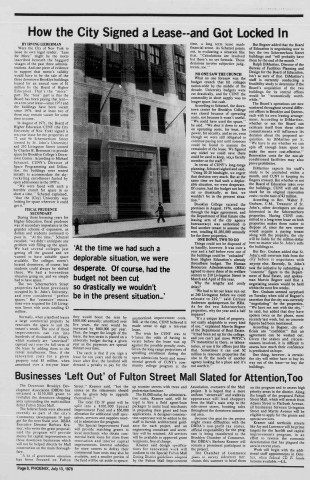
How the City Signed a Lease-and Got Locked in%u2018At the time we had such adeplorable situation, we weredesperate. Of course, had thebudget not been cutso drastically we wouldn%u2019tbe in the present situation...%u2019BY IRVING LUMBERMANWere the City of New York to issue its own legal tender, %u2018%u2018Less for More\inscribed beneath the haggard visages of the past three administrations. And one piece of evidence to support that motto's validity would have to be the tale of the three downtown Brooklyn buildings leased for an annual sum of $1 million bv the Board of Higher Education. That's the %u2018%u2018more%u201d part. The \Board has been paying that rent%u2014 on a ten-year lease%u2014since 1971 and the buildings have been vacant since 1976. And at least two of them may remain vacant for some time to come.In August of 1971, the Board of Higher Education/CUNY (the City University of New York) signed a ten-year lease for the properties at 72 and 96 Schermerhorn Street (owned by St. John's University) and 210 Livingston Street (owned by Charles B. Berenson) to provide space for Brooklyn College%u2019s Downtown Center. According to Michael Schutzel, CUNY%u2019s Director of Space Programming and Utilization, the buildings were rented initially to accommodate the skyrocketing enrollment fueled by open admissions in the 1970%u2019s.\horrible crunch for space in so short a time,\%u201cthat the [City] University was looking for space wherever it could get it.%u201dFISCAL PRUDENCE SECONDARYDuring those booming years for Higher Education, fiscal prudence was of secondary importance in the grander scheme of expansion, as dollars and students continued to pour in. \recalled, %u201c we didn%u2019t anticipate any problem with filling up the space. We had several colleges just getting off the ground and we wanted to have suitable space available. The colleges weren%u2019t located downtown, of course, but students could always be shifted there. We had a horrendous situation going on, and we simply had to have space.%u201dThe two Schermerhorn Street properties had been previously occupied by St. John%u2019s University, and were considered %u201c perfect spaces.%u201d But \tions were required for 210 Livingston Street with costs totalling $3 million.Normally, when a landlord leases a large commercial property he renovates the space to suit the tenant%u2019s needs. The cost of these improvements can run into hundreds of thousands of dollars, which routinely are \(spread out) over the full term of the lease by adding them to the rental installments. Thus, if the renovation costs for a given property total $3 million, when amortized over a ten-year leasethey would boost the rent by 5300,000 annually; amortized over five years, the rent would be increased by $600,000 per year. Thus, the longer the length of the lease, the less strain is placed on a university budget during a given year as the payments are spread thinner over time.The catch is that if you sign a lease for ten years and decide to leave after five, the landlord will demand a penalty to pay for theunamortized improvement costs. Still, at the time, CUNY believed it made sense to sign a ten-year lease.The trick for CUNY was to b' lance the odds of having to vacate before the lease was up against the possible penalty costs. Given the long range projections of spiralling enrollment during the open admissions boom and monumental growth of CUNY%u2019s community college program at thetime, a long term lease made financial sense. As Schutzel points out, in evaluating a situation like that, %u201cCalculations are involved but there%u2019s no set formula. Those decisions involve subjective judgments, toe.%u201dNO ONE SAW THE CRUNCHWhat no one foresaw was the budget crunch that hit colleges nation-wide by the middle of the decade. University budgets were cut drastically, and for CUNY the commodity in short supply was no longer space, but cash.According to Schutzel, the downtown center for Brooklyn College was closed because of operating costs, not because it wasn%u2019t useful. \he said. %u201c We shut it down to save on operating costs, for heat, for power, for security, and so on, even though we were still obligated to continue paying rent until someone could be found to assume the remainder of the lease. We figured any nickel we could save there could be used to keep, say, a faculty member on the staff. %u2019 %u2019In terms of CUNY%u2019s long-range planning, Schutzel sighed and said, %u201c Using 20-20 hindsight, we regret that decision very much. But at the same time we had such a deplorable situation, we were desperate. Of course, had the budget not been cut so drastically, so fast, we wouldn%u2019t be in the present situation.%u201dBrooklyn College vacated the premises in August, 1976, midway through the leq^e agreement, and the Department of Real Estate (the leasing arm of the city agency bureaucracy) was authorized to find another tenant to assume the rent, totalling $1,055,000 annually for the three properties.ONE DOWN, TWO TO GOThings could not be disposed of so handily, however. It was over a year and a half before even one of the buildings could be %u201c unloaded%u201d from Higher Education%u2019s already threadbare budget. The Human Resources Administration (HRA) agreed to move three of its welfare centers to 210 Livingston Street in March and April of this year.Why the lengthy and costly delay?%u201c We had to let our lease run out at 240 Livingston before we could relocate to 210,%u201d said Cerisse Anderson spokesperson for HRA. As for the two Schermerhorn properties, why the year and a half impasse?%u201c It%u2019s a unique kind of property, not easily adaptable to every kind of use,%u201d explained Marvin Bogner of the Department of Real Estate. %u201c It had been set up for the college, and you can%u2019t just move WNYC%u2019s TV transmitter in there, or laboratories, or use it for offices just like that. Sometimes it can cost $2 million to renovate properties that size to fit the needs of another agency looking for a place and it%u2019s not worth it.%u201dBut Bogner added that the Board of Education is negotiating now to buy the two Schermerhorn Street buildings and %u201cwill probably have them by the end of the month.%u201dRalph DiMartino, Director of the Bureau of Facilities Planning and Design for the Board of Education, isn%u2019t so sure of that. DiMartino%u2019s staff is currently conducting a feasibility study to determine if the Board%u2019s acquisition of the two buildings for its central offices would be %u201c economically worthwhile.%u201dThe Board%u2019s operations are now scattered throughout several different offices in Brooklyn and Queens, each with its own leasing arrangement. According to DiMartino, whether or not the Board can extricate itself from these other commitments will influence its decision about the proposed acquisition. As DiMartino put it, %u201c We have to see whether we can spin off enough lease space to make the move cost-effective.%u201d Renovation costs for the non-air conditioned facilities may also prove prohibitive.DiMartino expects his staff%u2019s study to be concluded within a month, and CUNY is keeping its fingers crossed. But whether or not the Board of Education takes over the buildings, CUNY will still be stuck for its original renovation costs%u2014to the tune of $3 million.According to Rev. Walter F. Graham, C.M., Treasurer of St. John%u2019s, other developers are also interested in the Schermerhorn properties. Having CUNY committed to a long-term lease on both properties makes them easier to dispose of, since the new owner would acquire a paying tenant along with the property; the city will be liable for the million-dollar rent no matter who St. John%u2019s sells the buildings to.But Rev. Graham added that St. John%u2019s will entertain bids from the city before it negotiates with anyone else. Recently, St. John%u2019s took the initiative by submitting a %u201c concrete%u201d figure to the Department of Real Estate, and spokesman Marvin Bogner said that a negotiating session would be held within the next few weeks.Rev. Graham seemed surprised on Tuesday when told of Bogner%u2019s assertion that the city was currently %u201c negotiating%u201d for the properties. %u201c We have not met with the city,%u201d he said, but added that they have spoken twice on the phone, most recently last week, but no concrete figures had been mentioned.According to Bogner, city officials are %u201cconfident%u201d that an agreement can be worked out. Given the stakes and circumstances involved, it is difficult to assess how much their confidence is predicated on hope.One thing, however, is certain: the city will either have to buy its way out of the lease%u2014or buy the buildings.Businesses %u2018Left Out' of Fulton Street Mall Slated for Attention,TooThe Downtown Brooklyn Development Association (DBDA) has ooxained a $150,000 grant to revitalize the downtown shopping area surrounding the multi-million dollar Fulton Street Mall.The federal funds were allocated recently as part of the city%u2019s Community Development IV budget for the next fiscal year. DBDA Executive Director Barbara Kramer, who wrote the grant proposal, said the program will provide money for capital improvements to those downtown businesses which will not be helped directly by Mall construction on the main thoroughfare.\has been focused on FultonStreet,%u201d Kramer said, %u201cbut the stores on the sidestreets should also be given help to upgrade themselves.%u201dThe total CD IV grant will be split into a $100,000 Special Improvement Fund and a $50,000 allocation for additional staff specialists, services and supplies needed to administer the program.The Special Improvement Fund will provide matching grants to local merchants who obtain commercial bank loans for store front renovation and interior capital improvements. Interest subsidies for store owners to defray their commercial loan costs may also be available, and a smaiier portion of the fund will be set aside to spruceup roomier streets with trees and pedestrian furniture.The $5,000 outlay for administrative costs, Kramer said, will be usjd to hire a field agent/loan packager to assist local merchants in preparing their grant and loan applications. A designer/constructton supervisor will be added to the staff to furnish architectural guidance for each project, and an engineering consultant and secretary will be retained. All services will be available to approved grant recipients, free of charge.Kramer said design specifications for renovation work will conform to the Special Fulton Mall Zoning District guidelines adopted by the Fulton Mall ImprovementAssociation, overseers of the Mall project. It is hoped that a more uniform %u201c streetwall%u201d and walkway appearance will lead shoppers from the Mall%u2019s main strip to the side-street stores, boosting sales throughout the downtown commercial area.Because this goal for the project might create difficulties with the DBDA%u2019s non-profit tax status, official responsibility for the program is being transferred to the Brooklyn Chamber of Commerce. But DBDA%u2019s Barbara Kramer will remain a prominent participant in the project.The Chamber of Commerce plans to survey sidcstrcct mcr chants this summer to brief themon the program and to assess high priority areas in the district. Along the length of the proposed Fulton Street Mall, which will stretch from Adams Street to Flatbush Avenue, all businesses between Livingston Street and Myrtle Avenue will be eligible to apply for the grants and special services.Kramer said northside streets like Jay and Lawrence will be prime targets for the facelift and capital improvements program, in an effort to reverse the economic deterioration that has plagued the area in recent years.Work will begin with the additional staff appointments in OctoJ ___1 r i r \\ n r r % VV l i c i t I C U C I O I V _ J L / I V i l i l i u sbecome available.%u2014-I.L.Page 8, PHOENIX, July 13,1978


