


Page 183 - Demo
P. 183
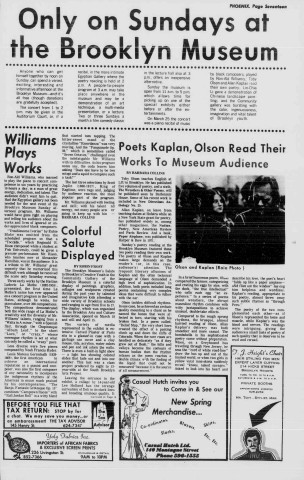
PHOENIX, P a g * S a v e n ta e nO nly on Sundays atiL a D - I I ii ___ me D ro o K iyn museumAnyone who can get himself together by noon on Sunday, can spend a varied, exciting, interesting and informative afternoon at the Brooklyn Museum%u2014end it's all free (though donations are gratefully accepted).The concert from 1 to 2 p.m. may be given in the Auditorium Court, or, if arecital, in the more intimate Egyptian Gallery where the poetry reading is held at 2 p.m. A people-to-people program at 3 a.m. may take place anywhere in the museum and may be a demonstration of an art technique, a multi-media presentation, or a lecture. Two or three Sundays a month a film comedy classic%u2022 %u00abin the lecture hall also at 3 p.m., offers an inexpensive alternative.Sunday the museum is open from 11 a.m. to 5 p.m. which allows time for picking up on one of the special exhibits either before or after the entertainments.On March 25 the concert was a piano recital of musicby black composers, played by Ron-Ald Williams; Toby Olson and Allan Kaplan read their own poetry; Lin-Chia Li gave a demonstration of Chinese landscape painting; and the Community gallery was bursting with the color, ingenuousness, imagination and vital talent of Brooklyn youth.%u2022 %u2022 %u2022WilliamsPlaysWorksRon-Ald Williams, who learnedto play the piano to concert competence in six years by practicing10 hours a day, is a man of greatenergy, dedication, and talent. Theaudience didn%u2019t want him to quit.Had the Egyptian gallery not beenneeded for the next event of theBrooklyn Museum Sunday afternoon program, Mr. Williamswould have gone right on playingand telling his audience about theworks and lives of ignored or under-appreciated black composers.%u201cTroublesome Ivories%u201d by EubieBlake was omitted from thescheduled program so that a%u201cToccata,%u201d which Reginald R.Rison composed while a student atFisk University, could be given apremier performance. Mr. Rison,who teaches now at AlexanderHamilton, was in the audience. It isa tribute to Mr. Williams%u2019 greatcapacity that he memorized thisdifficult work although he receivedthe score only Saturday evening.Three early works by the HaitianLudovic La Mothe (1882-1953),presented, the first time LaMothe%u2019s name has ever appearedon a concert program in the UnitedStates, although he wrote, forpiano alone, over 200 compositions.The compositions demonstratedboth the wide range of La Mothe%u2019screativity and the diversity of Mr.Williams%u2019 talents, ranging from a%u201cWaltz in A minor,%u201d with a Spanishflair, through the Chopinesque%u201cAlbum Leaf,%u201d to the short%u201cLoco,%u201d or %u201c crazy,%u201d whosemerengue rhythm is set at whatcan only be called a %u201ccrazy%u201d pace.Less diverse were five piecescomposed by Noah Francis Ryder.Louis Moreau Gorrschalk (1829-1869), the first American toachieve an internationalreputation as a pianist and composer, was also the first composerof any nationality to incorporatethe indigenous rhythms of theAmericas in music much praisedby his contemporaries. %u201cTheBanjo, Fantasie Grotesque Op. 15%u201dcombines %u201cCamptown Races%u201d with%u201cRoll Jordan Roll%u201d in a witty blendthat started toes tapping. Thebitter-sweet mood of thecrystalline %u201cRicordanza%u201d was verymoving. And the %u201cPasquinade Op.59,%u201d which is sometimes called%u201cSeven Octaves,%u201d challenged eventhe indefatigable Mr. Williamswith its difficulties. As his programnotes say, the coda leaves himasking %u201cDoes one have to be twooctopi and a squid to complete sucha task?%u201dThe last three selections by ScottJoplin (1868-1917), King ofRagtime, were rags and, judgingby audience reaction, the mostpopular part of the program.Mr. Williams played with feelingand skill; with his talent ndenergy, not many people are> ergoing to keep up with hin %u2014BARBARA COLLINSColorfulSaluteDisplayedBY ROBIN FROSTThe Brooklyn Museum%u2019s Saluteto Brooklyn%u2019s Creative Youth in theCommunity Gallery of theBrooklyn Museum is a colorfuldisplay of paintings, graphics,collages and sculptures createdduring the past year by talentedand imaginative kids attending awide variety of Brooklyn schoolsand ranging in age from five to 17.The display, which was organizedby the Brooklyn Arts and CultureAssociation, opened on March 18and will end April 15.The variety of mediarepresented in the exhibit is extensive. Carved Plaster of Parissits in a glassed-in case with agarbage can cover and a claymouse. Oils, acrylics, water colorsand pen and ink adorn the walls.There is even a built-in light show%u2014 a light box showing coloredslides that fade out and into oneanother. This last was a classproject produced by eight to 13-year-olds at the South BrooklynArts Project.Leaving the entrance to theexhibit, a collage by 14-year-oldLee Holland has the strangesurrealism of Dali in its stark linesand brooding ominous quality. ItBEFORE YOU FILE THATTAX RETURN: STOP by fora chat. W %u00ab may save you mon%u00aby...oran smbsrassmsntl THE TAX ADVISOR145 Henry St. _____ 624-7347Q jo L y Q a fc iic i. d nc.IMPORTERS of AFRICAN FABRICS& EXCLUSIVE SCREEN PRINTS226 Livingston St WHOLESALE & RETAIL852-7366 9AM to 1GPMPoets Kaplan, Olson Read TheirWorks To Museum AudienceBY BARBARA COLLINSToby Olson teaches English atLIU in Brooklyn. He has publishedfive volumes of poetry, and a sixth,The Wrestlers & Other Poems, willbe published soon by BarlenmirHouse. Some of his recent work isincluded in New Directions Anthology No. 25.Allan Kaplan, on leave fromteaching duties at Hofstra while ona New York State grant for poetry,has published widely in, amongother magazines, the Nation,Poetry, New American Reviewand Paris Review. And a book,Paper Airplane, was published byHarper & Row in 1971.Sunday%u2019s poetry reading at theBrooklyn Museum featured thesetwo poets reading their own work.The poetry of Olson and Kaplanmakes large demands on thereader%u2019s (or, in this case,audience%u2019s) attention. Thefrequent literary allusions ofKaplan and the often technicallanguage of Olson demanded ahigh level of sophistication. Inaddition, both poets included longpoems containing very complexideas that were difficult to followwith the ear.Olson tackles difficult rhythms.In one case, he achieved an archaicquality mounting to a chant as henamed the bones that were affected in turn, starting with hisbroken foot. In a poem called,%u201cRelief Map,%u201d the very short linescreated the effect of a pantingclimb up and down the cliffs ofColorado. When the rare roses arehandled as delicately %u201cas if theygrew out of flesh,%u201d the hills andvalleys become the contours ofhuman bodies then the rhythmrelaxes as the poem reaches adouble climax wRh the finding ofthe liquid that could not bemeasured %u201cbecause it is the sourceof all measurement.%u201dOlson and K aplan (R aia Photo }In a brief humorous poem, Olsuncompared the farmer, categorizingand crating his eggs by size, withthe duck, %u201cthe true intellectual%u201dwho calls each egg %u201can experience.%u201d In a series of poemsabout wrestlers, the abruptmasculine rhythm combines withwitty juxtapositions to achieveunusual, double-take effects.Compared to the rough sprungrhythms, the brusque, almosthurried reading of Olson, AllanKaplan%u2019s delivery was bothsmoother and more casual. Thebombshells in his sophisticatedpoetry came without preparation.When, on a Greyhound bustraveling through New Jersey, hesess the %u201ccord of white road-line%u201ddraw the bus up and out of thelimited world, or when two girls inyellow vinyl mini-skirts suddenlyreveal %u201cknees, naked savages.%u201dAsked to look into his heart anddescribe his love, the poet%u2019s heart%u201cfolds up like a paper airplane%u2014aNd flies out the window%u201d leavinghim helpless and wordless.Kaplan%u2019s reading, appropriate tohis poetry, almost threw awaysuch subtle rhymes as %u201cthroughPeru.%u201dThe poetry of the two complemented each other%u2014as ifOlson%u2019s represented the bone andmuscle, while Kaplan%u2019s was theblood and nerves. The readingswere intriguing, giving theaudience a small taste of poetry ofsuch quality that is deserves to beread and reread.Continued on Page 18Casual Hutch invites youto Come in & See ourNewMerchandise....A W %u00b0%u00bbeSiSV'S \\g ^ s '%u25a0e^* y . Q .. c ty s ic j/it'i d f u d iH A IR S TY L IN G FOR M ENE X P E R T L A Y E R C U T T IN G2 1 4 H IC K S STR EETB ro o klyn H eig htsT U E S . TO F R I. 12 TO 9 P .M .S A T U R D A Y S 9 A .M . TO 6 P .M .P R IVA TE BOOTHSA P P O IN T M E N T S A C C E P T E R6 2 5 - g 2 5 2M r . T o n y - S t y l i s t . M g r .\\ Emsmmi Smtdh tM L. \\ t 4 0 M e m tm g m e S t r e e tU P h e m e & m - i & M S


