


Page 324 - Demo
P. 324
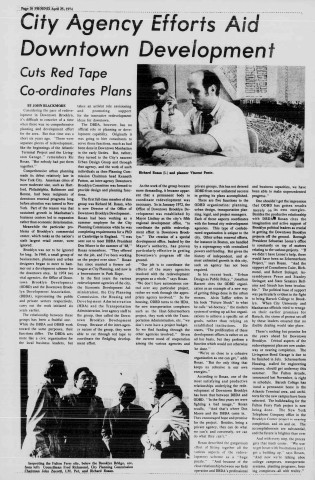
Page 18 PHOENIX April 25, 1974City Agency Efforts AidDowntown DevelopmentCuts Red TapeCo-ordinates PlansBY JOHN BLACKMOREConsidering the pace of redevelopment in Downtown Brooklyn, it%u2019s difficult to conceive of a time when there was no comprehensive planning and development effort for the area. But that time was a short six years ago. %u2018%u2018There were separate pieces of redevelopment, like the beginnings of the Atlantic Terminal Project and the Livingston G arage,%u201d remembers Ric Rosan, %u201c But nobody had put them together.%u201dComprehensive urban planning made its debut relatively late in New York City. American cities of more moderate size, such as Hartford, Philadelphia, Baltimore and Boston, had been recipients of downtown renewal programs long before attention was turned to New York. Part of the reason was that sustained growth in Manhattan%u2019s business centers led to expansion rather than economic deterioration.Meanwhile the particular problems of Brooklyn%u2019s commercial center, which ranks as the nation's sixth largest retail center, were ignored.Brooklyn was not to be ignored for long. In 1968, a small group of businessmen, planners and urban designers began to meet to hammer out a development scheme for the downtown area. In 1974 two vital agencies, the Office of Downtown Brooklyn Development (ODBD) and the Downtown Brooklyn Development Association, (DBDA), representing the public and private sectors respectively, carry out the work initiated six years earlier.The relationship between these groups has been a fruitful one. While the DBDA and ODBD work toward the same purposes, their functions differ. The DBDA acts more like a civic organization for the local business leaders, buttakes an activist role envisioning and promoting support for the innovative redevelopment ideas for downtown.The DBDA, however, has no official role or planning or development capability. Originally it was going to hire consultants to serve these functions, much as had been done in Downtown Manhattan in the early Sixties. But, rather, they turned to the City%u2019s nascent Urban Design Group and through that agency, and the work of such individuals as then-Planning Commission Chairman head Kenneth Patton, an inter-agency Downtown Brooklyn Committee was formed to provide design and planning functions.The First full-time member of this group was Richard M. Rosan, who is now Director of the Office of Downtown Brooklyn Development. Rosan had been working as a summer employee for the City Planning Commission while he was completing requirements for a PhD at Cambridge in England. %u201c I was sent out to meet DBDA President Don Moore in the summer of %u201968,%u201d Rosan remembers. %u201c They offered me the job, and I%u2019ve been working on the project ever since.%u201d Rosan has since married a former colleague at City Planning, and now is a brownstoner in Park Slope.In the first years the various redevelopment agencies of the city, the Economic Development Administration, the City Planning Commission, the Housing and D evelopm ent A d m in istratio n (HDA) and the Transportation Administration, lent agency staff to the group, then called the Downtown Brooklyn Development Group. Because of the inter-agency nature of the group, they were able to cut through red tape to coordinate the fledgling development effort.As the work of the group became more demanding, it became apparent that a permanent body to coordinate redevelopment was necessary. So in January 1972, the Office of Downtown Brooklyn Development was established by Mayor Lindsay as the city%u2019s fifth regional development office, %u201c to coordinate the public redevelopment effort in Downtown Brooklyn.%u201d The creation of a special development office, backed by the M ayor%u2019s authority, has proven particularly effective in getting Downtown%u2019s program off the ground.%u201c Our job is to coordinate the efforts of the many agencies involved with the redevelopment program as a whole,%u201d says Rosan. %u201c We don%u2019t have autonomous control over any particular project, rather we work through the appropriate agency involved.%u201d So for housing, ODBD turns to the HDA, for new transportation complexes such as the Hoyt-Schermerhorn project, they work with the Transportation Administration, etc. \don%u2019t even have a project budget. So we find funding through the other agencies involved.%u201d Given the current mood of cooperation among the various agencies andprivate groups, this has not detered ODBD from near unilateral success in getting its plans accomplished.There are five functions to the ODBD organization: planning, urban design, transportation planning, legal, and project managers. Each of these aspects coordinates with the formal city redevelopment agencies. This type of confederated organization is unique to the city. Other urban renewal efforts, for instance in Boston, are handled by a superagency with centralized powers and funding. But given the history of independent, and almost unlimited growth in this city, such an agency has not been required.In his recent book, %u2018%u2018Urban Design as Public Policy,%u201d Jonathan Barnett cites the ODBD organization as an example of a new way of getting things done in the urban morass. Alvin Toffler refers in his book %u201c Future Shock%u201d to what he calls %u201c ad-hocracy,\system of setting up ad-hoc organizations to achieve a specific set of goals, rather than relying on established institutions. He states, %u201cThe proliferation of these development offices is rather on an ad hoc basis, but they perform a function which would not otherwise be done.%u201d%u201c We%u2019re as close to a cohesive organization as one can get,%u201d adds Rosan, %u201c But the only thing that keeps us cohesive is our own energies.%u201dAccording to Rosan, one of the most satisfying and productive relationships underlying the redevelopment of Downtown Brooklyn has been that between DBDA and ODBD. %u201c In the first years we were fighting a bad image,%u201d Rosan recalls, %u201c And that%u2019s where Don Moore and the DBDA came in. Thev encouraged hope and promise for the project. Besides, being a private agency, they can do what we can%u2019t; and conversely, we can do what they can't.\Rosan described the gargantuan effort of fitting together all the various aspects of the redevelopment scheme as a %u201c huge puzzle.%u201d %u201c And because of the close relationship between our field operation and DBDA%u2019s professionaland business capacities, we have been able to make unprecedented progress.%u201dOne shouldn%u2019t get the impression that ODBD has gotten results merely on its own energies. Besides the productive relationship with DBDA%u00ae Rosan cites the imagination and active support of Brooklyn political leaders as crucial in getting the Downtown Brooklyn projects off the ground. Borough President Sebastian Leone%u2019s office is constantly on top of matters relating to the various projects. %u201c If we didn%u2019t have Leone%u2019s help, there would have been no Schermerhorn Project,%u201d says Rosan. %u201c And the support of Councilmen Cuite, Richmond, and Robert Steingut; Assemblymen Pesce and Stanley Steingut; and State Senators Bellamy and Straub has been invaluable.%u201d The political base of support was particularly evident in the fight to bring Baruch College to Brooklyn. When City University and Manhattan officials tried to renege on their earlier promises for Baruch, the storm of protest set off by these leaders ensured that no double dealing would take place.There%u2019s nothing but promise for the years ahead for Downtown Brooklyn. Critical aspects of the redevelopment plan are now underway or nearing completion. The Livingston-Bond Garage is due to be finished in July. Schermerhorn Housing, stalled for engineering reasons, should get underway this summer. The Fulton Arcade, announced last November, is right >n schedule. Baruch College has ound a permanent home in the Atlantic Terminal area, and architects for the new campus have been selected. The bulkheading for the Fulton Ferry Park project is now being done. The New York Telephone Company office in the B roo klyn C enter n ro ie rt i%u00abs nearino completion, and on and on. The accomplishments are substantial, and the future is brighter than evetAnd with every step, the proces gets that much easier. \to get beset with frustrations just t get a building up.%u201d says Rosan, %u201c And now we're talking abou college campuses, transportatto systems, planting programs, hou; ing complexes-all with reality.%u201dInspecting the Fulton Ferry site, below the Brooklyn Bridge, are, from left: Councilman Fred Richmond, City Planning Commission Chairman John Zucotti, I.M. Pei, and Richard Rosan.


