


Page 330 - Demo
P. 330
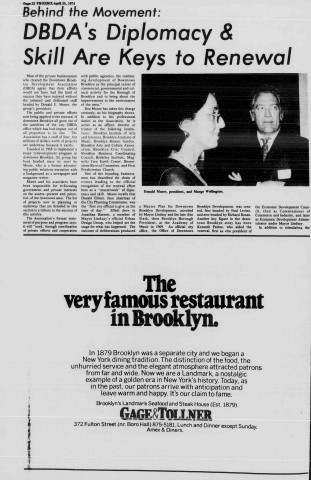
Pase22PH0^1XApr%u00ab2S, 1974Behind the Movement:DBDA's Diplomacy &Skill Are Keys to RenewalMost of the private businessmen who created the Downtown Brooklyn Development Association (DBDA) agree that their efforts would not have had the kind of success they have enjoyed without the talented and dedicated staff headed by Donald E. Moore, the group%u2019s president.The public and private efforts now being applied to the renewal of downtown Brooklyn all grow out of the activities of the tiny DBDA office which has had impact out of all proportion to its size. The Association has a staff of four, but millions of dollars worth of projects are underway because it exists.Founded in 1968 to implement a major redevelopment program in downtown Brooklyn, the group has been headed since its start by Moore, who is a former advertising-public relations executive with a background as a newspaper and magazine writer.Moore and his associates have been responsible for re-focusing government and private interests on the assets-present and potential-of the downtown area. The list of projects now in planning or underway that are detailed in this section is a tribute to the success of this activity.The Association%u2019s formal statement of purpose and program says: it will %u201c seek, through coordination of private efforts and cooperationwith public agencies, the continuing development of Downtown Brooklyn as the principal center of commercial, governmental and cultural activity for the Borough of Brooklyn and to bring about the improvements to the environment of the area.%u201dDon Moore has taken this charge seriously, as his biography shows. In addition to his professional duties at the Association, he is active as an officer, director or trustee of the following institutions: Brooklyn Institute of Artsand Sciences, Brooklyn Academy of Music, Brooklyn Botanic Garden, Brooklyn Arts and Culture Association, Brooklyn Civic Council, Brooklyn Business Coordinating Council, Berkeley Institute, Magnolia Tree Earth Center, Brownstone Revival Committee, and First Presbyterian Church.One of the founding businessmen has described the chain of events leading to the official recognition of the renewal effort here as a %u201c masterwork%u201d of diplomacy and skill. Moore recalls that Donald Elliott, then chairman of the City Planning Commission, was the %u201cfirst city official to give us the time of day.%u201d Elliott drew in Jonathan Barnett, a member of Mayor Lindsay%u2019s official Urban Design Group, who helped set the stage for what has happened. The outcome of deliberations producedDonald Moore, president, and Margo Wellington.a M aster Plan for Downtown Brooklyn Development, unveiled by Mayor Lindsay and the late Abe Stark, then Brooklyn Borough President, at the Academy of Music in 1969. An official city office, the Office of DowntownBrooklyn Development, was created, first headed by Paul Levine, and now headed by Richard Rosan. Another key figure in the downtown Brooklyn story has been Kenneth Patton, who aided the renewal, first as vice president ofthe Economic Development Council, then as Commissioner of Commerce and Industry, and later as Economic Development Administrator under Mayor Lindsay.In addition to stimulating thec The very famous restaurantin Brooklyn.In 1879 Brooklyn was a separate city and we began a New York dining tradition. The distinction of the food, the unhurried service and the elegant atmosphere attracted patrons from far and wide. Now we are a Landmark, a nostalgic example of a golden era in New York%u2019s history. Today, as in the past, our patrons arrive with anticipation and leave warm and happy. It%u2019s our claim to fame.I Brooklyn%u2019s Landmark Seafood and Steak House (Est 1879)I fiAr.riTtHi.isi kb| 372 Fulton Street (nr. Boro Hall) 875-5181. Lunch and Dinner except Sundavg Amex& Diners.


