


Page 336 - Demo
P. 336
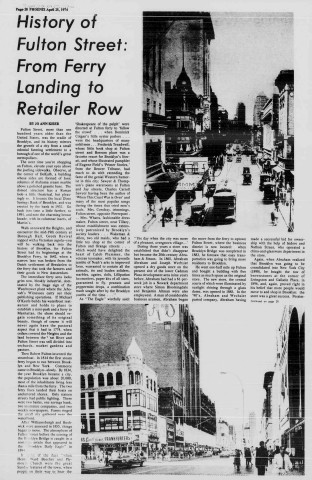
Hern VVard Beecher and PlymouC Church were the great Sunday features of the town, when people on their way to hear themade a successful bid for ownership with the help of Isidore and Nathan Straus, who operated a china-and-glassware department in the store.Again, when Abraham realized that Brooklyn was going to be consolidated into New York City (1898), he bought the row of brownstones at the corner of Livingston and Gallatin Place, in 1896, and, again, proved right in his belief that more people would move to and shop in Brooklyn: the store was a great success. PessimContinued on page 29.BY JO ANN KISERFulton Street, more than one hundred years older than the United States, was the cradle of Brooklyn, and its history mirrors the growth of a city from a small colonial farming settlement to a borough of one of the world%u2019s great metropolises.The next time you%u2019re shopping on Fulton, elevate your eyes above the jostling sidewalks. Observe, at the corner of DeKalb, a building whose sides are formed of Ionic columns of Alabama cream marble above a polished granite base. The domed structure has a Roman look--a little theatrical, but pleasingly so. h houses the local Dime Savings Bank of Brooklyn, and was erected by the bank in 1932. Go back into time a little further, to 1891, and note the charming brown facade, with its columnar insets, of Martin's.Walk on toward the Heights, and encounter the mid-19th century at Borough Hall, Greek Revival topped with a Victorian cupola-you will be walking back into the history of Brooklyn, for Fulton Street had its beginnings at the Brooklyn Ferry, in 1642, when a narrow lane was broken from the Dutch settlement of Breukelen to the ferry that took the farmers and their goods to New Amsterdam.The immediate ferry area looks grim now, bleakly industrial, dominated by the huge sign of the Watchtower plant where the Jehovah%u2019s Witnesses carry out their publishing operations. If Michael O%u2019Keefe builds his waterfront restaurant and holds to plans to establish a mini-park and a ferry to Manhattan, the shore should regain something of its original beauty, though of course it will never again have the pastoral aspect that it had in 1774, when cedars covered the Heights and the land between the ^ ast River and Fulton Street was still divided into orchards, market gardens and pasture.Then Robert Fulton invented the steamboat. In 1814 the first steam ferry began to run between Brooklyn and New York. Commerce came to Brooklyn-slowly. By 1834, the year Brooklyn became a city, the population was about 20,000, most of the inhabitants living less than a mile from the ferry. The two ferry lines landed their boats on uncluttered shores. Only sixteen streets had public lighting. There were two banks, one savings bank, two insurance companies, and tw%u00bbo weekly newspapers. Farms ringedco-IQ 11 r%u00bbitv oath#*r#*H noar thf* *%u25a0*'' %u201c %u201cJ o--waterfront.After Williamsburgh and Bushwick were annexed in 1855, things began to move. The atmosphere of Fulton Street before the coming of the Dt klyn Bridge is caught in a ar J///nc nosl article that appeared in the rooklyn Daily Eagle\1894%u2018Shakespeare of the pulpit%u2019 were directed at Fulton ferry to %u2018follow the crowd%u2019 . . . when Dominick Colgan%u2019s little oyster parlors . . . were the headquarters of many solid men . . . Frederick Treadwell, whose little book shop at Fulton street and Boerum place was a favorite resort for Brooklyn%u2019s literati, and whose illustrated pamphlet of Eugene Field%u2019s %u2018Primer Stories,%u2019 from the Denver Tribune, had much to do with extending the fame of the genial Western humorist in this city; Sawyer & Thompson%u2019s piano warerooms at Fulton and Jay streets, Charles Carroll Sawyer having been the author of %u2018When This Cruel War is Over%u2019 and many of the most popular songs during the times that tried men%u2019s souls. Mrs. Cowdray, trimmings, Fulton street, opposite Pierrepont .. . Mrs. Whatts, fashionable dress maker, Fulton street, near Tillary, whose establishment was extensively patronized by Brooklyn%u2019s society leaders . . . Wakeman & Allen, two old maids, who had a little toy shop at the corner of Fulton and Orange streets . . . which would have delighted the heart of Caleb Plummer, the veteran toymaker, with its juvenile jumble of Noah%u2019s arks in improved form, warranted to contain all the animals, tin and leaden soliders, marbles, agates, dolls, Lilliputian locomotives, paper kits of all sizes, guaranteed to fly, peanuts and peppermint drops, a combination much sought after by the Brooklyn youths of the time ...\As %u201c The Eagle%u201d wistfully said:%u201c The day when the city was more of a pleasant, overgrown village...%u2019 During those years a store was established that didn%u2019t disappear but became the 20th-century Abraham & Straus. In 1865, Abraham Abraham and Joseph Wechsier opened a dry goods store on the present site of the lower Cadman Plaza development area (nine years before, Abraham had had a $l-perweek job in a Newark department store where Simon Bloomingdale and Benjamin Altman were also employees). A man of considerable business acumen, Abraham beganthe move from the ferry to uptown Fulton Street, where the business district is now located: whenBrooklyn Bridge was completed in 1883, he foresaw that easy transportation was going to bring more residents to Brooklyn.He went one-half mile up Fulton and bought a building with five times as much space as the original store. The new store, the central courts of which were illuminated by sunlight shining through a glass dome, was opened in 1885. In the %u201890%u2019s, Abraham and Wechsier parted company, Abraham havingPage 28 PHOENIX April 25,1974History ofFulton Street:From FerryLanding toRetailer Row


