


Page 480 - Demo
P. 480
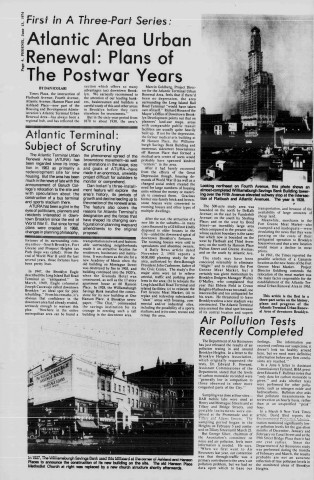
Page 4, PHOENIX, June 13, 1974 First in A Three-Fart Series:Atlantic Area UrbanRenewal: Plans ofThe Postwar YearsBY DAN ICOLARITimes Plaza, the intersection of Flatbush Avenue, Fourth Avenue, Atlantic Avenue, Hanson Place and Ashland Place%u2014now part of the Housing and Development Administration%u2019s Atlantic Terminal Urban Renewal Area%u2014has always been a regional hub, and has reflected theRenewal Area (ATURA) has been regarded since its inception in 1963 as primarily a redevelopment site for new housing. But the area has been much in the news of late with the announcement of Baruch College%u2019s relocation to the site and w ith speculation about the construction of a bus terminal and sports stadium there.ATURA has been a glint in the eyes of politicians, planners and residents interested in downtown Brooklyn since the end of World War II. But since formalGreene and Prospect Heights (as Park Slope was called). From the end of World War II until the last several years, those fortunes have been pretty lean.In 1947, the Brooklyn Eagle described the Long Island Rail Road Terminal as \In March, 1949, Eagle columnist Joseph Caccavajo called downtown Brooklyn \rebuilding.\obvious that confidence in the downtown area had already eroded, seriously enough to warrant this plea: \metropolitan area can be found asection which offers so many advantages (as) downtown Brooklyn. We earnestly recommend to the attention of our leading bankers, businessmen and builders a careful study of this and other areas in Brooklyn before they turn elsewhere for investments.%u201dBut in the sixty-year period from 1870 to about 1930, the area%u2019sthe phenomenal spread of the brownstone movement-as well as alterations in the scope, size and goals of A T U R A -have made it an enormous, unwieldy project difficult for outsiders to monitor or comprehend.Dan Icolari%u2019s three-installment feature will explore the area%u2019s history, its periods of growth and decline leading up to the creation of the renewal area. The feature also covers the reasons for Atlantic Terminal%u2019s designation and the forces that have shaped its changing configuration on planning maps and amendments to the original proposal.transportation network and fashionable surrounding neighborhoods made it an attractive location for residences, businesses and institutions. It was chosen as the site for a new Academy of Music when the old building on Montague Street was destroyed by fire in 1903, and building continued into the 1920%u2019s, when the Granada Hotel was constructed, as well as the 17-story apartment house at 60 Hanson Place. In 1928, the Williamsburgh Savings Bank installed the cornerstone for its new building at One Hanson Place. A Brooklyn newspaper, %u201cThe Chat,%u201d commended the savings institution for its courage in erecting such a tall building in the downtown area.Marvin Goldberg, Project Director for the Atlantic Terminal Urban Renewal Area, feels that if there%u2019d been no depression, the area surrounding the Long Island Rail Road Terminal \care of itself. %u2019 %u2019 Richard Rosan of the Mayor%u2019s Office of Downtown Brooklyn Development points out that on planners%u2019 land-use maps, areas with comparable public transit facilities are usually quite heavily built up. If not for the depression, the former medical arts building at 80 Hanson Place, the Williamsburgh Savings Bank Building and numerous sidestreet brownstones off Hanson Place that formed a medical-arts center of sorts would probably have spawned kindred \After it had barely recovered from the effects of the Great Depression though, housing demands of World War II (as well as a changed social order) created the need for large numbers of housing units without the money or materials to construct them. Gracious former one-family brick and brownstone houses were converted to rooming houses and other types of multiple dwellings.After the war, the attraction of a new life in the suburbs%u2014in many cases financed by a GI bill not kindly disposed to older houses in the City%u2014aided the downward spiral of downtown Brooklyn%u2019s fortunes. The rooming houses were sold to speculators and absentee owners.A Daily News article dated November 2, 1955 reports a $100,000 planning study for the area, authorized by then-Borough President John Cashmore, father of the Civic Center. The study%u2019s five major aims were (a) to relieve arterial, traffic and parking problems in the area; (b) to relocate the Long Island Rail Road Terminal and related facilities; (c) to relocate the Fort Greene Meat Market; (d) to replan and redevelop substandard \mercial and/or industrial sites, including the possibility of a sports stadium; and (e) to zone, rezone and remap the area.iiuiiiiiimiiHiiimiiiiiiiiiiiiiiiiiiiiiiiiiiiiiiiiiiiiiiiiiiiiiiiiiiiiiiiiiiiiiiiiiiiiiiiiiiiiiiiiiiiiimiiiiiiiiiiiAtlantic Terminal:Subject of ScrutinyThe Atlantic Terminal Urbanplans were created in 1968, changes in planning philosophy,.......................nil....Illlllll.......Hill...... ......Ill........Illlllllllllilllllllllllillllllllllfortunes of its surrounding comm unities-%u2014South Brooklyn, FortMethodist Church at right was replaced by a new church structure shortly afterwards.Looking northeast on Fourth Avenue, this photo shows analmost-completed Williamsburgh Savings Bank Building towering over the Fifth Avenue elevated subway stop at the intersection of Flatbush and Atlantic Avenues. The year is 1928.The 500-acre study area was bounded on the north by DeKalb Avenue; on the east by Vanderbilt Avenue; on the south by Sterling Place; and on the west by Bond Street%u2014an incredibly large area when compared to the present site, whose eastern boundary is the same but which now is bounded on the west by Flatbush and Third Avenues; on the north by Hanson Place Fulton Street and Greene Avenue; and on the south by Atlantic Ave.The study may have been conceived ostensibly to eliminate \Greene Meat Market, but it certainly was given momentum by Brooklyn Dodgers Manager Walter O%u2019Malley, who complained that year that Ebbets Field in Crown Heights-Flatbush was too small, too inaccessible and too antiquated for his team. He threatened to leave Brooklyn unless a new stadium was constructed. The Atlantic Terminal area seemed the ideal spot because of its central location and superbtransportation, and because of the availability of large amounts of cheap land.Meanwhile, merchants in the Fort Greene Meat Market%u2014also cramped and inadequate---were circulating the news that they were passing on the costs of\antiquated operation to Brooklyn housewives and that a new location would mean a decline in meat prices.In 1961, the Times reported the possible selection of a Canarsie location as the new home of the Fort Greene Meat Market. Project Director Goldberg contends the relocation of the meat market was the main factor responsible for the establishment of the Atlantic Terminal Urban Renewal Area in 1963.This article is the first In athree-part series on the history,plans and progress of theAtlantic Terminal Urban Renewal Area of downtown Brooklyn.Air Pollution TestsRecently CompletedThe Department of Air Resources has just released the results of air pollution testing in and around Brooklyn Heights. In a letter to the Brooklyn Heights Association, which originally requested the tests, Dr. Edward F. Ferrand, Assistant Commissioner of the Department, stated that the levels of carbon monoxide recorded were \those observed in other more congested parts of the City.%u201dSampling was done at four sites%u2014 DAR mobile labs were used at Henry and Montague Streets and at Tillary and Bridge Streets, and portable instrum ents were employed at the Promenade and atT i l l o r v o n rl \\ r l o m c C fo n n t r T l>%u00ab %u201c ------J ------- - - ~ ^ *> %u00bb.* w wsampling period began in the Heights on February 5 and continued on Tillary Street until March 25.But George Silver, chairman of the Association's committee on noise and air pollution, feels more information is needed. He says, \Resources last year, our contention was that through-traffic was a primary contributor to the area's air pollution problem, but we had no data upon which to base ourfeelings. The information just received confirms our suspicions; it doesn%u2019t look too healthy around here, but we need more definitive information before any firm conclusions are reached.%u201dIn a June 6 letter to Assistant Commissioner Ferrand, BHA president Edwards F. Rullman notes that \given,\were performed for other pollutants, such as nitrogen oxide and hydrocarbons. Rullman also asks that pollutant measurements be reviewed on an hourly basis, rather than at an unspecified \hour.In a March 8 New York Times article, David Bird reports the. ..v-.i.Lv.u.. * * ''iv.v noH nuIuiriiS-(ration monitored significantly lower pollution levels for the gas-short months of December, January and February on Canal Street and at the 59th Street Bridge Plaza than it had one year earlier. Since the Department of Air Resources study was performed during the months of February and March, the results probably are not an accurate reflection of true pollutant levels in the monitored areas of Brooklyn Heights.


