


Page 481 - Demo
P. 481
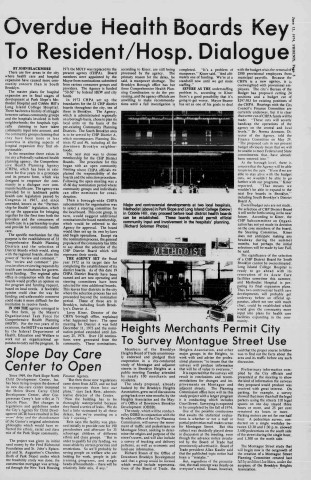
Overdue Heaith Boards KeyTo Resident/Hosp. DialogueBY JOHN BLACKMOREThere are few areas in the city where health care and hospital expansion have caused more community concern than in South Brooklyn.The master plans for hospital expansion are in final stages of development at Park Slope%u2019s Methodist Hospital and Cobble Hill%u2019s Long Island College Hospital. There has been a history of struggle between various community groups and the hospitals involved in both neighborhoods; the hospitals typically claiming to have taken community input into account, and the community groups claiming that they have been more or less powerless in altering aspects of hospital expansion they find objectionable.In the meantime there exists in the city a Federally-subsized health planning agency, the Comprehensive Health Planning Agency (CHPA), which has been in existence for five years in a prototype and its present form, which was designed to empower the community in a dialogue over community healthcare. The agency was provided for in landmark public health care legislation passed by Congress in 1967, and since amended, known as the %u201c Partnership for Health%u201d legislation, which set up the apparatus for bringing together for the first time both the providers and the consumers of health care in a partnership to plan and provide for community health care.The specific mechanism for this purpose is the establishment of 33 Comprehensive Health Planning Districts and the selection of District Boards which would, along with the regional boards, share the power of %u201creview and comment.%u201d The %u201creview and comment%u201d process involves reviewing requests by health care institutions for government funding. The regional cpha office in conjunction with the local boards would proffer an opinion on the program and funding request, based on local needs. A favorable opinion could clear the way for funding; and unfavorable comment could make it more difficult for the institution to receive funds.IN 1969 THE agency emerged in its first form, as the Mayor%u2019s Organizational Task Force for Comprehensive Health Planning (MOTF). For the two years of its existence, the MOTF was mandated by the federal Department of Health, Education and Welfare to work out an organizational apparatus to carry out the program. In1971 the MOTF was replaced by the present agency (CHPA). Board members were appointed by the Mayor from nominations submitted from various consumer groups and providers. The Agency is funded %u201c50-50%u201d by federal HEW and city funds.In 1972 CHPA set up the boundaries for the 33 CHP district boards throughout the city, ten of these in Brooklyn. The Agency, which is administrated regionally on a borough-basis, chose to plan its local units on the basis of the pre-existing Community Planning Districts. The South Brooklyn area is to be served by CHP District A, which encompasses Planning Districts #2 and #6, including all the downtown Brooklyn neighborhoods.The next step was to choose membership for the CHP District Boards. The procedure for this began with an open community meeting where CHPA officials explained the responsibility of the boards and the selection procedure. Following the open meeting was a 45-60 day nomination period where community groups and individuals can offer nominees for consideration.Then a borough-wide CHPA subcommittee for organization was to select a steering committee for the local board. This core group, in turn, would suggest additional nominations for board membership, which would be referred to the Agency for approval. The board would then set up its own by-laws and begin operations. Except via the nomination process, the general populace of the community has little to say about the selection of the CHP District Board which will represent their needs.THE AGENCY SET the fiscal year 1972 as its target date for completing the establishment of its district boards. As of this date 19 CHPA District Boards have been named and are now operating and steering committees have been selected for nine additional boards. This leaves four districts in the city where the selection process has not proceeded beyond the nomination period. Three of these are in Brooklyn, including South Brooklyn%u2019s District A.Leroy Kiner, Director of the CHPA borough office, explained what happened here: The openmeeting for District A was held December 11, 1973 and the nomination period extended until January 25, 1974. Over 120 nominations were generated from the community. These nominations,Slope Day CareCenter to OpenSince 1969, the Park Slope North Child Development Center, Inc. has been trying to open the doors of its new day-care center (renamed the Helen Owen Carey Child Development Center, after Congressman Carey's late wife) at 71 Lincoln Place. But changes in regulations and guidelines under the City's Agency for Child Development (ACD) have resulted in fivevcarC dclav and the abandonmentFinance Agency.%u201c But then those new regulations came down from ACD, and we had to incorporate them Into our plans,%u201d says Jack Rein, administrative director of the Center, \thoroughly waterproofed because they found a series of leaks. We do feel a little victimized by all these delays, but we%u2019re counting on a Julv 1 oneninp.%u201dof the Center's original admissions philosophy which would have reflected the ethnic, racial and class mix of the Park Slope community.The project was given its initial seed money by the Fred Richmond Foundation and St. John%u2019s Episcopal and St. Augustine%u2019s Churches (both of Park Slope) under which the teasihility study was done; the construction mortgage was arranged through the New York HousingRein says the facility was planned initially to provide care for 190 preschoolers and aftercare for 35 school-age children of different ethnic and class groups. %u201c But in order to qualify for city funding, we must abide by certain priorities and restrictions. So we'll probably be seving people on welfare who are looking for work, people in jobtraining programs, and singie heads of households - there will be relatively little mix, if any.\according to Kiner, are still being processed by the agency. The primary reason for the delay, he said, is manpower shortage. The Brooklyn Borough office has but three Comprehensive Health Planning Coordinators to do the processing, and the agency officials are unwilling to make recommendations until a full investigation iscompleted. \manpower,\standstill now until we get more staffing.%u201dSEVERE AS THE understaffing problem is, according to Kiner there%u2019s a good possibility that it%u2019s going to get worse. Mayor Beame has set as one of his goals to dealwith the budget crisis the removal of 2500 provisional employees from municipal payrolls. Because the CHPA is a new agency, it is overweighted with provisional employees. The city's Bureau of the Budget has proposed cutting 24 positions and a budget cut of $297,953 for existing positions of the CHPA. Hearings with the City Council%u2019s Finance Committee are currently underwav, but it is clear that some cut of CHPA funds will be made. \handicap the operations of the agency on the central and local levels,%u201d Dr. Norma Aronson, Director of the Agency, told the Finance Committee on May 29, \budget obviously mean that we will be unable to meet Federal and State commitments that...have already been entered into.%u201dAt the borough level, there is concern that the Agency will be able to survive the cuts. %u201c Even if we are able to stay alive with the budget cuts, we wouldn't be able to go further with our programs,\reported, %u201c That means we wouldn't be able to expand to the next five boards in Brooklyn,%u201d including South Brooklyn%u2019s District Board A.Even if budget cuts are not made, the selection of CHP District Board A will not be forthcoming in the near future. According to Kiner, the CHP Subcommittee on Organization has not yet made its decision on the core members of the board, the Steering Committee. Kiner does not anticipate making any headway during the summer months, but perhaps the initial selections will be made by late Fall, he said.The significance of the selection of a CHP District Board for South Brooklyn cannot be overestimated. Long Island College Hospital is ready to go ahead with its renovation of its Acute Care facilities sometime this summer, and Methodist Hospital is preparing its final expansion plans. Thus two controversial health care developments will probably get underway before an official apparatus, albeit not one with much clout, could be established which would give the community more input into plans for health care facilities expanding in the community.Major and controversial developments at two iocai hospitals,Methodist [above] in Park Slope and Long Island College [below]in Cobble H ill, may proceed before local district health boardscan be established. These boards would permit officialcommunity input and involvement in the hospitals%u2019 planning.[Richard Solomon Photos]Heights Merchants Permit CityTo Survey Montague Street UseMembers of the Brooklyn Heights Board of Trade unanimously endorsed and pledged their cooperation in a city-conducted study of Montague and adjacent streets in Brooklyn Heights at a public meeting Tuesday attended by nearly 100 merchants and residents.The study proposal, already backed by the Brooklyn Heights Association, grew out of discussions going back over nine months by the Heights Association and the Mayor%u2019s Office of Downtown Brooklyn Development (ODBD).The study, which will be conducted by ODBD in conjunction with the Brooklyn Office of the Citv Planning Commission, will survey the movement of traffic and pedestrians on Montague Street, seeking to determine the origins and purpose of the street%u2019s users, and will also include a survey of trucking and delivery patterns, as well as economic and land-use information.Richard Rosan of the Office of Downtown Brooklyn Development said ihai a group wouiu be formed which would include representatives of the Board of Trade, theHeights Association, and other major groups in the Heights, to work with and advise the professional planners %u201c to insure that the surveys will produce information that will be of value to everyone.%u201d It is expected that the surveys will result in conclusions and recommendations for changes and improvements on Montague and adjacent streets. The Planning Commission office here will tie this study project with a larger program it is conducting which includes Court Street. Surveying is expected to be completed by the fall of 1974.One of the possible conclusions that awaits the statistical evaluations is whether or not a mall or partial pedestrian mall makes sense for Montague Street. But this subject was decidedly played down in discussion at the meeting, even though the advance notice circulated by the Board of Trade had prominently advertised it. Board of Trade president Allan Kaufer said that the published topic notice had been a %u201c mistake.%u201doui, icgaiuicas of iiic presentation, the mall concept was clearly on everyone%u2019s mind. Rosan, however,said that the proper course to follow was to find out the facts about the area and its traffic before any such discussion.Preliminary information compiled by the City officials and presented at the meeting to show the kind of information the surveys they proposed would produce was received with great interest. On parking, for example, a survey showed that more than half the legal parkers using the streets 110 legal spaces on one day stayed three hours or more, and 25 per cent remained six hours or more. Parking meters are set for one-half hour. A pedestrian survey, conducted on a single weekday between 12:30 and 1:30 p.m. showed 3,600 pedestrians on the south side of the street during the single hour, and 1,300 on the north side.The Montague Street study that will begin now is the outgrowth of the creation of a Montague Street Planning Committee created lastf H 1. -----Ula.__a T__iL _ it t ii u y a i t m i c u j u t m t u . | u t i u t i u iwauspices of the Brooklyn Heights Association.Jure 13, 1974, PHOENIX, P;


