


Page 49 - Demo
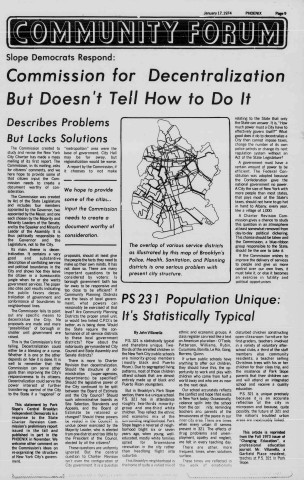
P. 49
January 17,1974 PHOENIX Page 9Slope Democrats Respond:Commission for DecentralizationBut Doesn't Tell How to Do ItDescribes ProblemsBut Lacks SolutionsThe Commission created tostudy and revise the New YorkCity Charter has made a massmailing of its first report. TheCommission, in its mailing, asksfor citizens' comments, and wehere hope to provide some ofthat citizen input the Commission needs to create adocument worthy of consideration.The Commission was createdby Act of the State Legislatureand includes four membersappointed by the Governor, twoappointed by the Mayor, and oneeach chosen by the Majority andMinority Leaders of the Senate,and by the Speaker and MinorityLeader of the Assembly. It isthus politically responsible tothe Governor and theLegislature, not to the City.Its main theme is decentralization. It contains a verygood and substantivedescription of conflicting serviceand political boundaries in theCity and shows hoe they leavethe citizen in a bureaucraticjungle when he or she wantsgovernment services. The paperalso cites poll results indicatingthe public favors decentralization of government andconformance of boundaries toneighborhood lines.The Commission fails to pointout any specific means todecentralize the City. Noproposals are made and mere\borough orsmaller unit government areraised.This is the Commission%u2019s firstfailing. Decentralization couldeither be a blessing or a curse.Whether it is one or the otherdepends on hdw it is done. It iswell to remember that theCommission can serve othergoals than improving the City%u2019sresponsiveness to its citizens.Decentralization could serve thepower interest of furth ertransferring control of the Cityto the State if a %u201cregional\This statement by ParkSlope%u2019s Central BrooklynIndependent Democrats is aresponse to the StateC harier Revision com %u00admission%u2019s preliminary reportissued in the fall andpublished in part in thePHOENIX in November. Wewelcome other comment onthe Commission's ideas onre-organizing the structureof New York City's government.%u201cmetropolitan%u201d area were thebase of government. City Hallmay be far away, butregionalization would be worse.A report by the Commission, ifit chooses to not makeW e h o p e to p ro v id es o m e o f th e c itiz c ..in p u t th e C om m issio nn e e d s to c re a te ad o c u m e n t w o rth y o fc o n s id e ra tio n .proposals, should at least givethe people the facts they need tomake up their own minds. It hasnot done so. There are manyim portant questions to beconsidered by voters: Isborough government both toofar away to be responsive andtoo close to be efficient? IfCommunity Planning Districtsare the basis of local government, what powers canreasonably be exercised at thatlevel? Are Community PlanningDistricts the proper small unit,or would two linked C.P.D.%u2019s bebetter, as is being done. Wouldthe State require the conformance of all service districtsto these local governmentdistricts? How about thenotoriously gerrymandered CityCouncil and State Assembly andSenate districts?There is more to CharterRevision than decentralization.Should the structure of administration (super-agencies,departm ents) be specified?Should the legislative power ofthe City continued to be splitbetween the Board of Estimateand the City Council? Shouldsuch administrative boards asSite Selection, Standards andAppeals, and the Board ofEstim ate be retained orchanged? Should these powersbe veSteu in iiie C o uncil? isundue power exercised by theMajority Leader, who is electedfrom one district and too little bythe President of the Council,elected by all the citizens?These questions are uniformlyignored. But the centralquestion to Charter Revisionisn't even The contiguration ot City government. It is a questionThe o v e rla p o f v ario u s s e rv ic e districtsas illu s tra te d by this m a p o f B ro o klyn 'sP olice, H e a lth , S a n ita tio n , a n d P la n n in gdistricts is o n e serio u s p ro b le m w ithp re s e n t city s tru ctu re .relating to the State that onlythe State can answer. It is, \much power must a City have toeffectively govern itself?\good does it do to decentralize aCity than cannot impose taxes,change the number of its ownpolice patrols or change its rentregulation system without anAct of the State Legislature?A government must have acertain amount of power to beefficient. The Federal Constitution was adopted becausethe Confederation gave thenational government no power.A City the size of New York withmore people than most states,that pays most of the State%u2019staxes, should not have to go hatin hand to Albany, every year,like a village of 1,000.A C harter Revision Commission gives a chance to studythis question in an atmosphereat least somewhat removed fromday-to-day political dickering.This chance should be taken andthe Commission, a blue-ribbongroup responsible to the State,should be the one to take it.If the Commission wishes toimprove the delivery of servicesto people and give us morecontrol over our own lives, itmust take it, or else it becomesan exercise in futility andpolitical opportunism.PS 231 Population Unique:It's Statistically TypicalBy John VillanellaP.S. 321 is statistically typicaland therefore unique. Twothirds of the enrolled children inthe New York City public schoolsare minority-group members(mostly black and PuertoRican). Due to segregated livingpatterns, most of those childrenattend schools that are almostentirely made up of black andPuerto Rican youngsters.But in Brooklyn%u2019s Park Slopesection, there is a unique school.P.S. 321 has in attendanceroughly two-thirds minoritygroup and one-third whitechildren. They reflect the ethnicand economic mix of theSui luuHunig neighborhood. Park Slope began a reversal of neighborhood blight six or sevenyears ago, when young, welleducated, mostly white familiesopted for brownstonerenovation in the city ratherthan headlong flight intosuburbia.This BrooKiyn neighborhood isthe home of quite a varied mix ofethnic and economic groups. Aclass register can read like a texton American pluralism: O'Toole,Patterson, Williams, Rubin,Cusumano, Bonilla, Le Roi, Gong,Borrero, Quinn.If urban public schools haveanything to offer our children,they should have this, the opportunity to work and play withchildren who come from half aworld away and who are as nearas the next desk.Our school accurately reflectsthe conflict and hope that existsin New York today. Occasionally,violence spill1: into the schoolfrom the cor rnity, remindingteachers ano parents of thetenuousness of the peace in ourinner-city area. There a re timeswhen every urban ill semmspresent in 321. The effects ofdrug problems and unemployment, apathy and neglect,are felt in every teaching day.There are other, morefrequent, times, when solutionssurface.These tim es are reflected in th e w o rk of e m o tio n a llydisturbed children constructingopen-classroom furniture forfirst-graders, teachers involvedin a variety of voluntary afterschool clubs, a third of the staffmembers also communityresidents, a teacher sellingChristmas trees with his or herchildren for their class trip, andthe insistence of Park Slopeparents that their children canand will attend an integratedschool and receive a qualityeducation.P.S. 321 is unique preciselybecause it is an accuratereflection 'of the city inmicrocosm and because, quitepossibly, the future of 321 andthe nation's troubled urbanai caS a rc ti icM i locibiy im'rveu.This article is reprintedfrom the Fall 1973 issue of%u201cChanging Education\aprofessional educationjournal. Mr. Villanella, aGarfield Place resident,teaches at P.S. 321 in ParkSlope.^ ' ** * / . . * %u2022 < r %u2019 f < w , v i t m


