


Page 127 - Demo
P. 127
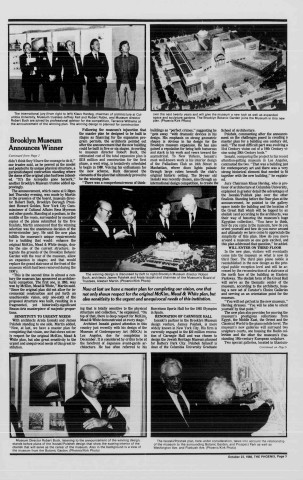
T h e international jury (from right to le ft) Klaus H erd eg , chairm an o f a rch itec tu re at C o lum bia University, M u seu m tru stee s J e ffre y Keil and R obert R ubin, and M useu m directorR obert Buck are joined by pro fession al advisor for th e c o m p etitio n , Terrance W illiam s atth e annou n cem en t of th e w in n in g plan. T h e w inning d esign is plan n ed for co n stru ctio nover th e next tw en ty years and w ill give the m useum a new look as w ell as expandedspace and sculpture gardens. T h e B rooklyn B otanic G arden joins the M u s eu m in th is newplan. (P h o en ix/K irk Photo)Brooklyn Museum Announces WinnerContinued from Page 1didn%u2019t think they%u2019d have the courage to do it,%u201d one trustee said, as he peered at the model and pointed to its unique physical structure, a pyramid-shaped contraction standing where the dome of die original plan had been Intended. %u201cIt%u2019s the Acropolis gone berserk,%u201d another Brooklyn Museum trustee added approvingly.The announcement, which came at 5:30pm last Thursday evening, was made by Martin in the presence of the board, museum director Robert Buck, Brooklyn Borough President Howard Golden, New York City Commissioner of Cultural Affairs Bess Myerson and other guests. Standing at a podium, in the middle of the room, surrounded by mounted copies of the plans submitted by the five finalists, Martin announced that the winning selection was the unanimous decision of the seven-member jury. He said the new plan fulfills the museum%u2019s unique requirements for a building that would: enhance the original McKim, Mead & White design, double the size of the current structure; integrate the grounds of the Brooklyn Botanic Garden with the rear of the museum, allow an expansion in stages; and that would replace the grand staircase at the front of the museum which had been removed during the 1930%u2019s.%u201cThis is the second time in almost a century the museum has sponsored an architectural competion. The first one, in 1893, was won by McKim, Mead & White,%u201d Martin said. %u201cSince the original plan did not allow for incremental construction and put forth an unachievable vision, only one-sixth of the proposed structure was built, resulting in a fragmented, yet historically-significant Beaux-Arts masterpiece of majestic proportions.SENSITIVITY TO URGENT NEEDSWith architects Arata Isozaki and .James Polshek standing to one side, Martin added, %u201cNow, at last, we have a master plan for completing that vision, one that shows not only respect for the original McKim, Mead & White plan, but also great sensitivity to the urgent and unequivocal needs of this great institution.Following the museum%u2019s injunction that the m aster plan be designed to be built in stages as financing for the expansion program permits, the architects pointed out after the announcement that the new building could be built in five or six stages. According to museum director Robert Buck, the estimated cost of the total expansion plan is $218 million and construction for the first phase, a west wing, is tentatively scheduled to begin in 1988. Voicing his enthusiasm for the new scheme, Buck discussed the elements of the plan that ultimately proved to be the winning plan.%u201cThere was a comprehensiveness of thinkbuildings as %u201cperfect crimes,%u201d suggesting he %u201cgets away %u201cwith dramatic devices in his design. His emphasis on strong geometric shapes is obvious in his design for the Brooklyn museum expansion. He has also gained a reputation for being both humorous and stark in his work and veers toward the asymetrical. To New Yorkers, Isozaki%u2019s most well-known work is his interior design of the Palladium Club on 14th Street in Manhattan, where disco lights pulsate through large cubes beneath the club%u2019s original historic ceiling. The 55-year old Isozaki was recently chosen, also through an international design competition, to create theT h e w inning d e sig n is discussed by (left to right) B rooklyn M u s eu m director RobertB uck, a rch itec ts J am es Polshek and A rata Isozaki and chairm an o f th e M u s eu m %u2019s Board ofTru stees, A lastair M artin . (P h o en ix /K irk Photo)Now at last we have a master plan for completing our vision, one thatnot only shows respect for the original McKim, Mead & White plan, butalso sensitivity to the urgent and unequivocal needs of this institution.ing that is totally sensitive to the physical structure and collection,%u201d he explained. %u201cOn top of that, there is deep respect for McKim, Mead & White demonstrated at every stage.%u201d Architect Isozaki gained attention in this country just recently with his design of the Museum of Contemporary Art (MOCA) in Los Angeles, due for completion in December. It is considered by critics to be at the forefront of Japanese avant-garde architecture. He has often referred to hisBarcelona Sports Hall for the 1992 Olympics in Spain.RENOVATION OF CARNEGIE HALLIsozaki%u2019s partner in the Brooklyn Museum design venture, James Polshek, is more widely known in New York City. His firm is currently engaged in the $32 million renovation of Carnegie Hall and was chosen to design the Jewish Heritage Museum planned for Battery Park City. Polshek himself is dean of the Columbia University GraduateSchool of Architecture.Polshek, commenting after the announcement on the challenges posed in creating a master plan for a building one century old, said, %u201cliie most difficult part was evolving a 21st Century vision out of a 19th Century vision using 20th Century tools.%u201dIsozaki, comparing the project to his recent attention-getting museum in Los Angeles, contrasted the two. %u201cThat was a building just for contemporary art and there was a very strong historical element that needed to fit together with the new building,%u201d he explained.Jury Chairman Klaus Herdeg, who is profesor of architecture at Columbia University, explained in greater detail the advantages of the Isozaki/Polshek plan over the other finalists. Standing before the floor plan at the announcement, he pointed to the gallery space inside the building and the location of the Great Hall which will be topped by an obelisk (and according to the architects, was their way of honoring the museum%u2019s huge Egyptian collection). %u201cYou have to think, how do you come in the museum, how do you orient yourself and how do you move around and ultimately we have come to appreciate the simplicity of this plan. How do you move around a museum so one gets excited, and this plan addressed that question,%u201d he added.WILL ENTER ON THIRD FLOOR In the new plan, visitors will eventually come into the museum on what is now its third floor. The third plan piano nobile is reestablished in the new design as the principal public reception level and will be accessed by the reconstruction of a staircase at the north face of the building on Eastern Parkway. The obelisk form of the Great Hall will serve as the thematic center of the museum, according to the architects, housing a new set of Curator%u2019s Choice Galleries and serving as an orientation point for the museum.%u201cYou will not get lost in the new museum,%u201d Herdeg stresses. %u201cYou will be able to orient yourself by that point.%u201dThe new plan also provides for moving the museum%u2019s prestigious collections from Egypt, the Middle East, the Orient and the Classical World to the piano nobile level. The museum%u2019s new galleries will surround two sculpture courts, one housing the Rodin collection and the other the museum%u2019s freestanding 19th-century European sculpture. Two special galleries, located in titaniumContinued on Page 6The Iso za ki/P o lsh e k plan, here under consideration, takes into account the relationshipof the m useum to th e surrounding B otanic G arden, and Prospect Park as w ell asW ashington Ave. and Flatbush Ave. (Ph oenix/K irk Photo)M useum D irec to r R obert B uck, listening to the a n n o u n cem en t o f the w inning design,s tan ds before plans of th e Iso za ki/P o lsh e k design th a t show th e soaring interior of theobelisk that w ill serve as th e cen ter of th e m useum . A lso in th e background is a view ofth e m useum from the B otanic Garden. (P h o en ix/K irk Photo)O c to b er 2 3,1 9 8 6 , TH E P H O E N IX , Page 3


