


Page 121 - Demo
P. 121
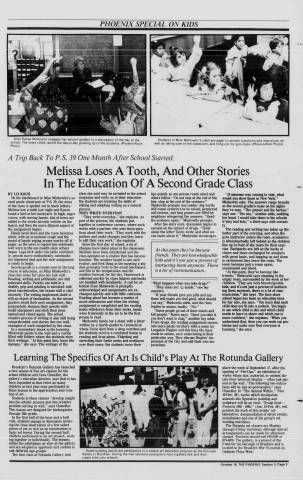
PHOENIX SPECIAL ON KIDSMiss Renee Minkowitz engages her second graders in a discussion of the day at the school. The class notes record the day-to-day growing up of the students. (Phoenix/Koch Photo)Students in Miss Minkowitz's class are eager to answer questions and read aloud, as well as taking care of the classroom, and filing out for gym class. (Phoenix/Kirk Photo)A Trip Back To P. S. 39 One Month After School Started:Melissa Loses A Tooth, And Other Stories In The Education Of A Second Grade ClassBY LIZ KOCHOn the blackboard in Miss Minkowitz%u2019s second grade classroom at P.S. 39, the news of the class is spelled out in black letters: Melissa lost a tooth last night and Karen found a bird in her backyard. In high, eager voices, with waving hands, bits of news are added to the words already written on the board, and then the more diligent aspect of the assignment begins.Heads bend down and the room becomes silent, with an occasional cough and the sound of hands wiping eraser marks off of paper, as the news is copied into notebooks well worn in the one month since school began. Legs kick under the table confidently, pencils move methodically, notebooks are slammed shut and the next assignment is ready to begin.Second grade is a crucial year in the long course of education, as Miss Minkowitz%u2019s class has come far since my last visit. Reading, writing and arithmetic are still awkward skills. Pencils are held in a deathly grip and printing is executed with great concentration, the eraser still a vital necessity. The writing implement itself is still an object of fascination. As the second graders await their next assignment, they purposefully sharpen their pencils with small sharpeners and click their pens opened and closed again. The actual creative process of writing is also still being comprehended, and stories line one wall, examples of work completed by the class.In a momentary break in the learning, Minkowitz points to the wall and a carton filled with folders where the students store their writings. %u201cAt this point they learn like sponges,%u201d she says. The writings of theclass she said may be included in the school magazine and early on in their education the students are learning the skills of editing and adopting writing as a natural process.THEY WRITE EVERYDAY%u201cThey write everyday,%u201d she explains. As part of the process, the students join together in conference corners, where each works with a partner who asks them questions about their work. %u201cThey work with the partner and make changes and they learn to edit their own work,%u201d she explains.Since the first day of school, a lot of changes have taken place in the classroom. Methods have been established and the class operates on a routine that has become familiar. The weather board is one such routine, and first thing in the morning a student promptly trots to the small blackboard and fills in the temperature and the weather forecast for the day. Homework is collected quickly by class helpers and books are handled with familiarity. A call for attention from Minkowitz is promptly acknowledged and assignments are exchanged quickly and with little confusion. Reading aloud has become a matter of much enthusiasm and when the writing assignment is completed and the reading books withdrawn from their desks, hands wave frantically in the air to be the first person to read.Minkowitz hands out a sheet with a letter written by a fourth grader in Connecticut whose Uncle died from a drug overdose and the students receive a combined lesson in reading and drug abuse. Fidgeting and stretching their turtle necks and necklaces over their noses, the students move theirlips quietly as one person reads aloud and others follow. %u201cDo not stop at the end of the line, stop at the end of the sentence,%u201d Minkowitz prompts one reader. Big words still cause eyebrows to be raised, perplexed and serious, and long pauses are filled by neighbors whispering the answers. %u201cRead the sentence again,%u201d Minkowitz prompts.After the story ends, discussion begins in earnest on the subject of drugs. %u201cThink about the letter Tasha wrote and what we can learn about it,%u201d Minkowtiz encourages.At this point they%u2019ve becomefriends. They are knowledgeablekids and it%u2019s not just a process o finstructing them anymore. Thereis a lot o f communication.%u201cWhat happens when you take drugs?%u201d%u201cThey mess you up inside,%u201d one boy answers.%u201cIf your friends give you pills and say these will make you feel good, what should you say,%u201d Minkowitz adds, and the class replies in unison, loudly: %u201cNo.%u201d%u201cSome people go out of their minds and kill people,%u201d Karen says. %u201cOnce you take it you don%u2019t want to stop,%u201d another boy adds. From drugs, the reading assignment moves into more poetic territory with a poem by Langston Hughes and this time the class reads in unison, each enunciating in their particular way. They discuss Hughes%u2019 impression of the City and add their own impressions.%u201c If someone was coming to visit, what would you show them in New York,%u201d Minkowitz asks. The answers range broadly as the second graders muse on the sights they%u2019ve seen. %u201cThe airport and the harbor,%u201d says one. %u201cThe zoo,%u201d another adds, nodding her head. I would take them to the schools if they had kids,%u201d a third says with certainty.The reading and writing has taken up the better part of the morning, and when the gym instructor enters the room, academics is wholeheartedly left behind as the children line up in front of the room for their exercise. Backpacks are left on the backs of chairs and shoes exchanged for sneakers with great haste, and hopping up and down in excitement they leave the room. The room becomes just a room again, unanimated and silent.%u201cAt this point, they%u2019ve become like friends,%u201d Minkowitz says standing in the empty room, surrounded by the work of her children. %u201cThey are very knowledgeable kids, and it%u2019s not just a process of instructing them anymore, there is a lot of communication,%u201d she says. The time since school began has been an education time for her also, she says. %u201c You learn that each child does not fit into a pattern. You begin to see which child is shy and which child needs to learn to share and which one is more confident,%u201d she explains. %u201cWhen you understand that, then you can work out problems and make sure that everyone is learning,%u201d she says.Learning The Specifics Of Art Is Child%u2019s Play At The Rotunda GalleryBrooklyn%u2019s Rotunda Gallery has launched a new season of free art classes for the school children and Cara Chandler, the gallery%u2019s education director, says that is has been expanded so that twice as many children as last year may participate in these lessons in the appreciation and creation of art.Students in these classes %u201cdevelop insight into the artistic process and into creative problem solving as well,%u201d says Chandler. The classes are designed for kindergarten through 12th grade.In the first half of the hour and a half visit, students engage in discussion involving the close observation of a few select pieces of art as well as an introduction to basic art terms. During the second half, children Darticioate in an art Droiect, working together or individually. The lessons utilize the exhibitions on view at the gallery and are adapted in approach and content to suit different age groups.The first class at Rotunda Gallery tookThese budding artists are participants in a unique art education program at the Rotunda Gallery in Brooklyn. During the free sessions youngsters hear a gallery talk and then create their own artwork.place the week of September 27, after the opening of %u201cPin-Ups,%u201d an exhibition of works whose size, material, or content dictate their informal display %u2014 often just pinned to the wall. %u201cThe following two exhiuitions will be just as provocative,%u201d says Chandler. In %u201cThe Animal Within,%u201d (Nov. 10-Dec. 20), works which incorporate animals into figurative painting and sculpture will be on view. %u201cGroup Scud %u2014 Projects 1982 - 1985,%u201d (Jan. 13-Feb. 28), will present the work of this artists%u2019 collaborative; documentation of street events, installations and one of the group%u2019s art vending machines.The Rotunda art classes are Monday through Friday mornings, although special arrangements can be made for afternoon classes. Teachers should call 643-5102 or 875-4031. The gallery, is a project of the Fund for the Borough of Brooklyn and is located in the Brooklyn War Memorial on Cadman Plaza West.O c to b er 16, TH E P H O E N IX , Section II, Page 9


