


Page 117 - Demo
P. 117
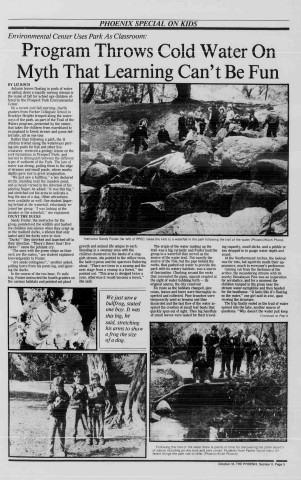
PHOENIX SPECIAL ON KIDSEnvironmental Center Uses Park As Classroom:Myth That Learning Can%u2019t Be FunBY LIZ KOCHAutumn leaves floating in pools of water or sailing down a rapidly moving stream is the vision of fall for school age children offered by the Prospect Park Environmental Center.On a recent cool fall morning, fourth graders from Packer Collegiate School in Brooklyn Heights trooped along the waterways of the park, as part of the Trail of the Waters program, presented by the center, that takes the children from marshland to swampland to forest stream and goose dotted lake, all on one tour.Rather than following a path, the 15 children trotted along the waterways perring into pools for fish and other live creatures; received a geology lesson on the rock formations in Prospect Park; and learned to distinguish between the different types of wetlands of the Park. The lure of water was strong, pulling them to the edge of streams and small ponds, where murky depths gave rise to great imagination.%u201cWe just saw a bullfrog,\shrilly, standing near the meadow' pond, and as heads turned in the direction of his pointing finger, he added, %u201cit was this big,%u201d and stretched out his arms to indicate a frog the size of a dog. Other attractions were available as well. One student lingering behind at the waterfall, reluctantly rejoined her group. %u201cI was looking at the sneaker in the waterfall,%u201d she explained. COUNT THE DUCKSSandy Foster, the instructor for the group, pointed out the wildlife and hushed the children into silence when they crept up on the mallard ducks, a silence that only lasted until the ducks were in view. %u201cDucks!%u201d they shrieked and launched off in their direction. %u201cThere%u2019s three! four! five ducks!\%u201cThe ones w'ith the green stripe on their neck are the males,%u201d one student explained knowledgeably to Foster.%u201cAre seeds contagious?,%u201d another asked, pulling burrs from his pants leg, and ignoring the ducks.In the course of the two hour, 1V2 mile trip, Foster instructed the fourth graders on the various habitats and pointed out plantFollow ing the trail of the water there is plenty of tim e for discovering the other aspectsof nature including prickly burs and pine cones. Students from Packer found many different things the park has to offer. (Phoenix/Koch Photos)Instructor Sandy Foster (far left) of PPEC, takes the kids to a waterfall in the park following the trail of the water. (Phoenix/Koch Photo)The origin of the water making up the trail was a big curiosity and Foster lead the group to a waterfall that served as the source of the water trail. Not exactly the source of the Nile, but the pipe behind the rocks, that gushed out water to provide the park with its watery habitats, was a source of fascination. Climbing around the rocks that concealed the pipes, squeals erupted at the sight of water bubbling forth %u2014 its original source, the city reservoir.En route as the habitats changed, pine cones, leaves and burrs were thoroughly inspected and collected. Pine branches were temporarily used as brooms and then discarded and the fast flow of the water inspired the creation of small leaf boats that quickly spun out of sight. Then big handfuls of small leaves were tested for their traveling capacity, small sticks, and a pebble or two dropped in to gauge water depth and sound.At the Neathermead Arches, the lookout was for rats, but squirrels made their appearance, much to everyone%u2019s preference.Coming out from the darkness of the arches, the meandering stream with its nearby Himalayan Pine was an inspiration for acrobatics, and for a moment the children romped in the grass near the stream water-nymphlike and then headed for the boathouse. %u201cIt looks like it%u2019s floating on the water,%u201d one girl said in awe, upon viewing the structure.The trip finally ended as the trail of water opened into the lake, another source of questions. %u201cWhy doesn%u2019t the water just keepC o n tin u e d on Pane 6growth and animal life unique to each. Standing in a swampy area with the children clustered on the banks of a sluggish stream, she pointed to the willow trees, the bald cypress and the sparrows fluttering about. %u201cThere are trees in a swamp and the next stage from a swamp is a forest,%u201d she pointed out. %u201cThis area is dredged twice a year, otherwise it would become a forest,%u201d she said.We ju st saw abullfrog, statedone boy. It wasthis big, hesaid, stretchinghis arms to showa frog the sizeo f a dog.October 16, THE PHOENIX, Section II, Page 5


