


Page 115 - Demo
P. 115
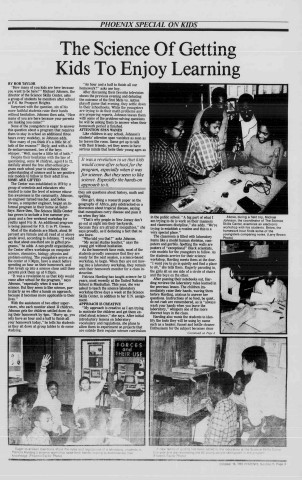
PHOENIX SPECIAL ON KIDSO f O p > t + i n r rKids To Enj oy LearningBY ROB TAYLOR\you want to be here?%u201d Michael Johnson, the director of the Science Skills Center, asks a group of students he monitors after school at P.S. 9in Prospect Heights.Surprised with the question, six of his more faithful students raise their hands without hesitation. Johnson then asks, %u201cHow many of you are here because your parents are making you come?%u201dNone of the youngsters is eager to answer this question about a program that requires them to stay in schooi an additional three hours every weekday, so Johnson adds, \both of the reasons?%u201d Shyly, and with a little embarrassment, two of the boys whisper, %u201cWell, maybe a little bit of both.%u201dDespite their hesitation with the line of questioning, some 60 children, aged 8 to 12, dutifully attend the free after-school program each school year to enhance their understanding of science and to see positive role models to follow in their adult lives. SOME ARE GIFTEDThe Center was established in 1979 by a group of scientists and educators who wanted to raise the level of science education awareness in the community. Johnson, an engineer turned teacher, and Sekou Owusu, a computer engineer, began an,informal program in their home on Saturdays. Since then, The Science Skills Center has grown to include a free summer program and a free weekend workshop for youths aged 9 to 16. An additional program is being planned for P.S. 11 in Ft. Greene.Most of the students are Black, about 50 percent are female and all read at or above grade level, according to Johnson. %u201cI would say that about one-third are in gifted programs,%u201d he adds. A non-profit organization, the Center offers workshops on computer science, chemistry, biology, physics and problem-solving. The youngsters arrive at the center at 3:30pm, have a snack before spending an hour on their homework, and then break up into a science class until their parents pick them up at 6:15pm.%u201cIt was a revelation to us that kids would come after school for the program,%u201d says Johnson, %u201cespecially when it was for science. But they seem to like science, particularly as we offer a hands on approach, because it becomes more applicable to their lives.%u201dWith the assistance of two other supervisors, who each monitor about 15 children, Johnson gets the children settled down doing their homework by 4pm. %u201cHurry up, you only have an hour and a half to finish all your homework today,%u201d he tells his students as they sit down at group tables to do some studying.%u201c An hour and a half to finish all our homework?%u201d asks one boy.After discussing their favorite television shows the previous evening and debating the outcome of the first Mets vs. Astros playoff game that evening, they settle down to their schoolbooks. While the youngsters are trying to do their math problems and are preparing reports, Johnson teases them with some of the problem-solving questions he will be asking them to answer when their homework period is finished.ATTENTION SPAN WANESLike children in any school, Johnson%u2019s students%u2019 attention span vanishes as soon as he leaves the room. Some get up to talk with their friends, yet they seem to have serious minds that belie their young ages asIt was a revelation to us that kidswould come after school fo r theprogram, especially when it wasfo r science. But they seem to likescience. Especially the hands-onapproach to it._________________they ask questions about history, math and spelling.One girl, doing a research paper on the geography of Africa, gets sidetracked on a discussion about tropical disease, saying that mosquitoes carry disease and pass it on when they bite.%u201cThat%u2019s why people in New Jersey don%u2019t go out at night into their backyards, because they are afraid of mosquitoes,%u201d she says proudly, as if deducing a fact that no one knew.%u201cWho told you that?%u201d asks Johnson.%u201cMy social studies teacher,%u201d says the young girl without hesitation.As the homework time ends, most of the students proudly announce that they are ready for the next session, a science-based workshop, to begin. When they are not moving into a laboratory workshop, they remain with their homework monitor for a class instruction.Patricia Harding has taught science for 12 years, most recently at the United Nations School in Manhattan. This year, she was asked to teach the science laboratory workshop three days a week at the Science Skills Center, in addition to her U.N. assignment.APPROACH IS CREATIVE%u201cMy approach is creative as I am trying to motivate the children and get them excited about science,%u201d she says. After initial introductory lessons on laboratory vocabulary and regulations, she plans to allow them to experiment on projects that are outside their regular science curriculumin the public school. %u201cA big part of what I am trying to do is work on their manners and classroom discipline,%u201d she adds. %u201cWe%u2019re trying to establish a routine and this is a very special place.%u201dThe classroom is filled with laboratory items like a model human skeleton, computers and gerbils. Spotting the walls are posters of %u201cexceptional%u201d Black scientists, role models for the youngsters to follow. As the students arrrive for their science workshop, Harding meets them at the door. %u201cI want you to go in quietly and find a place to sit,%u201d she tells them. Eagerly parading in, the girls sit on one side of a circle of chairs and the boys on the other.After passing their notebooks out, Harding reviews the laboratory rules learned in the previous lesson. The children immediately raise their hands, waving them before Harding, anxious to answer her questions. Instructions of no food, be quiet, do not rush are remembered, as is %u201calways wash your hands when you leave the laboratory,%u201d whispers one of the more discreet boys in the class.Harding also wants the students to identify the tools they will be using by name such as a beaker, funnel and bottle cleaner. Enthusiasm for the subject becomes clear C o n tin u e d on Page 4Above, during a field trip, Michael Johnson, the coordinator of The Science Skills Center, examines an electronic workshop with his students. Below, the homework hour finds some of the youngsters comparing notes. (Larry Brown Photo);wiMtEager to answer questions about the rules and regulations of a laboratory, students patricia Harding's science workshop raise their hands, hoping to demonstrate their knowledge. (Phoenix/Taylor Photo)A new family of gerbils has been added to this year and are fascinating the 60 young pe (Phoenix/Taylor Photo)Moamsmimv'mamfsfthennleaboratory at taking part ithe Science Skills i the programtemmmmzsmmmKmO cto b e r 16, THE P H O E N IX . S ection II. Page 3


