


Page 119 - Demo
P. 119
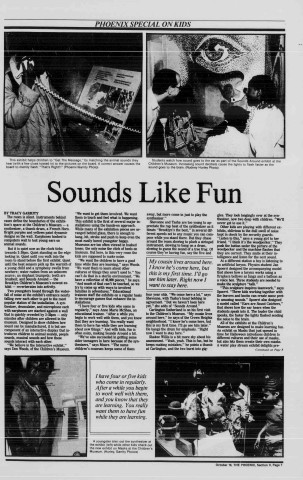
PHOENIX SPECIAL ON KIDSThis exhibit helps children to %u201c Get The Message,\hear (with a few clues tossed in) to the pictures on the board. A correct answer causes the board to merrily flash: %u201c That%u2019s Right!!%u201d (Phoenix/Garrity Photo)Students watch how sound goes to the ear as part of the Sounds Around exhibit at the Children%u2019s Museum. Increasing sound decibels cause the lights to flash faster as the sound goes to the brain. (Rodney Hurley Photo)S o u n d s L i k e F u nBY TRACY GARRITYThe room is silent. Instruments behind cases define the boundaries of the exhibition%u2019s space at the Children%u2019s Museum %u2014 a synthesizer, a thumb drum, a French Horn. Bright purples and yellows paint dynamic designs on the wall. Earphones hooked to computers wait to test young ears on animal sounds.But it is quiet now as the clock ticks towards 2:30pm. Quiet standing on the edge looking in. Quiet until you walk into the room to stand before the first exhibit. Quiet until the heat sensors pick up the warmth of a young child and a symphony swells from nowhere; water rushes from an unknown source; an elephant trumpets; teeth are brushed; and Sounds Around %u2014 the Brooklyn Children%u2019s Museum%u2019s newest exhibit %u2014 reverberates into activity.Two youngsters bound through the waterfall of noise at the exhibit%u2019s entrance nearly falling over each other to get to the most popular station of the installation. A synthesizer, drumulater, and microphone each with earphones are stacked against a wall that is quickly crowded by 2:35pm %u2014 only minutes after children are allowed in the museum. Designed to show children how sound can be manufactured, it is but one component of an interactive display that introduces children to animal sounds, people sounds, musical sounds and how these sounds interact with each other.%u201cWe believe in the interactive exhibit,%u201d says Don Woods, of the Children%u2019s Museum.%u201cWe want to get them involved. We want them to touch and feel what is happening. This exhibit is the first of several major installations using the hands-on approach. While many of the exhibition pieces are arranged behind glass, there is enough to bang, hit, stroke and push to keep even the most easily bored youngster happy. Museums are too often viewed in hushed tones; the only noise the click of heels on linoleum. But here, in this very room the kids are supposed to make noise.%u201cWe want the children to have a good time while they are learning,%u201d says Woods. %u201cWe want them to learn about other cultures or things they aren%u2019t used to.%u201d You can%u2019t do that in a sterile environment. %u201cWe have a collection of 40,000 pieces,%u201d he says. %u201cAnd much of that can%u2019t be touched, so we try to come up with ways to involved families in adventures.%u201d Educational trainees staff the exhibits on a regular basis to encourage games that enhance the installations.%u201cI have four or five kids who come in regularly,%u201d says Anne Marie McShea, an educational trainee. %u201cAfter a while you begin to work well with them, and you know that they are learning. You really want them to have fun while they are learning about new things.%u201d And with kids, fun is often noisy, making Sounds Around a hit.%u201cWe%u2019ve also succeeded in getting some older teenagers in here because of the synthesizers,%u201d says Moore. %u201cThe name children%u2019s museum keeps some of themaway, but more come in just to play the synthesizer.%u201dShevonne and Tasha are too young to appreciate the rap beat of the synthesizer as it bleats %u201cBrooklyn%u2019s the best,%u201d in several different speeds set to any music you can compose while you stand there. But they chase around the room slowing to pluck a stringed instrument, slowing to bang on a drum, slowing to guess the sound of a tree frog. Of course they%u2019re having fun, say the five andM y cousin lives around here.I know he's come here, butthis is my first time. I'll gosee him later. Right now Iwant to stay here.four year olds. %u201cWe come here a lot,%u201d says Shevonne, with Tasha%u2019s head bobbing in agreement. %u201cBut we haven%u2019t been here yet,%u201d she adds of %u201cSounds Around.%u201d Carlington Sutherland is on his first visit to the Children%u2019s Museum. %u201cMy cousin lives around here,%u201d he says of the Crown Heights neighborhood. %u201cI know he%u2019s come here, but this is my first time. I%u2019ll go see him later.%u201d He bangs the drum for emphasis. %u201cRight now I want to stay here.%u201dShakee Willis is a bit more shy about his assessment. %u201cYeah, yeah. This is fun, but he keeps making mistakes,%u201d he points a thumb at Carlington, and the two burst into giggles. They look longingly over at the synthesizer, now two deep with children. %u201cWe%u2019ll never get to use it.%u201dOther kids are playing with different exhibits, oblivious to the dull swell of noise kept in check by the security guards, %u201clisten to this,%u201d says a young girl to her friend. %u201cI think it%u2019s the woodpecker.%u201d They push the button under the picture of the woodpecker and the machine flashes that they are correct. They smile at their intelligence and listen for the next sound.At a different station a boy is listening to an artificial larynx. Physics student Jan Spoerri designed the accompanying model that shows how a larynx works using a fireplace bellows as lungs and a balloon as a voice box. Three students are needed to make the sculpture %u201ctalk.%u201d%u201cThis sculpture inspires teamwork,%u201d says Spoerri. %u201cThree kids working together with the leavers and knobs can create some pretty amazing sounds.%u201d Spoerri also designed a model called %u201cEars are Sound Catchers,%u201d that shows how the ear hears when the students speak into it. The louder the child speaks, the faster the lights flashed sending the noise to the brain.All of the exhibits at the Children%u2019s Museum are designed to make learning fun. An exhibit on Masks that just opened in time for Halloween introduces children to different cultures and their use of masks, but also lets them create their own masks.A water play stream exhibit delights preC o ru m u e d on Page 8A youngster trie > out the synthesizer at the exhibit (left) while other kids check out the new exhibit on Masks at the Children%u2019: Museum. (Hurley, Garrity Photos)/ have fou r or five kidswho come in regularly.A fter a while you beginto work well with them,and you know that theyare learning. You reallywant them to have funwhile they are learning.O cto b er 16, T H E P H O E N IX , Section II, Page 7


