


Page 175 - Demo
P. 175
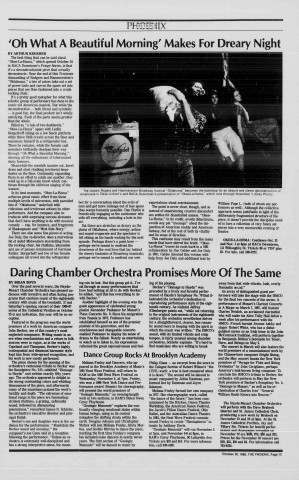
PHSFC TION2 IX'Oh What A Beautiful Morning' Makes For Dreary NightBY ARTHUR KROEBERThe best thing that can be said about%u201cOkee-La-Homa,%u201d which opened October 24in BACA Downtown%u2019s Fringe Series, is thatit%u2019s a deconstructionist piece that actuallydeconstructs. Near the end of this 75-minutedismantling of Rodgers and Hammerstein%u2019s%u201cOklahoma,%u201d a trio of actors take out a setof power tools and carves the spare set intopieces that are then fashioned into a cruderocking chair.It%u2019s a pretty good metaphor for what thiseclectic group of performers has done to theiconic old American musical. But while thedeconstruction %u2014 both literal and symbolic%u2014 is good fun, the final product isn%u2019t whollysatisfying. Each of the parts seems greaterthan the whole.Billed as %u201ca tale of two dustbowls,%u201d%u201cOkee-La-Homa%u201d opens with LedlieBorgerhoff sitting on a low black platformwhile Steve Shill crawls across the floor andensconces himself in a refrigerator box.There he remains, while the female castmembers brilliantly deadpan their waythrough %u201cOh What a Beautiful Morning,%u201dshowing all the enthusiasm of lobotomizeddairy farmers.Meanwhile the menfolk saunter out, kneeldown and start chalking territorial boundaries on the floor. Continually expandingthem in an effort to outdo one another, theywind up in a full-scale brawl which continues through the oblivious singing of thewomen.In its best moments, %u201cOkee-La-Homa%u201dachieves great comic effect from thesemultiple levels of subversion, with parodiedbits of %u201cOklahoma%u201d underlaid withridiculous and irrelevant actions by otherperformers. And the company also introduces with surprising success elementsthat don%u2019t have anything to do with musicalcomedy %u2014 rap, for instance, and fragmentsof Shakespeare and %u201cWest Side Story.%u201dThere are also some fine pieces of acting.Joe Daly, the co-director, does a marvelousbit of stolid Midwestern storytelling fromthe rocking chair, his rhythms, intonationand use of pauses reminiscent of GarrisonKeillor. Borgerhoff and two of her femalecolleagues all crowd into the refrigeratorThe classic R ogers and H am m e rstein B roadway m usical %u201cO k lah o m a%u201d becom es the backdrop for an absurd and clever d econ struction ofA m ericana in Telsa Linkum %u2019s and B A C A D o w n to w n %u2019s presentation of \ch runs through N ovem ber 1. (G rey Photo)box for a conversation about the evils ofmen and get more mileage out of less spacethan seem s humanly possible. Dan Hurlin isfrenetically engaging as the auctioneer whosells off everything, including a hole in theset.But there are stretches as dreary as theplains of Oklahoma, where energy, actionand sound evaporate and the spectator isleft sitting on his hands waiting for the nextepisode. Perhaps there%u2019s a point here %u2014perhaps we%u2019re meant to confront thedreariness of the real lives that lay behindthe cheery fantasies of Broadway musicals;perhaps we%u2019re meant to confront our ownexpectations about entertainment.The point is never clear, though, and soinstead of experiencing creative discomfortone settles for dissatisfied unease. %u201cOkeeLa-Homa,%u201d to its credit, avoids didacticism,avoids any pat %u201cmessage%u201d about the disjunction of American reality and Americanfantasy, but at the cost of both its vitalityand its sense of direction.This confusion may result from the manyhands that have stirred the broth. %u201cOkeeLa-Homa%u201d traces its roots back to a 1981collaboration by Jim Calder and Joe Dalyin 1981; Calder directed this version withhelp from Joe Daly and additional text byWilliam Pope L. (both of whom are performers as well). Although the collectiveapproach seems justifiable in light of thedeliberately fragmented structure of thepiece, it doesn%u2019t provide the discipline needed to turn a collection of very funny setpieces into a very memorable evening oftheater.OKEE-LA-HOMA: Continues Oct. 31and Nov. 1 at 8pm at BACA Downtown,111 Willoughby St. Tickets $8 or TDF plus$3. For info, call 596-2222.Daring Chamber Orchestra Promises More Of The SameBY BRIAN BOYDOver the past several years, the HaydnMozart Chamber Orchestra has pleased audiences with inventive and often daring programs that combine music of the eighteenthcentury with music of the twentieth. If lastSaturday%u2019s opening concert of their 1986-87series at the Cathedral Pavilion on October25 is any indication, this year will be no exception.Featured in the program was the worldpremiere of a work by American composerJohn Becker, one of this country%u2019s mostneglected composers. Writing music in anera when neoclassicism and a return to folksources were in vogue, as in the works ofCopeland and Thompson, Becker%u2019s highlycontrapuntal and dissonant harmonic stylekept him from wide-spread recognition, andhis work is now rarely performed.The piece chosen for the opening of theorchestra%u2019s centennial tribute to Becker washis Soundpiece No. 2-B, subtitled %u201cHomageto Haydn%u201d and written exactly fifty yearsago. The orchestra appeared to delight inthe strong contrasting colors and whirlingdissonances of the piece, and afterwardsmany of the musicians praised the work%u2019slucidity and depth. %u201cThe extremes of emotional range in the piece are fascinating:strident rhythms, a grating, unfriendlysound, followed by shimmeringpianissimos,%u201d remarked James R. Schlefer,the orchestra%u2019s executive director and principal flutist.Becker%u2019s son and daughter were in the audience for the performance. %u201cAbsolutely theBecker sound and meaning.%u201d thecomposer%u2019s son Gene said at a receptionfollowing the performance. %u201cUnless an orchestra is extremely well-disciplined andhas a strong interpretive sense, the meaning can be lost. But this group got it. I%u2019vesat through so many performances thathave had nothing at all to do with Becker,%u201dhe added, %u201cand this has everything to dowith Becker.%u201dAnother highlight of the evening was theguest appearance of celebrated youngpianist Alexander Peskanov for Mozart%u2019sPiano Concerto No. 9. Since his emigrationfrom Russia in 1973, Peskanov hasestablished himself as one of the premierpianists of his generation, and themischievous and changeable concertoenabled Peskanov to display his sense ofdrama to the fullest. Nearly as entertainingto watch as to listen to, his expressionsreflected the great expressiveness and feelMolissa Fenley and Dancers, who appeared in the Brooklyn Academy of Music%u2019s1983 Next Wave Festival, will return toBAM in the 1986 Next Wave Festival onWednesday, November 5, at 7pm. Fenley,who won a 1986 New York Dance and Performance award (Bessie) for choreography,will present the world premiere of%u201cGeologic Moments,%u201d an evening-lengthwork in two sections, in BAM%u2019s Helen OwenCarey Playhouse.%u201cGeologic Moments%u201d explores the continually changing emotional states withinhuman beings, using as its centralmetaphor the shifting strata within theearth. Douglas Johnson and ChristopherMattox will join Molissa Fenley, Silvia Martins. and Scottie Mirviss to dance the piece,marking the first time Fenley%u2019s companyhas included male dancers in nearly sevenyears. The first section of %u201cGeologicMoments%u201d will be danced to music bying of his playing.Becker%u2019s %u201cHomage to Haydn%u201d waspreceded by a lively and forceful performance of Haydn%u2019s Symphony No. 70 that illustrated the orchestra%u2019s dedication toreproducing performance style of the eighteenth century. As violinist JeffreyEllenberger points out, %u201cwhile not returningto the original instruments of the eighteenthcentury, the orchestra nevertheless strivesfor a straightforward, clearer, less romantic sound more in keeping with the spirit inwhich the music was written.%u201d The HMCO%u2019ssound, with its limited vibrato and crisptempos, is fairly unusual among chamberorchestras, Schlefer explains. %u201cIt%u2019s hard tofind musicians who are willing to breakPhilip Glass %u2014 an excerpt from the score tothe Cologne Section of Robert Wilson%u2019s %u201ctheCIVIL warS: a tree is best measured whenit is down.%u201d The second will be danced tomusic composed by Julius Eastman, performed live by Eastman and JoyceSolomon.Molissa Fenley formed her own companyin 1977. Her choreographic work, called%u201cthe dance of the future,%u201d has been commissioned by the Kitchen, Dance TheaterWorkshop, the American Dance Festival,the Jacob%u2019s Pillow Dance Festival, OhioBallet, and the Australian Dance Theatre.In 1983, the Next Wave Festival commissioned Fenley to create %u201cHemispheres%u201d tomusic by Anthony Davis.%u201cGeologic Moments%u201d will run November 5at 7pm, and November 6-8 at 8pm, inBAM%u2019s Carey Playhouse, 30 Lafayette Ave.Tickets are $18 and $14. For more information, call 636-4100.away from that wide vibrato, lush, overlyRomantic sound.%u201dAn array of distinguished guest performers will take the stage with the HMCOfor the final two concerts of the series. Aperformance of Mozart%u2019s Clarinet Concertoin A Major on March 7,1987, will featureCharles Neidich, an acclaimed clarinetistwho will make his Alice Tully Hall debut aweek after his performance with theHMCO. French homist Jerome Ashby andsinger Robert White, who has a distinguished career as an Irish tenor in the JohnMcCormack tradition, will perform togetherin Benjamin Britten%u2019s Serenade for Tenor,Horn, and Strings on May 2.The concert in March will also feature theworld premiere of a commissioned work bythe Chinese-born composer Bright Sheng,and the May concert boasts the New Yorkpremiere of %u201cVoyage for Flute and StringOrchestra%u201d by John Corigliano, perhapsAmerica%u2019s best-known living composer. Toconclude the HMCO%u2019s tribute to Becker, theorchestra will perform in May the NewYork premiere of Becker%u2019s Symphony No. 5,%u201cHomage to Mozart,%u201d as well as his orchestration of Charles Ives%u2019 %u201cGeneralWilliam Booth Enters into Heaven.%u201dThe Haydn-Mozart Chamber Orchestrawill perform with the Dave BrubeckQuartet and St. James Cathedral Choir,premiering a new work by Brubeck onNovember 22 and 23 at 8pm. At the St.James Cathedral Pavilion, Jay andTillary Sts. Tickets for benefit perform a n r p n n H r H a m n n c m p r o n a n H n n n nNovember 22 are $100, $75, $50 and $25.Prices for the November 23 concert are$20, $15, $10 and $5. For information call783-4235.Dance Group Rocks At Brooklyn AcademyO c to b er 30, 1986, T H E P H O E N IX , Page 15


