


Page 299 - Demo
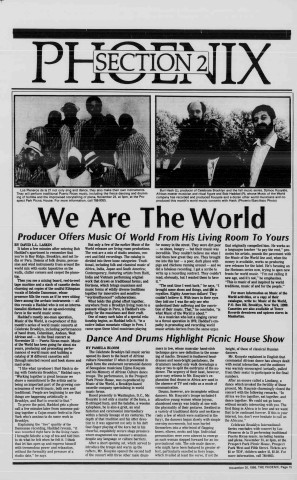
P. 299
Los Pleneros de la 21 not only sing and dance, they also make their own instruments.They will perform traditional Puerto Rican music, including the fierce dancing and drumming of bomba and the improvised storytelling of plena, November 23, at 3pm, at the Prospect Park Picnic House. For more information, call 788-0055.Burl Hash (L), producer of Celebrate Brooklyn and the fall music series, Djimou Kouyate,African master musician and ritual figure and Bob Haddad (R), whose Music of the Worldcompany has recorded and produced Kouyate and a dozen other world m usicians and coproduced this m onth%u2019s world music concerts with Hash. (Phoenix/Garciliazo Photo)W e Are The WorldProducer Offers Music O f World From His Living Room To YoursBY DAVID L.L. LASKINIt takes a few minutes after entering Bob Haddad%u2019s apartment to remember that you%u2019re in Bay Ridge, Brooklyn, and not India or Peru. Dozens of folk drums, percussion and wind instruments from around the world mix with exotic tapestries on the walls, clutter comers and carpet the pianotop.Then you see a mixing board, reel-to-reel tape machine and a stack of cassette decks churning out copies of the soulful Ethiopian vocals of Seleshe Damessae, whose presence fills the room as if he were sitting there among the archaic instruments %u2014 all this reveals a Haddad who is not an internationalist dilettante but an up-and-coming force in the world music scene.Haddad%u2019s mostly one-man operation, Music of the World, is co-producer of this month%u2019s series of world music concerts at Celebrate Brooklyn, including performances of hand drum, Columbian, Andean, West African and %u2014 in the final concert on November 23 %u2014 Puerto Rican music. Music of the World has been going for about six years, producing and promoting performances of world music and building a catalog of 16 different cassettes sold through selected record and book stores and mail order.%u201cI like what (producer) Burl Hash is doing with Celebrate Brooklyn,%u201d Haddad says. %u201cWorking together is great because we share a commitment to the artists and to being an important part of the growing consciousness of world music, both new and traditional. People are beginning to see that things are happening artistically in Brooklyn, and Burl is crucial to that.%u201dTo prove the point, Haddad gets a phone call a few minutes later from someone putting together a Cajun music festival in New York who%u2019s anxious to do some work in Brooklyn.Explaining the %u201clive%u201d quality of the Damessae recording, Haddad reveals, %u201cit w a s r e c o r d e d right here in the livine room.I brought Seleshe a cup of tea and told him to do what he felt when he felt it. I think that let him open up and express himself with tremendous power and relaxation, without the formality and pressure of a studio date,%u201d he says.But only a few of the earlier Music of the World releases are living room productions. The rest are a mix of studio sessions, concert and field recordings. The catalog is divided into three loose categories: Traditional, including folk and classical music of Africa, India, Japan and South America; Contemporary, featuring artists from Haiti, India and Vietnam performing original work that draws on traditional forms; and Horizons, which brings musicians and music forms of wildly diverse traditions together for innovative and sensitive %u201cworld-influenced%u201d collaborations.What holds this global effort together, anywhere from a Brooklyn living room to a peasant village in Peru, is Haddad%u2019s empathy for the musicians and their craft.One of many such tales of a special relationship begins, as Haddad tells it, %u201cin a native Indian mountain village in Peru. I came upon these blind musicians playingfor money in the street. They were dirt poor %u2014 no shoes, hungry %u2014 but their music was incredible. They couldn%u2019t believe me when I told them how great they are. They brought me into this bar %u2014 a poor, dark place with pigs and chickens running around %u2014 and we did a fabulous recording. I got a scribe to write up a recording contract. They couldn%u2019t read, obviously, but I wanted them to have it.%u201d%u201cThe next time I went back,%u201d he says, %u201cI brought some shoes and things, and (80 in royalties. Eighty American dollars! They couldn%u2019t believe it. With tears in their eyes they told me I was the only one who understood their suffering and the conviction of their music. That,%u201d he concludes, %u201cis what Music of the World is about.%u201dAs a musician who lost a singing career to a throat operation in 1979, Haddad%u2019s empathy in promoting and recording world music artists derives from the same urgesthat originally compelled him. He works as a languages teacher %u201cto pay the rent,%u201d promotes his artists, pounds the pavement with the Music of the World line and, when the money is available, works on producing new releases for the label. He%u2019s focusing on the Horizons series now, trying to open new fronts for world music. %u201cI%u2019m not calling it new age, and it%u2019s not,\%u201cThis is music of and inspired by world traditions, music of and for the people.%u201dFor more information on Music of theWorld activities, or a copy of theircatalogue, write to: Music of the World,P.O. Box 258, Brooklyn, New York, 11209.Cassettes are also available at TowerRecords downtown and uptown stores inManhattan.Dance And Drums Highlight Picnic House ShowBY PAMELA BLOOMThe Celebrate Brooklyn fall music series opened its doors to the heart of African culture November 17 when it presented in peak form the exuberant ceremonial dances of Senegalese musicians Djimo Kouyate and his Memory of African Culture dance troupe. The performance, in the Prospect Park Picnic House, was co-produced by Music of the World, a Brooklyn-based cassette company specializing in world music forms.Based presently in Washington, D.C., Mr. Kouyate is not only a master of the kora, a 21-stringed harp, and the balafon, a wooden xylophone, he is also a griot, an oral historian and ceremonial intermediary within a family lineage of six centuries. The depth of that tradition and his utter devotion to it was apparent not only in his deft four-finger playing of the kora but in his cheerful, exquisitely secure stage presence wnicn magnetized tne listener s attention despite any language or culture barriers.After a short opening set, which served to introduce the troupe and warm up the rafters, Mr. Kouyate opened the second half of the concert with three other male drummers in tow, whose muscular hand-stick technique gave new definition to the meaning of macho. Dressed in feathered headdresses and neon-bright pantaloons, the drummers needed only walk downstage a step or two to split the eardrums of the audience. The urgency of their beat, however, gave easy witness to Mr. Kouyate%u2019s explanation that drums in Africa are used in the absence of TV and radio as a mode of communication.Drums, however, are incomplete without dancers. Mr. Kouyate%u2019s troupe included 6 attractive young women whose joyous, abandoned energy was totally at one with the physicality of their gestures. Swathed in a variety of traditional skirts and necklaces (only a few of which were scattered in the fury), the dancers began slowly with simple one-step movements, but soon hurled themselves into a whirlwind of flapping knees, elbows, necks and hips. Individual personalities were even allowed to emerge as each woman stepped forward for an improvisational solo. The sole male dancer, who might have been featured to greater effect, particularly excelled in fiery leaps, which rivalled at least the verve, if not theheight, of those of classical Russian dancers.Mr. Kouyate explained in English that ceremonial African dance has always dealt with social interaction, and the audience was warmly encouraged (actually, pulled from their seats) to participate in the final numbers.After an encore called a Lindiang, a dance which invoked the fertility of those present, Mr. Kouyate charmingly closed the concert with the following remarks, %u201cIn Africa we live together, eat together, and dance together. We could not go home without socially interacting with you. The first thing in Africa is to love and we want that to be continued forever. If this is your interest, too, don%u2019t ever hesitate to call on the Africans.%u201dCelebrate Brooklyn International:Series concludes with concert by Los Pleneros de la 21 performing traditional Puerto Rican music, including bamba and plena. November 23, at 3pm, at the Prospect Park Picnic House, Prospect Park West and Fifth Street. Tickets are (5 or TDF, children under 12, (2.50. For more information, call 788-0055.November 20, 1986, THE PHOENIX, Page 15


