


Page 157 - Demo
P. 157
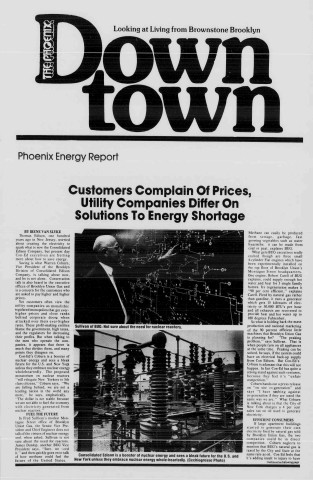
Phoenix Energy ReportCustomers Complain Of Prices,Utility Companies Differ OnSolutions To Energy ShortageBY IRENE VAN SLYKEThomas Edison, one hundred years ago in New Jersey, worried about creating the electricity to spark what is now the Consolidated Edison Company, but present day Con-Ed executives are fretting more about how to save energy.Saving is what Warren Coburn, Vice President of the Brooklyn Division of Consolidated Edison Company, is talking about now, and he is not alone. Conservation talk is also heard in the executive offices of Brooklyn Union Gas and is a concern for the customers who are asked to pay higher and higher prices.Yet customers often view the utility companies as monolithic regulated monopolies that get everhigher prices and close ranks behind corporate door$ when attacked over their ever-higher rates. These profit-making entities blame the government, high taxes, and the regulators for decreasing their profits. But when talking to the men who operate the companies, it appears that there is much that divides them, and many points they disagree on.Corr-Ed%u2019s Coburn is a booster of nuclear energy and sees a bleak future for the U.S. and New Yoijk unless they embrace nuclear energy wholeheartedly. The proposed moratorium on nuclear reactors %u201cwill relegate New Yorkers to 5th class citizens,%u2019%u2019 Coburn says, %u201c We are falling behind, we are not a leading nation in the world any more,%u201d he says, emphatically. %u201cThe dollar is not stable because we arc not able to fuel the economy with electricity generated from nuclear reactors.%u201dFUEL THE FUTUREIn Fred Sullivan's modest Montague Street office of Brooklyn Union Gas, the Senior Vice President and Chief Engineer does not talk of the virtues of nuclear energy and. when asked. Sullivan is not sure about the need for reactors. James Dunlop, another BUG Vice President says, %u201c Sure, we :eed it,%u201d and then quickly goes on to talk of how methane could fuel the future of the United States.Sullivan of BUG: Not sure about the need for nuclear reactors.Consolidated Edison is a booster of nuclear energy and sees a bleak future fo r the U.S. and New York unless they embrace nuclear energy w hole-heartedly. (Gcchiogrosso Photo)Methane can easily be produced from sewage, garbage, fast growing vegetables such as water hyacinths: it can be made from coal or peat, explains BUG.What gets BUG executives really excited though are three small 4-cylinder Fiat engines which have been experimentally installed on the top floor of Brooklyn Union%u2019s Montague Street headquarters. One engine, Robert Catell of BUG explains, could supply enough hot water.and heat for 3 single family homes. Its cogeneration makes it %u201c 90 per cent efficient,%u201d explains Catell. Fired by natural gas rather than gasoline, it runs a generator which gets 15 kilowatts of electricity or 50,000 BTU%u2019s per hour and all exhausts are recovered to provide heat and hot water up to 180 degrees Fahrenheit.So what is holding back the mass production and national marketing of the 90 percent efficient little machines that Brooklyn Union Gas is planning for? %u201cThe peaking problem,%u201d says Sullivan. That is when people turn on all appliances at the same time. Peaking can be solved, he says, if the system could have an electrical back-up supply from Con Edison. But Con-Ed%u2019s Cobum is adamant that this will not happen. In fact Con-Ed has quite a strong stand against such ventures, because they feel it%u2019s \competition.%u201dCoburn hands out a press release on %u201con site co-generation%u201d and says \co-generation if they are taxed the same wav we are.%u201d What Coburn is talking about is that the City of New York charges a 4 per cent sales tax on oil used to generate electricity.EFFICIENT CONSUMERSIf large apartment buildings started to generate their own electricity fired by natural gas sold by Brooklyn Union Gas, the two companies could be in direct competition. Coburn neglects to mention that BUG%u2019s natural gas is taxed by the City and State at the same rate as oil. Con Ed feels that it%u2019s adding insult to injury to have Continued on following page


