


Page 159 - Demo
P. 159
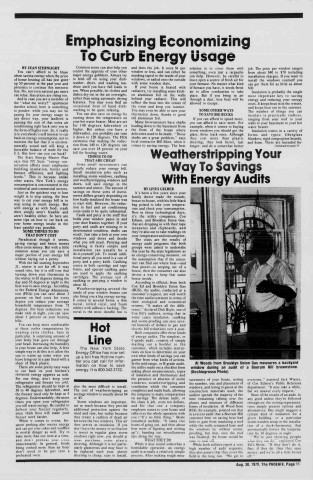
Emphasizing EconomizingTo Curb Energy UsageBY JEAN STERNLIGHTYou can%u2019t afford to be blase about saving energy when the price of home heating oil. has just gone1 up 50 percent in the past year and promises to continue this meteoric rise. No, not even natural gas users can relax. Gas prices are rising too.And in case you are a member of the %u201c what me worry?%u201d apartment dweller school, here is something to ponder: while you may not be paying for your energy usage in any direct way, your landlord is passing the cost of that extra air conditioning right back onto you in the form of higher rent. So, it really is in everybody%u2019s self interest to cut back on energy consumption, not to mention the fact that it is environmentally sound and will keep a favorable balance of trade for the U.S. But how can you cut back?The State Energy Master Plan says that NY State %u201c energy con-1 servation efforts must emphasize building insulation, boiler and furnace efficiency, and lighting levels.%u201d This is because unlike other states, New York%u2019s energy consumption is concentrated in the residential and commercial sectors.Just as the quickest way to lose weight is to stop eating, the best way to cut your energy bill is to stop using so much energy. But with energy as with food, crash diets simply aren%u2019t feasible and aren%u2019t healthy either. So here are some tips on how to cut back on your home energy intake in the least painful way possible.SOME THINGS TO DOTHAT DON%u2019T COSTParadoxical though it seems, jsaving energy and hence money often costs money. But with a little common sense you can save a major portion of your energy bill without laying out a penny.With the fall starting September 21, winter is not far off. It may sound trite, but it is still true that turning down your thermostat in the winter to 65 degrees during the day and 55 degrees at night is the best wav to save energy. According to the Federal Energy Administration (FEA) you can save about 3 percent on fuel costs for every degree you reduce your average household temperature from 72 degrees. For heat reductions you make only at night, you can save about 1 percent on your heating bills.You can keep more comfortable at these cooler temperatures by wearing extra clothes, hats in particular. A surprising amount of your body heat goes out through your head. Increasing the humidity in your house can also help. A free simple way to do this is to allow the sun to warm up some water you leave lying out in a pan lined with a sheet of black plastic.There are some pretty easy ways to cut back on your kitchen%u2019s ravenous energy appetite as well. For one thing, don%u2019t keep your refrigerator and freezer too cold. The refrigerator should be kept at 38 to 40 degrees fahrenheit, and the freezer need only be kept at 5 degrees. Understandably, the more times you open your refrigerator you will waste energy. Be careful to defrost your freezer regularly, since thick frost will make your freezer work harder.When it comes to ovens, frequent peeking also wastes energy and can put your cakes and souffles in mortal danger as well. Try to bake more than one item at a time, and don t preheat y o u i u v u unnecessarily. In general, foods being cooked more than an hour don%u2019t need to be put into a preheated oven.Common sense can also help you control the appetite of your other major energy gobblers. Always try to hold off on using your dishwasher, dryer, and washing machine until you have full loads to run. When possible, let clothes and dishes dry out in the air overnight, rather than using automatic drying features. You may even find an occasional bout of hand dishwashing to be quite relaxing.You can also save on energy by turning down the temperature on your hot water heater. Most are set for 140 degrees fahrenheit or higher. But unless you have a dishwasher, you probably can turn it down to 120 degrees. The FEA estimates that making the reduction from 140 to 120 degrees can save you over 18 percent on your bill for heating water.THINGS TO DOTHAT ARE CHEAPSome small investments can greatly reduce your energy bill. Small insulation jobs such as installing storm windows, caulking and weatherstripping windows and doors, will save energy in the summer and winter. The amount of savings on these sorts of investments differs greatly depending on how badly insulated the house was to start with. However, the reduction in fuel and air conditioning costs tends to be quite substantial.Caulk and putty is the stuff that holds your window panes in and your door frames together. If your putty and caulk are missing or in deteriorated condition, drafts can result. Just take a look at your own windows and doors and decide what you will need. Puttying and caulking is fairly simple and installation can usually be a do-it-yourself job. To install additional putty all you need is a can of putty and a putty knife. Caulking comes in both cartridge and tape forms, and special caulking guns are used to apply the caulking cartridges. The average cost of caulking or puttying a window is about $1.W eatherstripping around the inside of your window frames can also bring you a big energy saving. It comes in several forms: a thin metal, rolled vinyl, and foam rubber with adhesive backing. The metal is the most durable but isHotLineThe New York State Energy Office has now set up a toll free Hotline number you can call for information on how to save energy. It is 800-342-3722.also the most difficult to install. The cost of weatherstripping an average window is usually about $4 or $5.Storm windows are important, not so much because they provide additional protection against the wind and rain, but rather because they create a cushion of dead air between the two windows. This air then serves as insulation. If you don%u2019t have the money or inclination to invest in regular glass storm windows right now, you should at ie a si purchase some p ia siic sheeting. Although it is not particularly glamorous and may have to be replaced each year, plastic sheeting is cheap, easy to install,and does the job. It costs $1 per window or less, and can either be masking taped to the inside of your windows, or nailed onto the outside with some wooden slats.If your house is heated with radiators, try installing some kitchen aluminum foil on the walls behind your radiator. This will reflect the heat into the center of the room and keep you warmer. You may even be able to turn your thermostat down, thanks to good old aluminum foil.Many brownstoners have shafts leading down to the basement from the front of the house where deliveries used to be made. %u201cThose shafts are a great problem,%u201d says local contractor Bill Sikes, when it comes to saving energy. The bestBY LINUS GELBERIt%u2019s been a few years since your family doctor made the rounds, house-to-house, with his little black bag poised to take your temperature and check your comsumption. Now in these technological days, it%u2019s the utility companies, Con Edison, and Brooklyn Union Gas, that are dropping in with their tape measures and clipboards, and they%u2019re also out to take readings on your temperature and consumption.The visits are the results of energy audit programs that both groups were asked to undertake this year by the state legislature as an energy-conserving measure, on the assumption that if the consumer can find out where heat%u2014and thus power%u2014is seeping out of a house, then the consumer can also devise a way to keep that same house inside.According to official.; from both Con Ed and Brooklyn Union Gas (BUG), the audits, conducted at a customer%u2019s request, are well worth ihe time and investment in terms of their ecological and economical returns. %u201cIt makes all the difference,%u201d declared Dick Boyle, one of Con Ed%u2019s auditors, noting that in some cases insulation, caulking and storm-proofing can save several hunreds of dollars in gas and electric bill reductions over a year.Both companies offer three kinds of energy audits. The simplest, or C-grade audit, consists of simply mailing out a booklet to the customer, which includes instructions on how to determine on your own what kinds of savings you can garner from what kinds of actions. In the mid-range, or B-grade audit, the utility mails out a checklist form asking about measurements, types of insulation and thermostats and the presence or absence of storm windows, weatherstripping and ventilation which the consumer completes and mails back, allowing the company to make computations on savings. The deluxe audit, or the class A job, costs ten dollars, and for that one a company employee comes to your house and talks over the whole operation with you (%u201c It%u2019s no little thing,%u201d Boyle remarked ruefully. %u201c It takes two hours of going out, and then about four more of figuring and writing up%u201d (, handing out miscellaneous tips along the way. ntit * nriir^v tr\\A *%u00bb iin ti i iiL< i i/vWhile it may sound somewhat a formidable operation, an energy audit is actually a relatively simple process. After making rough measolution is to cover them with something, even just a tarpaulin can help. However, be careful to leave open a source of fresh air for your furnace. No matter what kind of furnace you have, it needs fresh air to allow combustion to take place. But if you bring in air through a duct, less heat will be allowed to escape.SOME OTHER WAYSTO SAVE BIG BUCKSIf you can afford to spend more, you can afford to save more. For example, when it comes to buying storm windows you should get the glass, three track ones. Although they cost more than plastic sheeting, they look better, last longer, and do a somewhat better(Occhiogrosso Photo)surements of your house, noting the number, size and placement of windows, and trying to guess at the construction materials used, the auditor spends the majority of the time remaining talking over the pluses and minuses of different forms of insulation. A1 Wood from BUG, for example, pointed out that in a recent audit that a Bocrum Hill customer bent on saving heat had little to gain from insulating a roof while the walls remained bare and the windows lie without stormproofing, but that, once the roof was finished, the house would be easy io seal off.While both utilities report a very high number of audit requests, they also assure that they cover the field in the long run. %u201c We get tojob. The price per window ranges from about $40 to $70 including installation charges. If you want to install the windows yourself you can get them for as little as about $30.Insulation is probably the single most important key to saving energy and reducing your energy costs. It keeps heat in in the winter, and keeps heat out in the summer. The number of things you can insulate is practically endless, ranging from your roof to your walls to your basement to your hot water heater.Insulation comes in a variety of forms and types: fiberglassblankets, rigid composition boards, and foam. These are intended forContinued on page 14everyone,%u201d asserted Jack Winter, of Con Edison%u2019s Public Relations department. %u201c It may take a while, but we answer every request.'None of the results of an audit do any good unless they%u2019re followed through on: the visiting representatives simply present options and alternatives. One might suggest a certain kind of insulation for a given building, or a particular storm-window setup or the installation of a clock-thermostat, that automatically lowers the temperature by 10 degrees at night.%u201c We%u2019re just showing people*- * * -- - %u2014 d C%u2019W 11 U l lilt J V. Ill 1 VJV./ , VAjJIWllIVU vw%u00bb%u00bbEd%u2019s Boyle. %u201c If they don%u2019t do it, fine; if they do, then they save money, and we%u2019re all a little better off.%u201d 'Weatherstripping YourWay To SavingsEnergy AuditsAl Woods from Brooklyn Union Gas measures a backyard w indow during an audit of a Boerum Hill brownstone.Aug. 30.1979, The PHOENIX, Page 11


