


Page 163 - Demo
P. 163
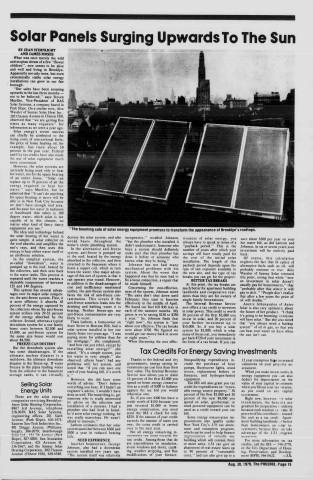
Solar Panels Surging Upwards To The SunBY JEAN STERNLIGHTAND JAMES MOSESWhat was once merely the wild and utopian dream of a few %u201c flower children%u201d , now seems to be alive and well and living in Brooklyn. Apparently not only trees, but even exonomically viable solar energy installations can grow in our fair borough.%u201cOur sales have been zooming upwards in the last three months %u2014 not to be believed,%u201d says Steven Mueller, Vice-President of DAS Solar Systems, a company based in Park Slope. On a similar note, Alex Wassler of Sunray Solar Heat Inc.. 202 Classon Avenue in Clinton Hill, observed that %u201c we are getting five times as many requests%u201d for information as we were a year ago.Solar energy%u2019s recent success can chiefly be attributed to the rising costs of conventional fuels; the price of home heating oil, for example, has risen about 50 percent in the past year. Federal and City tax credits have also made the use of solar equipment much more economical.However, the solar systems are currently being used only to heat hot water, not for the space heating of an entire house. %u201c Solar can replace up to 70 percent of all the energy required to heat hot w ater,%u201d says Mueller, but he admitted that %u201c It can%u2019t do anything for space heating, it never will be able to in New York City because we don%u2019t have enough roof area, and because hot water in radiators or baseboard thin tubes is 180 degree water, which solar is not capable of in this climate, no matter what kind of fancy dancy equipment you use.%u201dThe idea and technology behind tiie solar heating of hot water is quite simple. A solar collector on the roof absorbs and amplifies the sun%u2019s rays, and then uses this energy to heat either water itself or an antifreeze solution.In the simplest system, the so-called %u201c downdrain%u201d , water is pumped up to the roof, heated by the collectors, and then sent back to the water tanks. This process is repeated until the water reaches a desirable temperature of between 125 and 140 degrees.This system has several advantages over its major solar competitor, the anti-freeze system. First, it is more efficient; it absorbs 45 percent of the energy captured by the collectors where the anti-freeze system utilizes only 29-32 percent of the energy absorbed by the collector. Second, whereas a typical downdrain system for a one family home costs between $2,500 and $3,000, an anti-freeze system for the same size house would cost about $4,500.FREEZE CAN DESTROYBut the downdrain system also has some disadvantages. If the ultimate nuclear disaster is a meltdown, the ultimate downdrain disaster is the freeze-up. If water freezes in the pipes leading water from the collector to the basement storage tanks, it can virtuallySelling SolarEnergy UnitsThese are the solar energy companies servicing Brooklyn: Astro Solar Heating Corporation, 8807 3rd Avenue, telephone 238-3039; DAS Solar Systems, engineering offices, 201 Sixth Avenue, (Park Slope), 636-1471; Eastern Sun-Tech Industries Inc., 481 Driggs Avenue (Williamsburgh), 384-2070; Interborough Sclzv Ltd., IS1 A v/pnup /P a r k Slope), 357-4300; Sun Insulation Corporation, 421 Avenue O, 336-3567; and the Sunray Solar Heating Corporation, 202 Classon Avenue (Clinton Hill), 638-6540.destroy the solar system, and also wreak havoc throughout the home%u2019s entire plumbing system.In the alternative anti-freeze system, anti-freeze is pumped up to the roof, heated by the energy absorbed in the collector, and then returned to the basement where it heats a copper coil, which in turn heats the water. One major advantage of this sort of system is that it can operate year round. However, in addition to the disadvantages of cost and inefficiency mentioned earlier, the anti-freeze system also faces the risk of anti-freeze contamination. This occurs if the anti-freeze somehow leaks into the drinking and bathing water it is heating. Neither freeze-ups nor anti-freeze contamination are very likely to occur.Thais Lathem, a homeowner on State Street in Boerum Hill, had a solar system installed in her one family home two years ago. %u201c I was paying more for utilities than for my mortgage,%u201d she complained, %u201c and how can you rebel, except by installing solar energy?%u201d she asked. %u201c It%u2019s a simple system, just hot water is very simple,%u201d she observed, athem hasn%u2019t had any problems with her system, and noted that %u201c if you can save one sixth of your heating bill, it%u2019s worth it.%u201dHowever, she did have some words of advice: %u201c Don%u2019t believe everything you hear. If I hadn%u2019t an engineer%u2019s advice, I wouldn%u2019t have done as well. The main thing is, get someone who is really interested (to advise on the selection and installation of a system). I had a plumber who had lived in Israel, he%u2019d seen solar energy working, he was really marvelous. He wasn%u2019t afraid to innovate.%u201dl athem estimates that her solar system saves her between $300 and $500 a year in reduced heatinguma.NEED EXPERIENCEAnother homeowner, George Johnson, also had a downdrain system installed two years ago. %u201cThe system itself was relativelyinexpensive,%u201d recalled Johnson, %u201cbut the plumber who installed it didn%u2019t understand it. Someone who buys a system should definitely make sure that their plumber has done it before or someone who knows what they%u2019re doing.%u201d Johnson has not had many mechanical problems with his system. About the worst that happened was that he once had to fix a loose connection, a repair that he made himself.Concerning the cost-effectiveness of the system, Johnson noted %u201cThe units don%u2019t shut down until February; they start to function effectively in the middle of April. We found our fuel bill $30 less in each of the summer months. My guess is we're saving $150 to $250 a year.%u201d So, Johnson finds that %u201c right now%u201d , his system is \about cost effective. The tax breaks were about $700. We figured we would get our money back in seven or eight years.%u201dWhen discussing the cost effectiveness of solar energy, you always have to speak in terms of a %u201c payback period.%u201d This is the number of years after which your savings will have totally paid for the cost of the initial solar installation. The length of this payback period depends upon the type of sun exposure available to the new site, and the type of tax breaks you can get for the project. BETTER TAX BREAKSAt this point, the tax breaks are much better for apartment building landlords and cooperative residents than they are for owners of single family brownstones.The Internal Revenue Service now offers a tax credit to investors in solar power. This credit is worth 30 percent of the first $2,000 you invest in solar, and 20 percent of your further investment up to $10,000. So, if you buy a solar system for $2,800, which is what many of them cost, you immedately get back $720 of your investment in the form of a tax break. If you cansave about $300 per year on your hot water bill, as did Lathem and Johnson, in six or seven years your investment will be entirely paid back.Of course, this calculation neglects the fact that th eprice of alternative fuels such as oil, will probably continue to rise. Alex Wassler of Sunray Solar stressed this point, noting that while %u201c now an investment in solar doesn%u2019t usually pay for homeowners,%u201d that %u201cprobably after this winter it will pay to do it.%u201d %u201c People don%u2019t realize that after a few years the price of oil will double.%u201dAnette Athenasatos of Astro Solar is also very optimistic about the future of her product. %u201c I think it%u2019s going to be booming; everyone will have solar.%u201d But she also notei that %u201cyou always need a backup system%u201d of oil or gas, so that you can heat your water on days when the sun isn%u2019t out.Tax Credits For Energy Saving InvestmentsThanks to the federal and city governments, energy saving investments can cost less than their face value. The Internal Revenue Service now allows you to claim 15 percent of the first $2,000 you spend on home energy conservation as a credit of $300 to balance against the tax bill you would otherwise owe.So, if you owe $400 but have a credit worth of $150 because you just invested $1,000 in home energy conservation, you need send the IRS a check for only $250. If the amount of your credit exceeds the amount of taxes you owe, the extra credit is carried over to the next year.Not all energy conserving invMtmpnlc r>an ominf tau/arHc thptax credit. Among those that do are expenditures on insulation, storm windows and doors, caulking, weather stripping, and flue modifications of your furnace.Nonqualifying expenditures include the purchase of heat pumps, fluorescent lights, wood stoves, replacement boilers or furnaces, and hydrogen-fueled equipment.The IRS will also grant you tax credit for expenditures on %u201crenew able energy source property.%u201d 30 percent of the first $2,000 and 20 percent of the next $8,000 you spend on solar, geothermal, or wind powered equipment can be used as a credit toward your tax bill.Some energy conservation improvements also qualify under New York City%u2019s J-51 tax abatement and exemption program, which can be used to help financewirfnallv anvbuilding which will contain three or more units. J-51 can give an abatement of real estate taxes up to 90 percent of %u201creasonable costs,%u201d and can also give up to a12 year exemption frqfn increased valuations on your property assessment.Wheri^ou make invest ments in energy equipment you <.an also deduct for depreciation on the value of your capital investment when you fill out your tax returns, as you could on any capital investment.Right now, however, tor solar investments, the benefits are greatest for cooperative r sidents because each resident ca take 30 percent of his contributio toward the unit as a tax credi Apartment building landlords t o better than homeowners on solar investments, because they an take advantage of the J-51 programinr>pnflt/pcFor more information on tax credits, call the IRS %u2014 596-3770, or the City Department of Housing, Preservation, and Development (HPD), 566-0622. --J.S.Aug. 30,1979, The PHOENIX, Page 15


