


Page 249 - Demo
P. 249
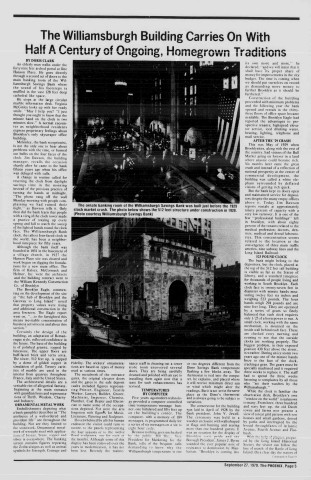
The Williamsburgh Building Carries On WithHalf A Century of Ongoing, Homegrown TraditionsBY DORIS CLARKAn elderly man walks under the forty nine feet arched portal at One Hanson Place. He goes directly through a second set of doors to the main banking room of the Williamsburgh Savings Bank where the sound of his footsteps is muffled in the vast 128 feet deep cathedral like space.He stops at the large circular marble information desk. Virginia McGinley looks up with her ready smile. %u201c May 1 help you? %u201c I just thought you ought to know that the minute hand on the clock is two minutes slow.%u201d A normal encounter as neighborhood residents express proprietary feelings about Brooklyn%u2019s only skyscraper office building.McGinley, the bank receptionist, is not the only one to hear about problems with the time, or burned out bulbs on the four faces of the clock. Jim Dawson, the building manager, recalls the occasion shortly after he came to the bank fifteen years ago when his office was deluged with calls.A change in routine called for resetting the clock from daylight savings lime in the morning instead of the previous practice of turning the hands at midnight. %u201c The phone rang off the wall Monday morning with people complaining we had ruined their night,%u201d as Dawson tells it. Only then did the bank learn that people with a vic\\vof the clock tower made a practice of staying up every spring and fall to watch the sweep of the lighted hands round the clock face. The Williamsburgh Bank clock, the tallest four-faced clock in the world, has been a neighborhood timepiece for fifty years.Although the bank itself was founded in 1851 in the basement of a village church, in 1927 the Hanson Place site was cleared and work begun on digging the foundations for a new main office. The firm of Halsey, McCormack and Helmcr, Inc. were the architects and the building contract went to the William Kennedy Construction Co. of BrooklynThe Brooklyn Eagle, commenting on the development of the site at %u201c the hub of Brooklyn and the Gateway to Long Island\that property values were rising and additional construction in the area foreseen. The Eagle report went on, %u201c ...to the farsighted this means inevitable concentration of business activities in and about this section.%u201dCertainly the design of the building, an adaptation of Romanesque style, reflected confidence in the future. The base of the building is of polished granite, topped by limestone. The upper floors are buff-faced brick and terra cotta. The tower, 512 feet up, is capped by a dome of gilded copper in simulation of gold. Twenty varieties of marble are used in the interior from quarries throughout France, Italy and the United States.The architectural details are a veritable riot of allegorical fantasy, beginning at the main entrance with guardian lions and representations of Thrift, Wisdom, Charity and Industry.ORNAMENTAL METAL WORKEmbellishments depicting what a bank pamphlet describes as %u201c The attributes of a well-ordered and provident life%u201d are throughout the building. Nor are they limited to the stonework. Ornamental metalwork of wrought steel with applicatiOHS of bronze, ponnrr anHsilver is everywhere. The banking screen contains figures repeating the Zodiacalsigns as well as animal symbols for Strength, Courage andThe ornate banking room of the Williamsburgii Savings Bank was built just before the 1929 stock market crash. The photo below shows the 512 feet structure under construction in 1928. (Photo courtesy Williamsburgh Savings Bank)Fidelity. The wickets' ornamentations are based on types of money used at various times.The metalwork of the entrance gates, the original elevator doors and the gates to the safe deposit vaults included figures representing Printer, Engineer, Textile Worker, Lawyer, Builder, Grocer, Machinist, Importer, Chemist, Plumber, Coal Dealer and Electrician to name some of the occupations depicted. Nor were the arts forgotten with figures for Music, Literature, Painting and Sculpture.If overwhelmed by all this human endeavor the visitor could turn to nature, to the panels representing ihc four seasons or to the twelvef l o r a l Q p u l n t n r p c a n p f o r n a r h o f ithe months. Although some of this display has been removed over the years in modernization, it has not been lost. Recently the maintenance staff in cleaning out a tower store room uncovered several doors. They are being carefully cleaned and polished with an eye to installing them again now that a taste for such enhancements has revived.TEMPERATURESBY COMPUTERFive years ago modern technology provided a computer controlled lime/termpcraturc/mcssagc banner, one htrtidered and fifty feet up on the building%u2019s corner. The computer, with a memory of 189 messages, is programmed daily for a series of six messages on a six to eight hour cycle.Because nothing goes uncheckedIt y %u2019 th r * m i h i i r R i l l V i, %u00ab nPresident for Marketing for the Bank, tells of the frequent calls demanding to know why the Williamsburgh temperature is oneor two degrees different from the Dime Savings Bank temperature flashing a few blocks away. The thermostat is tied into the computer, he explains, and placed where it will receive minimum direct sun or wind which might alter the readings. Butitisnot set in the same place as the Dime%u2019s thermostat and is always going to be subject to variations.The cornerstone for the building was laid in April of 1928 by the bank president, John V. Jewell. The ceremony was held in a wooden enclosure with walls draped in flags and bunting and seating more than one hundred guests. It was an occasion for the display ofRrt>ok 1 vn r;i v i(' nriHr> anH t hnBorough President, James J. Byrne sounded the ever popular note of resistance to domination by Manhattan. %u201c Brooklyn is coming intoits own more and more,%u201d he declared, %u201c and we will insist that it shall have its proper share of money for improvements in the city budget. The time is coming when we should put ourselves on record as demanding more money to further Brooklyn as it should be furthered.\Construction of the building proceeded with minimum problems and the following year the bank opened and rentals in the thirtythree floors of office space became available. The Brooklyn Eagle had reported the advantages to prospective tenants; highspeed elevator service, iced drinking water, heating, lighting, telephone and mail service.AFTER THE 29 CRASHThis was May of 1929 when Brooklynites, along with the rest of the country, had visions of the Bull Market going on forever in a land where anyone could become rich. Six months later came the great crash and instead of a reflection of national prosperity at the center of commercial development, the building was called a white elephant surrounded by deflated visions of getting rich quick.But the bank kept its doors open and maintained service for depositors despite the many empty offices above it. Today Jim Dawson reports rentals at approximately ninety percent of capacity with a very low turnover. It is one of the few \in brooklyn, with about eighty percent of the tenants related to the medical profession; doctors, dentists, medical and dental laboratories. This concentration seems related to the location at the convergence of three main traffic arteries, nine subway lines and the Long Island Railroad.523 POUND CLOCKThe bank might belong to the depositors, but the clock, placed at the top of the 512 feet tall building is visible as far as the Statue of Liberty, and a standard timepiece for thousands of people living and working in South Brooklyn. Each clock face is twenty-seven feet in diameter with minute hands measuring twelve feet six inches and weighing 523 pounds. The hour hands weigh 294 pounds and are nine feet long. Tlhey are operated by a series of gears so finely balanced that each clock requires only 1/25 of a horsepower to run. A small clock, working with the same mechanism, is mounted on the inside wall behind each face. These arc checked every morning and evening to see that the outside clocks are working properly. The biggest problem, in their exposed position 430 feet above the street, is weather. During an ice storm two years ago one of the minute hands froze to the face of the clock, cracking a gear. The gears must be specially machined and it required three weeks to replace it. The staff had to spend the three weeks listening to complaints by all those who %u201c set their watches by the Williamsburgh.%u201dWhile the clock is familiar the observation deck, Brooklyn%u2019s own %u201c window on the world%u201d is unknown to many. From here, three hundred and sixty feet up, the old Dutch towns and farms now present a view of a neat grid pattern with row houses and small gardens, dotted by parks and interrupted by the broad throughfares of Atlantic Avenue, Fourth Avenue and Flatbush.w ;.n................ %u201c %u00bbed by the Long Island Historical Society the visitor can follow the line of march of the Battle of Long Island. On a clear day the waters ofContinued on Page 19September 27. 1979. The PHOENIX, Page 5


