


Page 31 - Demo
P. 31
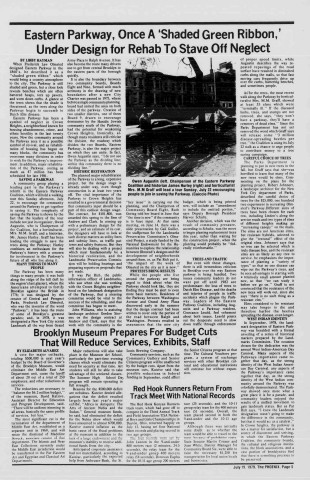
Eastern Parkway, Once A %u2018Shaded Green Ribbon,%u2019Under Design for Rehab To Stave Off NeglectOwen Augustin (left, Chairperson of the Eastern Parkway Coalition and historian Janies Hurley (right) and horticulturist Mrs. M.M Graff will lead a tour Sunday, July 22 encouraging people to join in saving the Parkway. (Cuiccio Photo)BY LIBBY HAYMANWhen Frederick Law Olmsted designed Eastern Parkway in the 1860%u2019s, he described it as a %u201c shaded green ribbon%u2019%u2019 which would bring a country atmosphere to the city. The Parkway is still shaded and green, but a close look reveals benches which are often battered heaps, torn up pavers, and worn down curbs. A glance at the trees shows that the shade is threatened, as the trees along the Parkway begin to succumb to Dutch Elm disease.Eastern Parkway has been a symbol of neglect in Crown Heights, a neighborhood known for housing abandonment, crime, and ethnic hostility in the last twenty years. Now the community around the Parkway sees it as a possible symbol of revival, and as rehabilitation of housing has begun on many blocks, the community has overcome many divisions in order to work for the Parkway%u2019s improvement. In addition, major rehabilitation of the Parkway, costing as much as $7 million has been scheduled for late 1981.SAVING A PARKWAYA community group playing a leading part in the Parkway%u2019s rebirth is the Eastern Parkway Coalition, which will hold a walking tour this Sunday afternoon, July 22, to encourage the community around the Parkway to get together in saving it. The complexity of saving the Parkway is shown by the fact that the leaders of the tour include not just its organizer, Owen Augustin, who is Chairperson of the Coalition, but a horticulturist, Mrs. M.M. Graff, and a historian Mr. James Hurley. Graft has been leading the struggle to save the trees along the Parkway; Hurley combines an enthusiasm for the Parkway%u2019s history with a concern for involvement in the Parkway%u2019s future of all who live along it.MANY THINGS TO MANYPEOPLEThe Parkway has been many things to many people: it was built along the ridge of the hill (left by the region%u2019s last glacier), where the Americans attempted to fortify Brooklyn against the British in 1776; it was designed by the creator of Central and Prospect Parks, Frederick Law Olmsted, who was the inventor of the word %u201c Parkway%u201d ; it has been the route of some of Brooklyn%u2019s greatest parades; and, in 1978, it was designated a New York City scenic Landmark all the way from GrandArmy Plaza to Ralph Avenue. It has also become the route many drivers use to get from central Brooklyn to the eastern parts of the borough quickly.It is also the boundary between two community boards, Boards Eight and Nine, formed with much acrimony in the drawing of new boundaries after a new City Charter was passed in 1975, where beforeasingle community planning board had united the area on both sides of the parkway. Creation of two smaller districts, one of them Board 9, drawn to encourage dominance by the Hasidic Jewish community south of the Parkway, had the potential for weakening Crown Heights. Ironically, although many residents still criticize the division, the roadway which divides the two Boards, Eastern Parkway, is also the major project on which they can unite. In fact, Owen Augustin says, %u201c Ido not see the Parkway as the dividing line; within this community there is no dividing line.%u201dHISTORIC RESTORATIONThe planned major rehabilitation of the Parkway is a long, expensive project, but the design stage is already under way, even though construction is at least two years off. The vital importance of the Parkway to Crown Heights has resulted in a governmental decision that community input should be a part of this earliest design stage. The contract, for $101,800, was awarded this spring to the firm of Andrew and Clark. In coming up with a preliminary design for the project, and an estimate of its cost, the designers will have to look at such diverse matters as utility lines and subway lines, as traffic patterns and safety features. But they will also be dealing with a project which must fundamentally be a historical restoration, and the Landmarks Preservation Commission will be holding hearings and preparing reports on proposals that are made.It was Pat Rich, the public information officer of Landmarks, who saw when she was working with the Crown Heights neighborhood on the landmark designation of the Parkway, that a steering committee would be vital to the success of the rebuilding, and that committee has begun to meet.John Williams, who is assisting landscape architect Gordon Stevens on the design contract at Andrew and Clark, says that the work with the community is the%u201c key issue%u201d in carrying out the planning, and the Chairperson of Community Board Eight, Ruth Goring told her board in June that %u201cthe time is now%u201d if the community is to have input. At that same meeting, on June 14, there was a slide presentation by Gail Guillet, the staffperson for the Landmarks Preservation Commission%u2019s Olmssted Project, a study funded by the National Endowment for the Humanities to explore the relationship between Olmsted%u2019s designs and the development of neighborhoods around them, or, as Pat Rich put it, %u2019the impact of the work of Olmsted on the city as it is now.%u201d PROTESTS BRING RESULTSWhile the people who live around the parkway are being urged to think about what the Parkway should look like, they are finding they must be alert to even more basic matters. Residents of the Parkway between Washington Avenue and Grand Army Plaza discovered early in the summer that the design contract had been written to cover only the portion of the road between Ralph and Washington. Protests resulted in assurances that the new citybudget, which is being printed now, will include an %u201c amendment to include the omitted portion,%u201d says Deputy Borough President Harvey Schultz.Another decision, which was the result of community pressure, according to Schultz, was the move to begin planting replacement trees this year, rather than waiting for the construction project, when the planting would probably be %u201c federally reimbursable.%u201dTREES AND TRAFFICBut even with these changes, there is still tremendous criticism in Brooklyn over the way Eastern parkway is being handled. Two issues community leaders do not want put off until 1982 are predominant: the loss of trees to Dutch Elm Disease, and the deaths and injuries of people in traffic accidents which plague the Parkway. Leaders of the Eastern Parkway Coalition, including Augustin and a Parkway resident, Constance Lesold, feel vehement about both issues. Lesold points out the desperate need to slow down traffic through enforcementBrooklyn Museum Prepares For Budget CutsThat Will Reduce Services, Exhibits, StaffBY ELIZABETH ALVAREZA vote for major cutbacks, totaling $500,000 in next year%u2019s budget by the Board of Governor%u2019s of the Brooklyn Museum, would eliminate the Middle East Art Department unit, cause the layoff of about 20 out of a total of 250 employees, and other reductions in services.The reductions are necessary to %u201cbalance the $6.2 million budget,%u201d of the museum, David Katzive, Assistant Director for Education and Program Development, said. %u201cThere will be uniform trimming in all areas, basically the same profile of services, but less.%u201dThe most significant cut is thetermination of the department ofMiddle East Art, established as aseparate unit in 1969, and willmean the dismissal of Madeline %u2022 - .l N O V e t %u2019 K , ( t b ^ G U a t V . V . U 1 0 1 U 1 u i U i u idepartment. The Islamic and Near East Collections currently under the Middle East jurisdiction would be transferred to the Far Eastern Art and Egyptian and Classical Art Departments.Major reductions will also take place in the Museum Art School, particularly the part-time evening classes which would eliminate the need for security at that time. Art students will still be able to take advantage of the weekend classes. The Summer High School Daj program will remain operating in full strength.Reasons for the $500,000 deficit are nebulous. Katzive denied allegations that the deficit resulted largely from last year%u2019s major exhibit, %u201cAfrica in Antiquity: The Arts of Ancient Nubia and the Sudan.%u201d General museum funds, he said, had eliminated the deficit for the Nubia show which would have amounted to almost $700,000. Katzive named inflation as the basic cause of the fiscal problems at the museum in addition to the%u00ab %u00ab o i * ----- * ---- 1 il.i d k h v zi a l a i ^ c G i m u w m ^ i u a u < u m v .museum's inability to receive additional funds from the city.Anticipated corporate assistance had not materialized, according to Katzive, particularly the expected help from Anheuser-Bush, the St.Louis Brewing Company.Community services, such as the Community Gallery and Senior Citizens program will be unaffected by the budget cuts. Apart from the museum cuts, Katzive said that possible reductions in federal funding in September, could affectThe Red Hook Kenyan Runners track team, which had gone off to compete in the Third Annual Track and Field Association/USA National Boys and Girls Championships in Dayton, Ohio, returned happily on July 12, having set four National Meet records and placing second in two age groups.rf,U %u2014 ont V%u00bbif 1 IIV 1UU1 IVWi v ovv WjJohn Lawton in the 9-and-under 800 meters race (2 minutes, 24.5 seconds), the relay team for the 9-and-under group 400 meters relay (54 seconds), Donovan Eupha for the 10111 age group 200 metersthe Senior Citizens program at that time. The Cultural Vouchers program, a system of exchange services with other Brooklyn cultural and educational institutions will continue but without expansion.race (25 seconds), and the 10-11 group relay team for the 400 meters race (51 seconds). Overall, the team placed second in both the 9-and-under and the 10-11 age groups.Although there was initially some doubt as to whether the team would be able to travel to the!T!CCt rif n r n h i h it i vf%u00bbState Senator Martin Conner and Joan White, District Manager for Community Board Six, were able to raise the necessary $1,250 for transportation for local union locals and businesses.Red Hook Runners Return FromTrack Meet With National Recordsof proper speed limits, while Augustin describes the way repeated repavings of the road surface have resulted in diminshed curbs along the malls, so that fast moving cars frequently drive up over the curbs, battering benches, and sometimes people.As for the trees, the most recent walk along the Parkway by horticulturalist Mrs. M.M. Graff, showed at least 35 elms which were %u201cterminally ill.%u201d If the diseased limbs, trees, and stumps are not removed, she says, %u201cthey won%u2019t have a parkway, they%u2019ll have a cemetery of dead elms.%u201d Since the Parks Department has not yet removed the wood which Graff says will release some %u201c 3 million disease-spreading beetles per tree,%u201d the Coalition is using its July 22 walk as a chance to urge people to contribute money to a tree saving campaign.CAREFUL CHOICE OF TREESThe Parks Department is planning to put in new trees in the fall, but Graff says that she-was horrified to learn that many of the new trees would be elms. Commenting on the plans for the planting project, Robert Johnnert, a landscape architect for the New York City department of Parks, described the careful choice of trees for the $25,000, one hundred tree experiment in recreating Olmsted%u2019s Parkway.Different sizes of trees have been chosen for each row, including Linden%u2019s along the service roads and two types of elms of different heights making an \The elms are not American elms, but resistant hybrids, selected to give the %u201ctextural%u201d effect of the original elms. Johnnert says that no tree can be selected which is truly disease free, and the resistant elms are as likely as any tree to survive, he emphasizes the importance of planting a %u201c variety of types%u201d so that no one disease can wipe out the Parkway%u2019s trees, and he sees advantages to starting with a relatively small amount planted now, so that %u201cwe can study it before we go on.%u201d Graff is not convinced that the resistance of the new trees will work out, since she says %u201cthere is no such thing as a resistant elm.%u201dElms consideed to be resistant may take longer to die and therefore harbor the beetles spreading the disease, even longer.WEST INDIAN IDENTITYIn September, 1978, the landmark designation of Eastern Parkway was heralded with a formal unveiling of a series of historical markers prepared by the Landmarks Commission. The occasion chosen for the dedication was the annual West Indian-American Day Carnival. Many aspects of the Parkways importance came together that day, as the strong identity of the West Indian American Day Carnival, any aspects of the Parkway%u2019s importance came together that day, as the strong identity of the West Indian community around the Parkway was colorfully demonstrated. The Parkway showed once more what a great place it is for a parade, and community leaders enjoyed the results of a unified movement to gain landmark status. But as Pat Rich says, %u201c I knew the Landmark designation wasn%u2019t going to make the difference in the community, but that it would act as a catalyst.%u201d In Crown heights, the parkway is not a matter for satisfaction, but a source of discontent and striving, in which the Eastern Parkway Coalition, the community boards, the cultural and religious institutions, the block associations, and a vast portion of brooklynites feel that there is something precious to be preserved.July 19, 1979, The PHOENIX. Page 5


