


Page 35 - Demo
P. 35
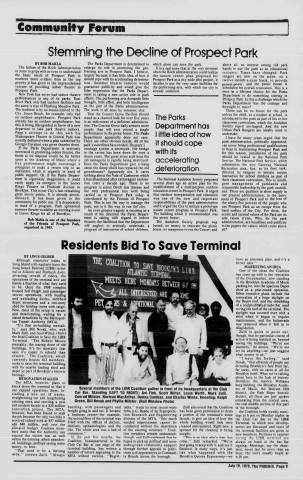
Community ForumStem m inn th^ Pnrk %u25a0 'WH %u25a0 %u25a0 %u25a0%.BY BOB MAKLAThe failure of the Koch Administration to come to grips with or even to understand the basic needs of Prospect Park is nowhere more evident than in the top priority it has given to the unprecedented venture of providing indoor theatre in Prospect Park.New York has never had indoor theatre performances in any of its parks. East River Park only had outdoor facilities and the same is true of Flushing Meadow Park. The tradition is by no means limited to the City. Jones Beach, for example, only had an outdoor amphitheatre. Prospect Park already has an outdoor amphitheatre, but this is being disregarded in favor of a new departure to take park theatre indoors. Papp%u2019s attempt to do this with his Shakespeare Theatre in Central Park was roundly defeated when a plan submitted by Georgio Cavalieri was given thumbs down.If the Parks Department is seriously interested in promoting indoor theatre, the funds at its disposal would be far better spent at the Academy of Music where a free performance might encourage a youngster to make a return trip to an institution which is urgently in need of public support. Or, if the Parks Department is vigorously imaginative, it could easily apply its energies to the Loews Kings Theatre on Flatbush Avenue in Brooklyn. This is our City%u2019s last remaining great movie palace. It is already airconditioned. It has been given to the community for public use. It is desperately in need of a program. Park sponsored summer theatre would be an exciting event at Loews Kings for all of Brooklyn.Bob Makla is one of the foundersof the Friends of Prospect Park,organized In 1965.The Parks Department is determined to enlarge its role in promoting the performing arts in Prospect Park, I believe, largely because it has little idea of how it should cope with its accelerating deterioration. Summer theatre indoors would guarantee publicity and would give the false impression that the Parks Department is taking a new active role in park affairs. The performing arts demands little thought, little effort, and little intelligence on the part of the Parks administration. The work is all done by someone else.That the Concert Grove Pavilion should stand as a charred hulk for over five years is an indictment of a deficient administration. The Concert Grove daily attracts more people than will ever attend a single performance in the picnic house. The Pagks Department apparently does not care. There are other obvious needs. All of the park%u2019s waterlines have eroded. The park%u2019s drainage system is destroyed, The bridge in the ravine has been down for over a dozen years. The great stone arch near the old menagerie is rapidly being destroyed. Does the Parks Department give a hang about the dump which has replaced the old greenhouses? Apparently not. It cares nothing about the Vale of Cashmere which it has abandoned after extravagant restoration costs a decade ago. There is no program to arrest Dutch elm disease and the only professional tree work being carried on in Prospect Park today is contributed by the Friends of Prospect Park. This is not the way to manage the park, nor is it the way to run the* city.An even greater tragedy is occuring as a result of the direction the Parks Department is taking with regard to indoor theatre; the likelihood that the Department will neglect to seriously undertake a program of instruction of school children,which alone can save the park.It is a sad irony that at the very moment when the Koch administration could realize the nature center plan proposed for Prospect Park as a city-wide pilot project, it decides to use the very same facilities for the performing arts, with which our city is already surfeited.The ParksDepartment hasI ittle idea of howit should copewith itsacceleratingdeterioration.The National Audubon Society proposed several years ago an action plan for the establishment of a multipurpose outdoor education center in Prospect Park. It urged that outdoor interpretation and education was one of the new and important responsibilities of the park administration and it urged the City to initiate a prototype nature center program in Prospect Park. The building which it recommended was the picnic house.The Audubon Society proposal was buried: no money to renovate the picnic house, no manpower to run the Center; andabove all, no interest among old park hands to use the park as an educational resource. Times have changed. Park rangers are now on the scene, on a twelve-month-a-year basis, to provide person-power, and the picnic house is scheduled for overall renovation. This is a once in a lifetime chance for the Parks Department to do something stirring in Prospect Park. Is this a challenge which the Parks Department has the courage and foresight to meet?There can be no future for the park unless the child, as a student at school, is introduced to the park as part of his or her classroom curriculum, which the Audubon Society report envisaged. And the new Urban Park Rangers are ideally sited to undertake.I have for many years urged that the park adminstration, politically appointed, can never bring professional qualifications to bear in maintaining Prospect Park and for this reason, jurisdiction of the park should be vested in the National Park Service. The National Park Service, which administers the new Gateway National Recreation area, has, as its first task, directed its rangers to initiate nature instruction for school children as part of their classroom curriculum. This is intelligent management of parklands and responsible leadership by the park custodians. These are qualities in short supply in our present administration, to the detriment of Prospect Park and to the loss of the ninety-five percent of the people who use Prospect Park as an escape from the hard surface of the City. For them, the scenic and natural values of the Park are its sole raison d%u2019etre. Why, for the park administration, are headlines and publicity in the papers the values which count above all?Residents Bid To Save TerminalBY LINUS GELBERAlthough commuter trains to Long Island still regularly leave the Long Island Railroad (LIRR) terminal at Atlantic and Flatbush Aves. attracting crowds of riders, the operations of the terminal now are barely a fraction of what they used to be. Once the 1908 complex housed full freight and passenger service operations, with loading and unloading docks, mobbed depot structures and a two-story shed for holding trains with cargo. Now, most of the setup is vacant and deteriorating, waiting for a slated demolition by the Metropolitan Transit Authority (MTA).%u201cIt%u2019s that no-building mentality,%u201d says Bill Novak, who, with Mark Zulli and ScottWitter, chairs the local Coalition to Save the LIRR Terminal. %u201c The Robert Moses mentality, the tearing down of old buildings. It%u2019s the mentality that says it%u2019s easier to rebuild than restore.%u201d The Coalition, which currently boasts 163 members, seeks to save the terminal building with its nearby loading shed and depot as part of Brooklyn%u2019s historic heritage.RENOVATION STALLEDThe MTA, however, plans to knock down the terminal so that it can expand operations there, installing a new set of tracks, straightening out and lengthening existing ones and erecting a new and modern facade in a $20 million renovation project. The MTA, however, has been forced to stall the job because the only two bids it received valued work at $37 million adn $40 million, well over the allocated budget. Coalition members insist that the Authority can expand the station just as well within the existing, albeit abandoned, buildings, perhaps saving some money, to boot.%u201cThat used to be a thriving area,%u2019%u2019 asserts,! Zulli. %u201c Always| j f|S| H%u2022%u00bb j| *fBnf IB3 wFiBlM rSeveral members of the LIRR Coalition gather in front of its headquarters at the Club Car Bar. Standing (LEFT TO RIGHT(: Avi Fink, Scott Witter, Louis Warth, Mark Zulli, Conrad Milster, Norman MacArthur, Donna Cambas, and Charles Winns. Kneeling: Ralph Green, Bill Novak and Phyllis Milster. (Hall Winslow Photo)bustling, with passengers and freight going in and out. It became a business center%u2014for example, the second floor of the terminal was filled with the offices of doctors, dentists, opthamologists and the like. The whole area was a hub of commerce.%u201dI n t f i P n o c t f p u / m n n t h c t h pr %u2022 %u2019 ------Coalition, headquartered in the Club Car Bar at one edge of the terminal building, has written a number of letters appealing to the MTA without success. %u201c Regrettably,%u201d reads its most recent reply frdm A.G. Raabe of the Transportation Research and Engineering division of the MTA, %u201cthis much needed improvement cannot be conducted without the demolition of the existing structure.%u201d Coalition members remain undaunted,t f m n o h o n H r7i*11 v p v n la in p H f h a f h phopes to pick up political and more widespread community support through further appeals to politicians a,id appearances at Community Boards across the borough.Zulli also noted that the Coalition has been given permission to clean a portion of the terminal%u2019s stone facade, to give an idea of how the whole building would look once cleaned and repaired. Right now , a sponsor for the cleaning is being sought.%u201c T his is an iHpa w hn%u2019s tim f hascome,%u201d Zulli remarked. %u201c We%u2019re just going to keep with it, and see it finished. In many ways, it%u2019s just like what happened with the Brooklyn Queens Expressway%u2014wehave an alternate plan, and it%u2019s a better idea.%u201dMARKETING AN IDEAOne of the ideas the Coalition has come up with is the relocation of the Greenmarket, now standing in the Brooklyn Academy of Music parking lot, into the spacious Depot shed as a year-round operation. Other tentative plans include the restoration of a huge skylight on the Depot roof, and the rebuilding of a sculptedb%u2019alustradethat used to ring the roof of the terminal. The skylight was covered over with a shed when it began to require maintenance, and the balustrade was removed when it fell in to dilapidation.Zulli is quick to point out, though, that no particular course of action is being insisted on, beyond saving the buldings. %u201c We%u2019re not planners,%u201d he attests. %u201c We%u2019re not set on anything%u2014we just suggest what occurs to us.%u201d%u201c I have the feeling,%u2019%u2019 said Novak, %u201c that all kinds of people are dictating Brooklyn%u2019s fate from far, far away, with no cares at all for Brooklyn itself. What we%u2019re talking about here is the hub of historic Brooklyn: the historic Williams burg bulding, the Brooklyn Academy of Music, the Boerum Hill district, the Park Slope historic district, all these are just spokes emanating from the central area, the real middle section of this part of the borough.the Coalition holds weekly meetings at 6 pm on Monday nights in the Club Car Bar in the LIRR Terminal, in which new developments are discussed and tours of the terminal facilities are given to new members. Petitions to supportc o y i n r%u00bb ( H p p i p I? f p r m i n a l a r palways on hand at the bar for signing. Meetings, say the chairmen, never last for move than an hour; the tours usually begin at 6:30 pm.July 19,1979, The PHOENIX, Page 9


