


Page 37 - Demo
P. 37
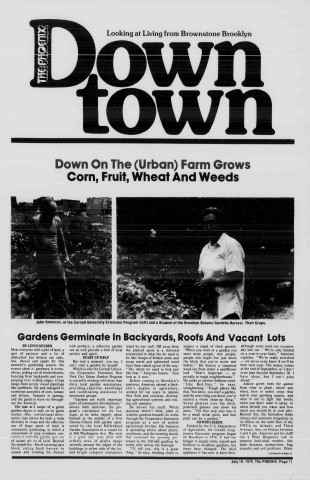
Down On The (Urban) Farm Grows Corn, Fruit, Wheat And WeedsJohn Ameroso, of the Cornell University Extension Program (left) and a Student of the Brooklyn Botanic Gardehs Harvest Their Crops.Gardens Germinate In Backyards, Roofs And Vacant LotsBY LINUS GELBERMost everyone with a plot of land, a spot of patience and a lot of dedication has broken out rake, hoe, shovel and spade for this summer%u2019s gardening season, the streets show it: greenery is everywhere, poking out of windowboxes, bursting from backyards and evet peeping over rooftop edges. Crops range from purely visual plantings like sunflower, lily and marigold to nutritious samplers of corn, tomato and lettuce. Summer is sprung, and the gardens have riz throughout the borough.The size ar d scope of a given garden deper. is only on its given tender. One lorticultural alternative that allows for both a wide diversity in crops and the effective use of large spots of land is community gardening, in which a consortium of area residents conS tr ilC t%u00ae ?. y i P r i t a h l ^ o a r r | o n c n n f r \\ n fof vacant pic es of land. Beyond the simple bei :fits of sprucing up a block, eating fresh harvest in season and stocking the freezerwith produce, a collective garden can as well provide a hub of local activity and spirit.START UP HELPBut wait a moment, you say. I can%u2019t start a garden by myself.Which is why the Cornell University Cooperative Extension New York City Urban Garden Program is currently working with more than thirty local garden associations, providing expertise, knowledge and coordinating assistance to interested groups.%u201c Gardens are really important parts of community development,%u201d attests John Amoroso, the program%u2019s coordinator for the borough, as he looks happily about himself in the middle of a Fort Greene-Clinton Hill garden sponsored by the local Hallenback Garden Association in a vacant lot at 460 Washington Ave. The viewic a o rv n H n n o - n p ^ t n l n t c w i t hO Aorderly rows of plants range serenely around the edges of the buildings to either side of the lot, and bright compost containersstand by one wall. Off away from the planted spots is a cluttered testimonial to what the lot used to be like: heaps of broken stone and scrap metal and splintered wood have been raked up out of the way. %u201c The whole lot used to look just like that,%u201d Ameroso beams. %u201cJust look at it now.%u201dBefore coming to Brooklyn%u2019s pastures, Ameroso ea'rned a bachelor%u2019s degree in agriculture, worked for ten years in upstate New York and overseas, developing agricultural systems and testjng soil samples.He knows his stuff. While Ameroso doesn%u2019t clear, plant or tend the gardens himself, he works through the Cooperative Extension program as a sort of mobile agricultural hot-line. His business is spreading advice about plants, conditions, and the teeming detailst h a t c i i r r m m H th *> r r r m v i n or r \\rr\\- o ' %u2014%u00a9 1cesses in the 150-odd gardens he works with across the borough.%u201c I%u2019ll tell you, this is a great thing,%u201d he says, bending closer toinspect a stand of thick growth. %u201c When you work in a garden you meet more people, new people, people who might live just down the block that you%u2019ve never met before.%u201d He heaves a tenacious weed out from under a cauliflower leaf. %u201cThat%u2019s important %u2014 especially in tough neighborhoods.%u201d He yanks at another bulbous weed. %u201c Like Bed-Stuy,%u2019%u2019 he says, straightening. %u201cTough places like that. You know, you start a garden, and the next thing you know you%u2019ve started a whole clean-up thing.%u201d Sweat glistens over his thick, polarized glasses and down his arms. %u201cThe First step only has to be a small initial push, and that push can be a garden.%u201dSOWING SEEDSFunded by the U.S. Department of Agriculture, the Cornell Cooperative Extension program began (in Rrnoklvnt in 1Q76 It had th*>budget to supply tools, topsoil and fertilizer to neophyte gardens, but times have changed. The chief appliance it has now is know-how,although some tools are occasionally lent out. %u201c We%u2019re only funded on a year-to-year basis,%u201d Ameroso explains. %u201c We%u2019re really stretched %u2014 we never even know if we%u2019ll be here next year. The money comes at the end of September, so I don%u2019t even plan beyond September 30. I have ideas, but I can%u2019t plan ahead.%u201dAdvice given runs the gamut from what to plant, where and when, how to select crops that match your growing season, and what to use to Fight that beetle when you don%u2019t want to spray, to when should you water and how much you should Fit in your plot. Beyond this, the Extension holds classes and seminars irregularly in its offices on the sixth floor of the YWCA on Atlantic and Third Avenues. Also, on Fridays between 1 and 5 pm, Ameroso and his staff run a Plant Diagnostic Lab to pinpoint individual troubles, like plant diseases, malnutrition, bug assaults and soil problems. OtherContinued on p%u00abRe 17July 19. 1979. The PHOENIX. Page 11


