


Page 403 - Demo
P. 403
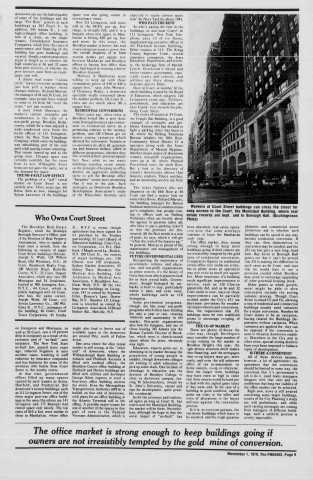
Workers at Court Street buildings can cross the street foreasy access to the Court, the Municipal Building, where realestate records are kept, and to Borough Hall. (OcchiogrossoPhoto)downtown can see the faded quality of some of the buildings and the large %u201c For Rent%u201d posters in such buildings as 383 Pearl St. In addition, 345 Adams St., a vast high-ccilinged office building, is now in a crisis, as the major tenants, Consolidated Insurance Companies, which bore the costs of maintenance and financing of the building has gone bankrupt and vacated. Finally, realtors andothers argue at length as to whether the high vacancies at 66 and 32 came from poor services, or whether the poor services came from an inadequate rent roll.A classic real estate %u201c vicious circle\just how soft a market these changes indicate. Richard Marcus, the manager of 44 and 16 Court, for example, says people have wanted to come to 16 from 66 %u201c over the years,%u201d not just recently.A story which illustrates the market%u2019s current strengths and weaknesses is the tale of a non-profit group, Brooklyn Rediscovery, which for a time enjoyed a wide-windowed view from the lovely offices of 111 Livingston, where the New York Telephone Company, which owns thebuilding, was subsidizing part of the rent until a full paying tenant turned up. That tenant turned up and so the group went. Cheaper space was certainly available, but the views from its new Willoughby Street home are not quite the same, nor is the demand for space.THE NO-FAULT LAW EFFECTThe problem of a %u201c soft%u201d rental market on Court Street is not entirely new. Three years ago, Eli Kriss, then as now, manager for Sylvan Lawrence of the buildingsThe Brooklyn Real Estate Register, which the Brooklyn Borough Surveyor%u2019s Office, part of the Division of Real Property Assessment, tries to update at least once a month, lists the following as owners of major Court Street buildings: 16Court, Joseph S. Wohl, 124 Willets Road, Old Westbury, N.Y.; 26 Court, Rembrook Realty Corp, 100 Merrick Road, Rockville Centre, N.Y.; 32 Court, Dupont Associates, which also own 185 Montague and 24 Joralemon, located at 405 Lexington Ave., N.Y.C.; 44 Court, which is jointly managed with 16 Court, also has the same owner, Joseph Wohl; 50 Court, c/o Sylvan Lawrence Co., 100 Williams St., N.Y.C., managers of the building; 66 Court, Court Tower Corporation, 45 Crosbyon Livingston and Montague, as well as 50 Court, saw a 10 percent drop in occupancy as a result of the recession and of %u201c no-fault%u201d auto insurance. The New York State no-fault law, passed some years ago, reduced litigation in auto accident cases, resulting in staff reduction by insurance companies and less business for some of the attorneys who bustle from Court Street to the nearby courts.At that time, governmental offices filled up many spaces vacated by such tenants as Aetna, Hartford, and Prudential. But downtown%u2019s newest buildings, such as 111 Livingston Street, one of the three major post-war office buildings in the area (the others are 141 Livingston and 175 Remsen) had rented space only slowly. The top rents of $10 a foot were similar to those in Manhattan, where officespace was also going vacant in recessionary times.Now 111 Livingston, with rents still in the $9-$ll per sq. foot range, is virtually full, and it is a bargain when new space in Manhattan is hitting $30 per sq. foot and more. In this sense, the Brooklyn market is better, but real estate onerators seem to apree that the overall disparity of at least several dollars per square toot between Manhattan and Brooklyn offices is having less effect than they had hoped in creating a better Brooklyn demand.%u201c Renters in Manhattan seem willing to keep up with those tremendous prices of $30 or $40 a square foot,%u201d says John Worstcr, of Chauncey Realty, a downtown specialist vitally concerned about the market problem. On Court St., rents are not much above $8 a square foot.RESIDENTIAL CONVERSIONSThree years ago, when rents in Brooklyn looked like a poor deal, some borough boosters saw conversion to residential units as a promising solution to the vacancy problem, and 130 Clinton got its minor zoning variances which allowed (he conversion. Tenants or co-op owners do, after all, generate tax and business dollars, albeit in different proportions, whether they live or work in their precious square feel. Now, while no one wants buildings standing vacant simply on the principle of keeping an office district, an aggressive marketing tactic to sell the Brooklyn office %u201c bargains%u201d seems more promising than it was in the past. Such strategies as Downtown Brooklyn Development Association's study of the Polytechnic Institute areaSt., N.Y.C is owner though agreement has been signed for its purchase by the Freidus partnership; 65 court (Board of Education building), Court Center Corporation, c/o H.J. Halback, 3 Maple wood La., Roslyn, N.Y. Off Court St., the owners of major buldings are: 130 Clinton, now 150 Joralemon. Sydney Garden Associates, 43 Sidney Place, Brooklyn; The Medical Arts Building, 142 Joralemon, by Medical Arts Associates, 6 Broadlawn Ave., Great Neck, N.Y. Of the two large new buildings on Livingston, 141 is owned by Seymour Cohn, Rensen%u2019s Lane, Oyster Bay, N.Y.. Number 111 Livingston is recorded as owned by Livingston Associated, 41 Broad Hollow Rd., Melville, N.Y.might also lead to better use of available space in the downtown are around Poly, north of Fulton Street.One area where the ofice rental market is still strong, is the %u201c other end%u201d of downtown, where the Williamsburgh Bank Building at Atlantic and Flatbush Avenues is filled with medical offices, the Brooklyn Center office building at Flatbush and Nevins buildings are filled with utilities and developer George Klein expects to erect a four-story office building accross the street. Even the Metropolitan Transportation Authority (MTA) is bullish on that end of downtown, with plans for an office building at the Atlantic Terminal still in the offing. A possible major tenant for one or another of the spaces in that part o f town is the Federal Veterans Administration, which isexpected to vacate current space near the Navy Yard by about 1981.WHO PAYS THE RENTSo who%u2019s paying the rent in the buildings on and near Court? At 111 Livingston, New York Telephone uses 13 of its floors, supplementing extensive offices in the Flatbush Avenue building. Other tenants at 111: The Kings County Supreme Court, several insurance companies, the State Education Department,andrecently, the brokerage firm of MerrillLynch. Downtown%u2019 s bread and butter tenants, government, especially courts and schools, and utilities arc there along with welcome private firms.Over on Court, at number 65 the whole building is used by the Board of Education, which outgrew 110 Livingston years ago. Utilities, government, and education arc also found, less monolithically, along Court Street.The roster of tenants at 44 Court, the Temple Bar Building, is a good example of strengths and problems. Anyone who has decided to fight a parking ticket has been to 44, where the Parking Violations Bureau inhabits the fifth floor. Community School District 13 is upstairs along with the State Department of Mental Hygiene. Another major source of downtown tenants, non-profit organizations, turns up at 44, where Planned Parenthood rents the sixth floor. But a look at the directory of tenants downstairs shows that lawyers, realtors, Timex watches, and an answering service arc here too.The ticket fighters who see dingincss on the fifth floor at 44 Court can find a neater look on some other floors. Richard Marcus, the building manager for Burton Seidman mentions a common manager%u2019s complaint, that people coming to offices such as Parking Violations often are hostile about the agency in question (after all, who likes to pay a parking ticket?) so that the premises are mistreated. All the floor needs is a coat of paint, he says, which it will get %u201c when the term of the lease is up.%u201d In general, Marcus is proud of the maintenance and management of his buildings.FUTURE GOVERNMENTAL USESRecognizing the importance of government, utilities, and education, and non-profit organizations as prime renters, it%u2019s the future of these functions which planners look for in their crystal balls. Government, though besieged by cutbacks, is here to stay, particularly where it uses, and even owns, whole buildings such as 110 Livingston.Some government programs, though, are like some non-profit programs which often have funding for only a year or two, creating turnover and uncertainty in the market. Non-profit organizations also look for bargains, and one of those leaving 345 Adams was the Roman Catholic Diocese of Brooklyn, which went to church-owned space where the price, obviously was right.Education, experts point out, is shrinking in its market because the population of young people is smaller, though downtown colleges are looking to adult education to pick up some slack. One incident of shrinkage in education was the decision of Brooklyn College to close its downtown campus, leaving 96 Schermerhorn, owned by St. John%u2019s University, vacant and ripe for development, quite possibly residential.As for the attorneys and realtors, all agree as long as Court St. has courts and the Municipal Building, the market will be there. Nevertheless, although the hope is that the worst impact of %u201c no-fault%u201d hasbeen absorbed, real estate operators note that some attorneys continue to leave for Manhattan each year.The office market, then, seems strong enough to keep most buildings going if their owners are not irresistibly tempted by the gold mine o f residential conversion. Comparative figures on residential versus office rent yields are tricky, but in prime areas an apartment may cost twice as much per square fool. More important, if a building needs significant improvements to survive, such as 130 Clinton apparently did, and as 66 and 32 Court seem to now, taxes on those improvements can be partially avoided under the City%u2019s J51 tax abatement provisions for residential improvements and conversions. Also, the requirement that J51 buildings must be rent stabilized seems to encourage co-oping of buildings.THE CO-OP MARKETThere are plenty of forces the other way, though. Developers must consider the large number of co-ops coming on the market in Brooklyn Heights this year, the tight money situation which makes their financing, and the mortgages their co-op buyers must get, more costly, and even the still unknown effect of tax re-assessment on home owners, co-op or otherwise. Over the longer term, buildings may have risen so high in value that their owners would be hard put to deal with the capital gains taxes if they were sold. In the case of a building in good condition, capital gains tax costs to the seller and costs of alterations to the buyer militate against the conversion process.So it is, as everyone guesses, the run-down buildings which have to be watched, and the tough questionplanners and commercial sector promoters ask is whether such buildings can be saved in any way besides residential conversion. If they can, then disincentives to conversion may be needed, and the J51 tax law gets a new long, hard look. Ray Levin at Borough Hall points out that it can%u2019t be proved that J51 is making the difference in such cases as 66 Court, and says that he would hate to see a provision eneded which Brooklyn may need to encourage upgrading of other potential housing stock.Other points at which government might be able to slow conversion include the zoning variance process. Though Court Street is zoned C5 and C6, allowing a mix of residential and commercial buildings usually need variances for a major conversion. Number 66 Court seems to be an exception, having cleared the Buildings Department without variances. When variances are applied for, they can be opposed if the conversion is seen to threaten downtown stability. Elsewhere in the City and in other cities, special zoning districts have even been imposed to balance types of development.IS THERE A CONSENSUS?All of these devices assume, however, a lot of agreement: the agreement that the conversions should be limited in some way, the concensus that it%u2019s government%u2019s job to do it, (and many managers disagree with that one) and the confidence that long run viability of the office market can be achieved.Right now, news is still awaited concerning some major buildings, results of the City Planning%u2019s study are still preliminary, and while such varying messages are coming from managers of different buildings, such a uniform position is utterly impossible.Who Owns Court StreetI he office market is strong enough to keep buildings going ifowners are not irresistibly tempted by the gold mine of conversion.November 1,1979, The PHOENIX, Page 9


