


Page 402 - Demo
P. 402
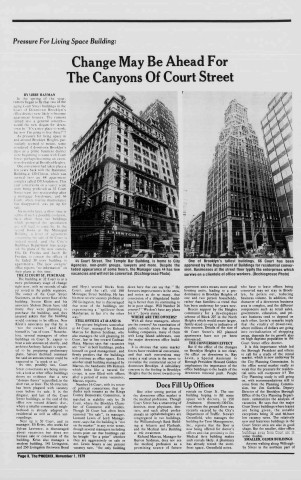
Pressure For Living Space BuildingChange May Be Ahead ForThe Canyons Of Court StreetBY LIBBY HAYMANIn ihc spring of ihc year, rumors began to fly that two of the aging Court Street buildings in the heart of Downtown Brooklyn's office district were likely to become apartment houses. The rumors turned into a general concern%u2014 would the new slogan for downtown be \hut now I'm going to live there!\As pressure for living space in and around Brooklyn Heights particularly seemed to mount, some wondered if downtown Brooklyn%u2019s days as a prime business district were beginning to wane with Court Street perhaps becoming an extensionofrcsidcntial Brooklyn Heights.One conversion had taken place a few years back with the Insurance Building at 130 Clinton, which was turned into an 88 apartment complex called 150 Joralcmon. This year conversions on a vaster scale were being predicted as 32 Court Street went into receivership after a mortgage foreclosure, and 66 Court, where routine maintenance has disappeared, was put up for sale.Six months later, a short time in terms of such a possible evolution, facts about these two buildings which prompted the speculation ate still hard to come bv. In the record books at the Municipal Building, a letter of agreement concerning the sale of nh Court is indeed noted, and the City's Buildings Department has accepted the plans of the new owners. Ella Dc Fricdus and Jacob De Fricdus. to convert the offices of the faded 30 story building to apartments. The new owners' office reports \their plans at this time.THE 32 COURT ST. PURCHASE The building at 32 Court is at a more preliminary stage of change right now, with no records of sale yet noted in the public registers. The owner of the Court Street Stationers, on the street floor of the building, Steven Klein and his associate Sholom Drizin have told many they were planning to purchase the building, and they assured askers that the building would continue to be offices. Now Klein's associates sav that he is \the ow ner,%u2019 %u2019 and Klein himself is %u201c out of town.\less, several managers of other buildings on Court St. expect to hear a sale announced shortly, and architect Anthony Salvati is reported to be preparing preliminary plans. Salvati declined comment but said an announcement could be expected in %u201c a week or so.%u201dAs one, possibly two, CourtStreet conversions are being initiated, a look at other office buildings shows no evidence that a new %u201c domino theory%u201d is justified, in the short run, at least. The 66 structure has been plagued with vacancy even before its sale. It is the dingiest, and last of the Court Street buildings, at the end of the office row toward Atlantic Ave., where a smaller commercial neighborhood is already adapted to residential as well as office surroundings.Next up is 50 Court, and its manager, Eli Kriss, who works for Sylvan Lawrence, is discouraged about vacancies but does not foresee sale or conversion of the building. Kriss also manages a modern building, 141 Livingston, and 250 Livingston (between Bond44 Court Street. The Temple Bar Building, is home to CityAgencies, non-profit groups, lawyers and more. Despite thefaded appearance of some floors, the Manager says 44 has lowvacancies and will not be converted. (Occhiogrosso Photo)One of Brooklyn%u2019s tallest buildings, 66 Court has beenapproved by the Department of Buildings for residential conversion. Businesses at the street floor typify the enterprises whichsurvive on a clientele of office workers. (Occhiogrosso Photo)and Hoyt) several blocks from Court, and the tall, old 188 Montague Street building. He has his most severe vacancy problem at 250 Livingston, but is discouraged that none of the buildings are experiencing a \Manhattan; in fact it's the other way.%u201dSTILL OFFICES AT 44 AND 16The picture brightens somewhat at 44 Court, managed by Richard Marcus for Burton Seidman, who also manages the still gleaming 16 Court, last in line toward Cadman Plaza. Marcus says that vacancies are %u201c low%u201d in both buildings, prides himself on good management, and firmly predicts that the buildings will continue as office space. Even another small building managed by Marcus, the handsome 186 Remsen which looks like a natural for co-ops, is now filled with offices after a period of some vacancies, Marcus reports.Number 16 Court, with its roster of political connections that includes such tenants as the Kings County Democratic Committee, is matched in stability only by 26 Court, where the Brooklyn Chamber of Commerce still resides. Though 26 Court has often been rumored %u201c for sale%u201d , its manager, Leonard Lewis of Lord Management, says that the building is %u201c not on the market%u201d in any strict sense, though several managers including Lewis point out that buildings can be bought %u201c for a price%u201d whether they are aggressively on sale or not. Lewis boasts a one percent vacancy rate, %u201c the only buildingdown here that can say that.%u201d He foresees improvements in the area, and notes as do so many, that conversion of a dilapidated building is better than its continuing to be in poor shape. Will Number 26 convert? %u201c We don%u2019t have any plans for it%u201d , Lewis states.WHERE ARE THE OWNERS?With all these managers, where are the owners? An examination of public records shows that diverse holding companies, many of them with Long Island addresses, own the major downtown office buildings.It is obvious that some market forces favor residential conversion, and that such conversions may create a real crisis in the move to revitalize the commercial sector of downtown Brooklyn. A subsidiary concern is the feeling in Brooklyn Heights that the move toward co-opapartment units means more small housing units, leading to a predominance in Brooklyn Heights of one and two person households, rather than families%u2014a trend that has been underway for years now.Recent support by the Heights community for a development scheme of Block 207 in the North Heights which would create larger, family-sized co-ops is indicative of this concern. Details of the size of 66 Court Street%u2019s 102 planned apartments have not yet been announced.THE CONVERSION EFFECTBut if the effect of the changes on Brooklyn Heights is not clear, the effect on downtown is. Ray Levin, a Special Assistant to Borough President Howard Golden emphasizes the importance of the -office buildings to the health of the downtown renewal push. PeopleDocs Fill Up OfficesOne other strong portion of the downtown office market is the medical profession. Though Court Street has a smattering of dentists, most physicans, dentists, and such alhed professionals as opthalomologists are congregated in two buildings, the Williamsburgh Bank Building at Atlantic and Flatbush, and the Medical Arts Building at 14Z joratemon.Richard Marcus, Manager for Burton Seidman, does not see the medical profession as a promising source of futurerentals on Court St. The one building hoping to fill some space with doctors, is 150 Joralcmon (formerly 130 Clinton) where the ground floor was recently vacated by the City%u2019s Department of Traffic. Stewart Greenfield, who manages the building for Terri Management, Inc., reports that the floor is now being offered for doctor%u2019s offices and tiiat proximity iu die Medical Arts building makes such rentals likely. A pharmacy has already rented the storefront space, Greenfield notes.who have to leave offices being converted may not stay in Brooklyn, he points out, reducing business volume. In addition, the character of a downtown business area is complex, and the different components such as retail sales, government, education, and private business tend to depend on each other. Levin%u2019s remarks imply that the vitality of downtown, where millions of dollars are going into revitalization o f shopping areas, depends for its growth also on high daytime population in theCourt Street office district.It is this importance which led the Borough President and others to call for a study of the rental market, which is now underway bythe City Planning Commission. Is the office rental market really so weak that the pressure for residential units will overpower it? The City Planning study is still going on, with recommendations still to come from the Planning Commission, but Jim Gardella, Deputy Director of the Brooklyn Borough Office of the City Planning Department, summarizes the analysis of vacancies. He says that the major Court Street buildings where leases are being given, the notable exceptions being 32 and 66,have low vacancy rates. The relatively new and luxurious buildings in the Court Street area are also in good shape. But the smaller, older officei . ' u ; ---------- --------------------u u i m i a g o a r v a j n o i n w u n u i vsome trouble.SMALLER, OLDER BUILDINGSAnyone walking along Willoughby Street in the northern part ofPage 8, The PHOENIX, November 1,1979


