


Page 100 - Demo
P. 100
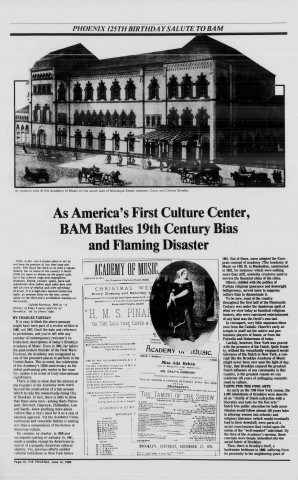
PHOENIX 125 TH BIRTHDA UTE TO BAMAn exterior view of the Academy of Music on the south side of M ontague Street, between C ourt and C linton Streets.As America%u2019s First Culture Center,BAM Battles 19th Century Biasand Flaming DisasterHere, at Iasi, was a proper place to act in,and here the geniuses of our time sang andspoke. This house has been at no time a regulartheatre; but no house in the country is betterfitted for opera or drama on the grand scale,for it has a heroic stage and magnificentdistances. Drama, concert, opera, farce andspectacular show follow each other here withodd absence of relation and with refreshingdiversity. It is a high-class musical recital onenight, an amateur farce on the next, comicopera on the third and a prohibition meeting onthe fourth...(,ubriel Harrison, I HI) in %u201cAHistory of Kings C ounty and City ofHrooklyn, \BY CHARLES TARZIANIt is easy to think the above passagemight have been part of a review written in1986, not 1893. Omit the date and referenceto prohibition, and you%u2019re left with anynumber of contemporary reviewer%u2019s introductory descriptions of today%u2019s BrooklynAcademy of Music. Even in 1893, far beforethe post-modern thunder of the Next WaveFestival, the Academy was recognized asone of the premiere places to perform in theUnited States. This in mind, the celebrationof the Academy%u2019s 125th anniversary as theoldest performing arts center in the country, makes it an event of truly internationalsignificance.There is little to show that the interest ofthe founders of the Academy went muchbeyond the construction of a hub aroundwhich to rally the meteorically-rising Cityof Brooklyn In fact, there is little to showthat these same men%u2014among them Pierrepont, Brevoort, Degrauw, Chittenden, Ix>wand Sands%u2014knew anything more aboutculture than a city%u2019s need for it as a seal ofnational approval. Yet the Academy%u2019s long,continuous and venerable history is nothingless than a compendium of the history ofAmerican culture.Its creation, by charter, in 1858 andsubsequent opening on January 15,1861,mark a maiden voyage by Americans insearch of a uniquely American culturalidentity. Yes, previous efforts yieldedcultural institutions in New York beforeTOMPKINS & HILL AU*>, Proprietors of the Boston Theatre, Boston.CHRISTMAS WE^E v e r y E v e n i n g a n d S a t u r d a y !%u25a0(ill be preneDted tbe S%u201etiiio%u00bbl end domic O p en (written by W. S.Skli IVAN,, in T*o Act- (%u00bb%u00bb pro en led *t the BobBonton, over 100 niubtel, entitled\Or The Lass that Loved aThe Hcenery by .................................................................Mtage %u00bbr%u00ab bi'ec*ure b y ...................................................AppoinuuMitH by .....................................................by ...................Mubic lariii te d by M'Coru.i'k'w Orcbehtra and MeiTneatre, OrcbeMra. directed by .....................Under wboi-e Mii-erviHion tl t> p:rilE KT HON H it JOSEI'H 1'OK IKK, K. (!. Iin i rally........... .........................IA P Ia IN %u2022 OKLOKtN. Ounu.aMlii g %u201c H M S Pi It\\I PH HALKVIhAW, Able Hainan|j|( K IjKa %u2022 K Alrlft ht-Nriian ..... ...........BILL HOH-T Y, Boatew-inHOIS BM KK'T. 1 -ip%u25a0 liter* Mat*...................TOM BOWLIN'I OM I b< KKm. Mi iniipinitoJOSLIT1IM-: Ihe Captain%u2019ll DaughterLI l I LK BUI I LBU P t % re < npph), a PoiImoiouC h a rlo tteC u s h m a nA ca d e m y ATiusjc.OSCAH J MURKAY......HERE. Kir k P in t CmiHinL Ifhi 1%u201e.,U Smtir* IliH < our-lrih and Him Arand Ladie.K of tb%u00bb UhornM. Mailont byS C E N E , lkee.lt u,,/ %u00ab%u00ab H M S. l i n n foreMiss Ada Rehan\\AND-................... DALY S COMPANYsiiakspkrkam AN%u201e Ol.l, coMliOY ( r,!ati%u201e nsT H I S A F T E R N O O N & E V E N I N G , S A T U R D A Y , A P R I Lw/t hf m. leiOrmedr.ln |.%u201e, , 3jh<*lt%u00abpere%u2019%u00bbr_ b%u00bbJ HE 1 AMINO OF THF S han 1 N'l 1,1.MISSION III- II.N MINI.'With all the >,ri((ina| and n%u00bb-i ... a t ^ -M Klorvii'-* Ruiant,.1 It Mull-n,M .l*-t K H-enden, iw Blau' be M oullonMi M>MM 'iw %u2014 - Mum Bu*|ia h_ .Mr* B K L .irrte r , M rx 0 B K ii.e rx o n , Mow l.m %u00bb i %u2022%u2018 \Tkkorm.M r O E Boylw.M r K H K ' m w w .M. J A Mr J J Mal'm-y,Mr r%u00bb E K t * fe .M%u00ab __B r o o k l y n C bamtista . %u201eChM ' c k n t T \*>' p i -..K M IO .m SlS'geiSKm .n *%u00ab Katherine.r& W F M s a r t f* * ; %u25a0 - i ! OROMIO %u201e %u201e %u201e , %u201c P t'. re,.revent V,n.t a i l o r %u2022H IO N liK L L O ........... ,T K A N IO . . . j iervant* to LucentlnJHIANCA, her sister **iiest!i, Singers, et%u00ab-. A Wl I .f ,\\AI %u00ab%u00bbN. .. . .of I'etriicfoH household\Mr Kll I'AIJL .Mr. iMr (iK O Mr. Wl Mr. S| |>N Mr. CLKMl %u201e Mr. Wll.K Mr. C.KOHi.l-.%u2018 V E !K A T M I'IM N P%u2022 VlkiM r.BROOKLYN, SATURDAY, DKCKMKKR 27, 1879.A L T I ALX %u2022K-WA ll,M?.Ur A Public %u00bbM%u00abr '1861. But of those, some adopted the European concept of academy (The Academy ofMusic on 14th St. in Manhattan, constructedin 1852, for instance) which were nothingmore than stiff, unwieldy creatures used toservice the financial elites of the cities.Others, riddled with the politics ofPuritan religious ignorance and downrightbelligerency, served more to suppressculture than to disseminate it.To be sure, most of the countrythroughout the First half of the NineteenthCentury was under the dunderous spell ofwhat we view today as fanatical religiousleaders, who were convinced entertainmentof any kind was the Devil%u2019s own tool.In retrospect, very little separates thesemen from the Catholic Church%u2019s early attempts to snuff out the satiric and pantomimic players of Rome, or from theFalwells and Robertsons of today.Luckily, however, New York was gracedwith the presence of the Dutch. Quite frankly, without the remarkably vanguard socialtolerance of the Dutch in New York, a concept like the Brooklyn Academy of Musicmight never have ever seen the light of day.Truly, that Brooklyn enjoyed the greatestDutch influence of any community in thiscountry, is the greatest reason we cancelebrate 125 years of unflagging committment to culture.TASTE FOR THE FINE ARTS As early as the 1796 New York census, the4,495 inhabitants of Brooklyn were described as %u201cchiefly of Dutch extraction with aliberality and taste for the fine arts.%u2019%u2019Dutch free public education for both sexes(Boston would follow almost 150 years laterin allowing women into schools) andreligious tolerance (which would eventuallylead to their downfall) were parts of asocial consciousness that rested upon thenotion of the %u201cwell-rounded%u201d individual. Bythe time of the Academy%u2019s opening, theseconcepts were deeply imbedded into thesocial fabric of Brooklyn.Then, there is Brooklyn itself, abackwater hicktown in 1800, suffering fromits proximity to the neighboring giant ofPage 16, THE P H O EN IX, June 12, 1986


