


Page 101 - Demo
P. 101
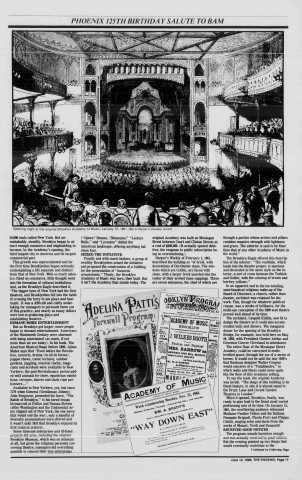
PHOENIX 125TH BIRTHDA YSALUTE TO BAM50,000 souls called New York. But unmistakably, steadily, Brooklyn began to attract enough commerce and shipbuilding tobecome, by the Academy%u2019s opening, thethird largest city in America and its largestcommercial port.This growth was unprecedented and forthe first time Brooklynites began seriouslycontemplating a life separate and distinctfrom that of New York. With so much attention fixed on commerce, little thought wentinto the formation of cultural institutions.And, as the Brooklyn Eagle described it,%u201cThe bigger town of New York had the firsttheatres, and Brooklynites fell into the habitof crossing the ferry to see plays and hearmusic. It was a difficult and costly undertaking for managers to persuade them outof this practice, and nearly as many dollarswere lost in producing plays andestablishing theatres....%u201dDEMAND MORE ENTERTAINMENTBut as Brooklyn got larger, more peoplebegan to demand entertainment. Americansof the Nineteenth Century were obsessedwith being entertained (as much, if notmore than we are today). In his book, TheAmerican Musical Stage Before 1800, JulianMates says that %u201cEven before the Revolution, concerts, drama (in all its forms),puppet shows, comic lectures, outdoorgardens, juggling, musical clocks, magicians and acrobats were available to NewYorkers; the post-Revolutionary period added wild animals for show, equestrian exhibitions, circuses, dances and slack rope performers....%u201dAvailable to New Yorkers, yes, but since1776 when General (Gentleman Johnny)John Burgoyne, presented his farce, %u201cTheBattle of Brooklyn,%u201d to his bored troopsbivouacced at Fulton and Nassau Streets(after Washington and the Continental Army slipped out of New York, the one movethat would end the war), only a handful ofdramatic presentations were offered andit wasn%u2019t until 1810 that Brooklyn enjoyed itsfirst musical oratorio.Some itinerant enterprises and ill-fatednrA jonfc Hid o ricn innluHirm ih c* n rid in a lBrooklyn Museum, which was no museumat all, but given the religious paranoia concerning theatre, managers did everythingpossible to conceal their true enterprises(%u201cOpera%u201d Houses, %u2018.%u2018Museums,%u201d %u201cLectureHalls,%u201d and %u201cLyceums%u201d dotted theAmerican landscape, offering anything butclean fun).SEIZED THE INITIATIVEFinally and with much fanfare, a group ofwealthy Brooklynites seized the initiativeand proposed the construction of a buildingfor the presentation of %u201cinnocentamusements.%u201d Thusly, the BrooklynAcademy of Music was bom, then built. Butit isn%u2019t the Academy that stands today. Theoriginal Academy was built on MontagueStreet between Court and Clinton Streets ata cost of $300,000. (It actually opened debtfree, the response to public subscription being so overwhelming.)Harper%u2019s Weekly of February 2,1861,described the building as %u201cof brick, withdecorations of Dorchester stone. The windows which are Gothic, are faced withstone, with a larger brick inserted into thecenter of their arched stone cappings. Thereare seven entrances, the chief of which arethrough a portico whose arches and pillarscombine massive strength with lightnessand grace. The exterior is said to be finerthan that of any other Academy of Music inthe world.%u201dThe Brooklyn Eagle offered this description of the interior: %u201cThe vestibule, whichleads into the theatre proper, is spaciousand decorated in the same style as the interior, a sort of cross between the Turkishand Gothic, with the coloring of brown andlow-key yellows.%u201dIn an apparent nod to the tee-totalling,semi-fanatical religious make-up of theBoard of Directors, a church, rather thantheatre, architect was retained for thework. This, though for whatever politicalreason, was a stroke of brilliance, for themulti-use conception of the 2300 seat theatreproved well ahead of its time.The architect, Leopold Eidlitz, saw fit todesign the theatre so it could also accommodate balls and dinners. The inauguraldinner for the opening of the BrooklynBridge, for example, was held here on May24,1883, with President Chester Arthur andGovernor Grover Cleveland in attendance.The entire floor of the Montague StreetAcademy could be converted to multilevelled space, through the use of a series ofhorses. It would not be until the late 1920%u2019sthat Bauhaus designer Walter Gropiuswould conceive of a %u201cTotaltheatre,%u201d inwhich walls and floors could move quitelike the floor of this Academy setting.To say the least, the original Academywas lavish. %u201cThe stage of this building is itsfinest feature, in size it is almost equai tothe Drui^ Lane and Covent GardenTheatres in London.%u201dWhen it opened, Brooklyn, finally, wasready to play host to the finest most variedperforming arts of its time. On January 15,1861, the overflowing audience witnessedMadame Pauline Colson and the Italians,Pasquale Brignoli, Nicola Ferri and FilippoColetti, singing solos and duets from theworks of Mozart. Verdi and Danazetti.RECEIVED GOOD NOTICESThe program sounds harmless enoughanu w a s a c tu a lly ic c e iv c u by guuu liutiC cS.But the evening pointed up two things thatwould eventually contribute to theContinued on Following PageJune 12, 1986, TH E PH O EN IX, Page 17


