


Page 105 - Demo
P. 105
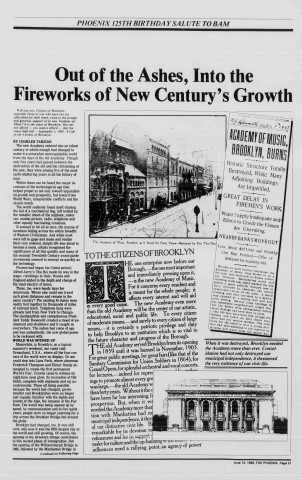
PHOENIX I25THBIRTHDA YSALUTE TO BAMOut of the Ashes, Into theFireworks of New Century%u2019s GrowthM HI you nor. Citizens o f Brooklyn,especially those o f you who have not yetsubscribed for their share, come to the promptand generous support o f its new Academy o fMusic? It is the cause o f Brooklyn. She cannot afford %u2014 you cannot afford %u2014 that thecause shall fail. %u2014September I, 1905. 4 Callto the Citizens o f Brooklyn.BY CHARLES TARZIANThe new Academy entered into an infantcentury in which enough had changed tomake it a somewhat unrecognizable worldfrom the days of the old Academy. Thoughonly five years had passed between thedestruction of the old and the christening ofthe new, they were among five of the mostearth-shattering years in all the history ofman.Within them can be found the major inventions of the technological age thathelped propel us not only toward unparalleled growth and prosperity, but toward twoWorld Wars, innumerable conflicts and theatomic bomb.The world suddenly found itself chasingthe tail of a mechanical dog, left behind bythe metallic sheen of the airplane, motorcar, motion picture, radio, telephone andother equally fascinating creations.It seemed to hit all at once, the manna ofinvention falling across the entire breadthof Western Civilization. And while mostwere left to gape and moan and realizetheir very ordered, simple life was about tobecome a mess, artists recognized thesignificance of all this quickly and many ofthe seminal Twentieth Century avant-gardemovements seemed to emerge as quickly asthe technology.Picasso had begun his Cubist period;Alfred Jarry%u2019s Ubu Roi made its way to thestage; rumblings in Italy, Russia andEngland added to the depth and charge ofthe most electric of times.These, too, were heady days forAmericans. Where else could one travelsuch great distances and remain in thesame country? The existing 45 states wereneatly tied together by thousands of milesof railroad track. Telephone lines werealready laid from New York to Chicago.The inexhaustible and cantankerous President Teddy Roosevelt created a mood of excitement and ebullience and it caught oneverywhere. The nation had come of ageand was undoubtedly, the new global powerto be reckoned with.WORLD WAS OPENED UPMeanwhile, in Brooklyn, on a typicalsummer%u2019s weekend, one could visitDreamland, U.S.A., where all the four corners of the world were on display. Or onecould step into Lana Park, where showmenFrederick Thompson and Elmer Dundy attempted to create the first permanentWorld%u2019s Fair. Crowds came to witness itsnight-time neon glow, its recreation of OldDehli, complete with elephants and raj accoutrements. These all being possiblebecause the world had changed, grownsmaller and Brooklynites were no longerjust vaguely familiar with the sights andsounds of the Alps, the Amazon or the FarEast. The world was being opened up byspeed, by communication and in five quickyears, people were no longer yearning for atrip across the Brooklyn Bridge but aroundthe globe.Brooklyn had changed, too. It was stillvast, only now it was the fifth largest city inthe world and still growing. Of course, theopening of the Brooklyn Bridge contributedto this second phase of immigration. Butthe opening of the Williamsburgh Bridge in1905, followed by the Manhattan Bridge inContinued on Following Page%u25bcT h e A c a d e m y o f M usic, Brooklyn, as It Stood fo r F o rty Y e a rs %u2014 Destroyed by F ire T h is M o t'OTHE CITIZENS OF BROOKLYN\Borough,%u2014 the one most important and immediately pressing upon it,__is the new Academ y of Music.For it concerns every resident and is meant for the whole people'* it affects every interest and will aid every good cause. T he new Academy even more ,an the old Academy will be the center of our artistic, lucational, social and public life. T o every citeen [ moderate m eans,-and surely to every a t e m j larg ieans,%u2014 it is certainly a patriotic privilege and d y , help Brooklyn to an institution which is so vital to tie future character and progress of the Borough.T -H E o ld Academy served BrooWynfrom^ Ot?oo38 1 in 1859 until it was burned in November, 19 .%u2022orgreat publ.cmeetings, for g re%u00a3 a.rs(hke that of the sanitary Commission for Union So diers in I torL a n d O pera, for splendid orchestral and vocal concerts,ior lectures,%u2014 indeed for repref ings to promote almost every go< was large,%u2014 the old Academy w than forty years. W ithout it th e rhave been far less interesting, prosperous. But, when it wus pjayhT -o tr a p ' lo ng - k , ' Z %u00b0 USP' \(h v t f i destroyed i,,. n%u00b0Wn t n b e *f o t t e r in g vya%u00b0 i|. S m o u ld e r in g * y


