


Page 108 - Demo
P. 108
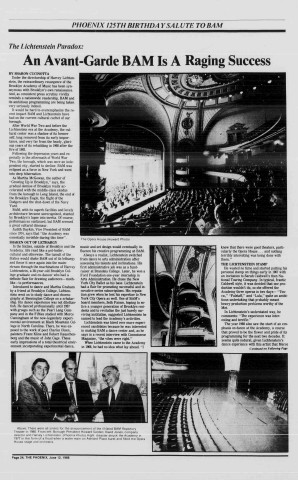
PHOENIX I25TH BIRTHDA YSALUTE TO BAMThe Lichtenstein Paradox:An Avant-Garde BAM Is A Raging SuccessThe Opera House (Howard Photo)BY SHARON CUCINOTTAUnder the directorship of Harvey Iichtenstein, the extraordinary resurgence of theBrooklyn Academy of Music has been synonymous with Brooklyn%u2019s own renaissance.And, as consistent press scrutiny vividlyreminds a nationwide readership, BAM andits ambitious programming are being takenvery seriously indeed.It would be hard to overemphasize the recent impact BAM and Lichtenstein havehad on the current cultural cachet of ourborough.After World War Two and before theLichtenstein era at the Academy, the cultural center was a shadow of its formerself, long removed from its early importance, and very far from the heady, glorious years of its rebuilding in 1908 after thefire of 1903.Following the depression years and especially in the aftermath of World WarTwo, the borough, which was once an independent city, started to decline. BAM waseclipsed as a force in New York and wentinto deep hibernation.As Martha McGowan, the author of%u201cGrowing Up in Brooklyn,%u201d says, thegradual demise of Brooklyn really accelerated with the middle-class exodusfrom the borough to Long Island, the end ofthe Brooklyn Eagle, the flight of theDodgers and the shut-down of the NavyYard.BAM, with its superb facilties and lovelyarchitecture became unrecognized, stuntedby Brooklyn%u2019s lapse into inertia. Of course,performances continued, but BAM seemeda great cultural dinosaur.Judith Daykin, Vice President of BAMsince 1974. says that %u201cthe Academy wasessentially invisible during this time%u201d .SHAKEN OUT OF LETHARGYIn the Sixties, outside of Brooklyn and theAcademy, life read like a pot-boiler,cultural and otherwise. The tumult of theSixties would shake BAM out of its lethargyand throw it once again into the mainstream through the machinations of HarveyLichtenstein, a 38-year-old Brooklyn College graduate and ex-dancer who had adefinite flair for drawing audiences%u2014mothlike%u2014to performances.Introduced to dance and Martha Grahamby a friend at Brooklyn College, Lichtenstein went on to study dance and choreography at Bennington College on a scholarship. His dance experience was not dilettantish. He danced professionally until 1957with groups such as the Pearl Lang Company and in the Fifties studied with MerceCunningham at the now-legendary experimental environment at Black Mountain College in North Carolina. There, he was exposed to the work of poet Charles Olsen,painters Franz Kline and Robert Rauschenberg and the music of John Cage. Theseearly impressions of a total theatrical environment incorporating experimental dance,music and set design would eventually influence his creative programming at BAM.Always a realist, Lichtenstein switchedfrom dance to arts administration afterassessing his talents and inclinations. Hisfirst administrative job was as a fundraiser at Brandeis College. Later, he won aFord Foundation one-year internship inArts Administration. He chose the NewYork City Ballet as his base. Lichtensteinhad a flair for promoting successful and innovative series subscriptions. His reputation grew when he lent his expertise to NewYork City Opera as well. One of BAM%u2019sboard members, Seth Faison, hoping to entice a younger generation of Brooklyn residents and to revitalize the just barely surviving institution, suggested Lichtenstein benamed to lead the Academy%u2019s activities.Lichtenstein was hired over more experienced candidates because he was interestedin making BAM a dance center and, as hesays in a recent interview with ConnoisseurMagazine, %u201cthe vibes were right.%u201dWhen Lichtenstein came to the Academyin 1966, he had no idea what lay ahead. %u201cIknew that there were good theaters, particularly the Opera House . . . and nothingterribly interesting was being done withthem.%u201dTHE LICHTENSTEIN STAMPHe wasted no time and started putting hispersonal stamp on things early in 1967 withan invitation to Sarah Caldwell%u2019s then National Touring Company. In typical, franticCaldwell style, it was decided that one production wouldn%u2019t do, so she offered theAcademy three operas in two days%u2014 %u201cTosca,%u201d %u201cFalstaff,%u201d and %u201cLulu,%u201d quite an ambitious undertaking that probably meantheavy production problems worthy of theMet.In Lichtenstein%u2019s understated way, hecomments: %u201cThe experience was interesting and terrific.%u201dThe year 1968 also saw the start of an emphasis on dance at the Academy, a coursethat proved to be the flower and pride of itsprogramming for the next two decades. Itseems quite natural, given Lichtenstein%u2019sdance experience with this artist that MerceContinued on Following PageAbove: There were all smiles for the announcem ent of the ill-fated BAM Repertory Theater in 1980 From left: Borough President Howard Golden; David Jones, com pany d ire c to r a n d Harvey i ich te n ste in . (P h o e n ix P h o to ) Right: d is a ste r s tr u c k the A c a d e m y in 1977 in the form of a flood when a w ater main on Ashland Place burst and filled the Opera House stage and orchestra.Page 24, TH E P H O E N IX , June 12, 1986


