


Page 109 - Demo
P. 109
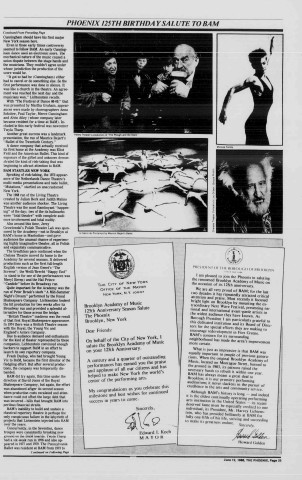
PHOENIX 125TH BIRTHDA UTE TO BAMContinued From Preceding PageCunningham should have his first majorNew York season here.Even in those early times controversyseemed to follow BAM. An early Cunningham dance used an electronic score. Themechanical nature of the music caused aunion dispute between the stage hands andthe musicians. They couldn%u2019t agree underwhose jurisdiction the production of thescore would be.%u201cIt got so bad he (Cunningham) eitherhad to cancel or do something else. So thefirst performance was done in silence. Itwas like a church in the theatre. An agreement was reached the next day and themusicians won,%u201d Lichtenstein recalls.With %u201cThe Festival of Dance 68-69,%u201d thatwas presented by Martha Graham, appearances were made by choreographers AnnaSokolow, Paul Taylor, Merce Cunninghamand Alvin Ailey ( whose company laterbecame resident for a time at BAM). Included in this early festival was newcomerTwyla Tharp.Another great success was a landmarkpresentation, the run of Maurice Bejart%u2019s%u201cBallet of the Twentieth Century.%u201dA dance company that actually receivedits first home at the Academy was EliotFeld and the American Ballet. This kind ofexposure of the gifted and unknown demonstrated the kind of risk-taking that wasbeginning to attract attention to BAM.BAM STARTLES NEW YORKSpeaking of risk-taking, the 1972 appearance of the Netherlands Dance Theatre%u2019smulti-media presentations and nude ballet,%u201cMutations,%u201d startled an unaccustomedNew York.The 1968 run of the Living Theatrecreated by Julian Beck and Judith Malinowas another audience shocker. The LivingTheatre was the most flamboyant %u201chappening%u201d of the day; two of the its hallmarkswere %u201ctotal theatre%u201d with complete audience involvement and total nudity.Also around this time, JerzyGrowtowski%u2019s Polish Theatre Lab was sponsored by the Academy%u2014not in Brooklyn atBAM%u2019s home in Manhattan%u2014and gaveaudiences the unusual chance of experiencing highly imaginative theater, all in Polishand exquisitely communicative.The breathless pace continued when theChelsea Theatre moved its home to theAcademy for several seasons. It deliveredproductions such as the first full-lengthEnglish version of Jean Genet%u2019s %u201cTheScreens%u201d ; the Weill/Brecht %u201cHappy End%u201d(a stand-in for one of the performances wasMeryl Streep) and the Hal Prince%u201cCandide%u201d before its Broadway run.Quite important for the Academy was therun of Peter Brook%u2019s stark %u201cA Mid-SummerNight%u2019s Dream%u201d performed by the RoyalShakespeare Company. Lichtenstein bookedthe hit production for two weeks after itsBroadway run and provided a splendid alternative for those across the bridge.%u201cBritish Theatre%u201d madness was the resultof that first Royal Shakespeare appearance.In 1974 there was a British Theatre seasonwith the Royal, the Young Vic andEngland%u2019s Actors Company.Due to audience demand and enthusiasmfor the kind of theater represented by thesecompanies, Lichtenstein convinced enoughbackers to support BAM in an effort tolaunch its own repertory company.Frank Dunlop, who had brought YoungVic to BAM, became the first director of thefledgling effort. But after several productions, the company was temporarily disbanded.BAM did try again, this time under thedirection of David Jones of the RoyalShakespeare Company, but again, the effortwas abandoned aftger its second seasonwhen production costs escalated and attendance could not offset the large debt thatwas incurred%u2014bills that brought BAM intoperilous financial straits.BAM%u2019s inability to build and sustain aclassical repertory theatre is perhaps theonly conspicuous failure in the labyrinth ofprojects that Lictenstein injected into BAMover the years.Concurrently, in the Seventies, dancetroupes were consistently breaking newground on iiie nA Ivi boards. T w y ia T h arphad a six-week run in 1976 and also appeared in 1977 and 1979. The PennsylvaniaBallet was resident at BAM from 1973 toContinued on Following Pagen uucy m e d ie i ;> pMOUUUiiuii u i m e r iu u y n d iiu w e o id ol e S acre du P rin te m p s by M aurice B e ja rt's B allett h e c i t y o f N e w Yo r kO FFIC E O F THE MAYOR n e w Y o r k , N .Y . i o o o zBrooklyn Academy of Music125th Anniversary Season SaluteThe PhoenixBrooklyn, New YorkDear Friends:On behalf of the City o f New York, Isalute the Brooklyn Academy of Musicon your 125th Anniversary.A century and a quarter o f outstandingperformances has earned you llie ptaand applause o f all our citizens and hashelped to make New York the world scenter of the performing arts.My congratulations as you celebrate thismilestone and best wishes lor continuedsuccess in years to come.Sincerely,Edward I. Kochm a y o rM o lis sa FenleyPRESIDENT OF T IE BOROUGH< IIY O I M U X IKK OF BROOKLYN1 am pleased to join the Phoenix in salnrino the renowned Brooklyn Academy of Music on the occasion of its 125th anniversaryWe are all very proud of BAM; for the lasftwo decades it has repeatedly attracted critical \%u201c %u25a0%u00abd Praise. Mosl raernly it f %u00a3 S g ight on Brooklyn by mounting (he ex traordinary Next Wave Festival 7 ^ CXtional and internalional avant-garde%u201d 5 , ^ the widea audience .hey have known As %u2018%u00b0 Borough President I am particularly grateful to this dedicated institution and its Board of Directors for the special efforts they arc makh g to encourage redevelopment in Fort Greene BAM s concern for its surroundingrmjre certain\made ' hC area's %u2122P%u2122vemen, Just as impressive is that BAM wasBAm T 7 fr dS t0 rebui,t 11 within %u00b0ne year Brooklyn;individual its President, Mr. Harvey l ichtenstcin, who has presided brilliantly at BAM forto ma%u00b0keei , f lh %u00b0,f his lifc' * \io make its greatness endure BSincerely,Howard GoldenJun%u00ab 12, 1986, TH E P H O E N IX , Psg%u00ab 25


