


Page 107 - Demo
P. 107
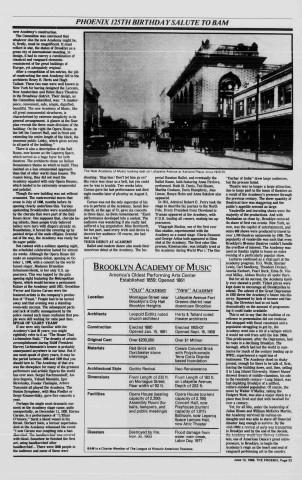
PHOENIX 125THBIRTHDA YSALUTE TO BAMnew Academy%u2019s construction.The Committee was convinced thatwhatever else the new Academy might be,it, firstly, must be magnificent. It mustreflect in size, the status of Brooklyn as agreat city ot international standing, indesign, it had to convey a combination ofclassical and vanguard elementsreminiscent of the great buildings ofEurope, yet adequately original.After a competition of ten entries, the jobof constructing the next Academy fell to thearchitects Henry B. Herts and HughTallant. These two men were well known inNew York for having designed the Lyceum,New Amsterdam and Helen Hays Theatresin the Broadway district. Their design, asthe Committee submitted, was: %u201cA masterpiece, convenient, safe, ample, dignified,beautiful. The new Academy of Music, likeall great monumental structures, ischaracterized by extreme simplicity in itsgeneral arrangement. A glance at the floorplan reveals the three main divisions of thebuilding: On the right the Opera House, onthe left the Concert Hall, and in front andextending the entire length of the block, theimmense public Lobby, which gives accessto all parts of the building.%u201dThere is also a description of the BallRoom, now known as the Lepercq Space,which served as a huge foyer for boththeatres. The architects chose an ItalianRenaissance theme on which to build. Theyinsisted on a less ornamented approachthan that of other world class houses. Thereason being, they did not want theAcademy equated with only Opera Houses,which tended to be extremely ornamentaland palatial.Though the new building was not withoutornament. The controversial storm thatarose in July of 1908, months before itsopening clearly underlines this. Variousupstanding Brooklynites were scandalizedby the cherubs that were part of the BallRoom decor. One supposes that, cherubs being infants, these people truly believedbabies were born with diapers already on.Nonetheless, it forced the covering up bypainted stripe of the nude effigies. Scandalout of the way, the Academy was ready forits eager public.Not content with a solitary opening night,the scheduled celebration lasted for almostsix weeks. Although the Opera House didmake an auspicious debut, opening on October 1,1908, with a concert by the worldfamed singer, Madame ErnestineSchumann-Heink, in her only U.S. appearance. This was topped by the galaopening night featuring the MetropolitanOpera, which would become a permanentfixture at the Academy until 1921. GeraldineFerrar and Enrico Caruso were thefeatured artists in the company%u2019s production of %u201cFaust.%u201d People had to be turnedaway and that evening was a standingroom-only success. The subsequent partyand lack of traffic management by thepolice caused such mass confusion that people were still waiting for cabs past 2am.SPEAK OF %u2018GLORY YEARS%u2019If (Hie were only familiar with theAcademy%u2019s last 20 years, you mightrightfully refer to it as %u201cThe House ThatLichtenstein Built.%u201d The density of artisticaccomplishment during BAM PresidentHarvey Lichtenstein%u2019s tenure is probablyunsurpassed anywhere in our time. But ifone must speak of glory years, it may bethe period between 1908 and 1929 that youshould turn to. The Academy of that erawas the showplace for many of the greatestperformers and artistic figures the worldhas ever seen. Sergei Rachmaninoff, Andres Segovia, Yehudi Menuhin, IgorStravinsky, Feodor Chaliapin, ArturoToscanini all played the Academy. TheBoston Symphony, with Max Fiedler orSerge Koussevitsky, gave five concerts ayear.Perhaps the single most dramatic moment on the Academy stage came, quiteunexpectedly, on December 11,1920. EnricoCaruso, in a performance of %u201cL%u2019ElisirD%u2019Amore,%u201d burst a blood vessel in histhroat. Herbert Swin, a former superintendent at the Academy witnessed the event:%u201cI saw Caruso was coughing into a hann ---------%u00bbm . _ %u00ab--------------------- n ------ ____________- ____ ___U R U \\ J U C i%u00ab a i r . u o u u n v i v m u n u u \\,v %u00bb v %u00bb v uwith blood. Somehow he finished the firstact, using handkerchief afterhandkerchief... There were 3000 people inthe audience and some of them were^ \%u25a0 ' .%u201d * %u00a3 %u00bb *%u2022 \\ %u25a0 \mKamMm .-,Ill .4 .7 .. ... %u25a0m~ %u25a0 -;,%u25a0s i smThe New Academ y of M usic looking east on Lafayette Avenue at Ashland Place, circa 1929-30shouting: %u2018Stop him! Don%u2019t let him go on!%u2019His voice was clear as a bell, but you couldsee he was in trouble. Two weeks later,Caruso gave his last performance and diedeight months later of pleurisy on August 2,1921.Caruso was not the only superstar of hisera to perform at the Academy. Sarah Bernhardt, at the age of 73, gave six concertsin three days. As Swin remembered: %u201cEachperformance developed into a contest. Theaudience was wondering if she really hadsuffered a leg amputation. Miss Bernhardt,for her part, used every trick and device todeceive her audience. Of course, she hadlost a leg.%u201dTHEIR DEBUT AT ACADEMYBallet and modem dance also made theirAmerican debut at the Academy. The Imperial Russian Ballet, and eventually theBallet Russe, both featuring Anna Pavlova,performed. Ruth St. Denis, Ted Shawn,Martha Graham, Doris Humphrey, JoseLimon, Hanya Holm and Anna Sokolow alsoappeared.In 1911, Admiral Robert E. Perry took thestage to describe his journey to the NorthPole. Every President from Cleveland toTruman appeared at the Academy, withF.D.R. leading all comers, making ten appearances.Vitagraph Studios, one of the first everfilm studios, experimented with theAcademy as a sound stage. Gloria Swansonand George Arliss both appeared in filmsshot at the Academy. The first color filmprocess, Kinemacolor, was initially tried atthe Academy during World War 1. The film%u201cDurbar of India%u201d drew large audiences,but the process failed.Theatre was no longer a large attraction,due in large part to the boom of theatres asa result of the Academy%u2019s presence throughthe previous century. The sheer quantity oftheatrical fare was staggering and thepublic%u2019s appetite seemed as large.Vaudeville and traveling shows were themajority of the productions. And withManhattan so close by, Brooklyn receivedits share of first run events. New York, asnow, was the capita! of entertainment, andsome 600 shows were produced to travel toover 1,700 theatres nationwide by 1905. Thepopularity of vaudeville was such that evenBrooklyn%u2019s 20-some theatres couldn%u2019t handlethe overflow of interest. The Academy wasused on Sunday nights to house an extraevening of a particularly popular show.Lectures continued as a vital part of theAcademy program. H.G. Wells, SinclairLewis, Carl Sandberg, Theodore Dreiser,Amelia Earhart, Pearl Buck, Edna St. Vincent Millay, Aldous Huxley all spoke there.But for all its success, the Academy hardly ever showed a profit. Ticket prices werekept down to encourage all Brooklynites toattend. The advent of the Great Depressionin 1929 threw the Academy%u2019s future into disarray. Squeezed by lack of income and funding, the Directors had to cut backdramatically on the amount of programming it could make available.This is not to say that the tradition of excellence in presentation did not continue.But strapped with fiscal constraint and apopulation struggling to get by, theAcademy went into a bit of a tailspin whichit would not exit from until the late 1960s.This predicament, after the Depression, hadits roots in a declining Brooklyn. Theborough, which had led the world in commerce for much of the century leading up toWWH, experienced a rapid loss ofbusinesses. The Academy stood on shakyground, enough for there to be talk of, first,tearing the building down, and, then, sellingit to Long Island University. Robert Moses%u2019skewed dream of middle-classdom, his odeto the twentieth century%u2014Ixmg Island, wasfast depleting Brooklyn of a unified,culture-minded population. Of course, themove by Walter O%u2019Malley, taking theDodgers West, was also a major shock to aplace that lived and died with baseball forover a century.Yet, for all this, under the leadership ofJulius Bloom and William McKelvy Martin,the Academy survived its various onslaughts and was able to stave off financialdisaster long enough to survive. By themid-1960s a revival of sorts was transpiringin Brooklyn and by the end of the decade,B rooklyn A cadem y of M usicAmerica%u2019s Oldest Performing Arts CenterEstablished 1859; Opened 1861%u201c O l d %u201d A c a d e m y %u201c N E W %u201d A C A D E M YLocation M ontague Street nearBrooklyn%u2019s C ity HailBrooklyn H eightsLafayette Avenue FortG reene district neardow ntow n BrooklynA rchitects Leopold Eidlitz notedchurch architectHerts & Tallant notedtheater architectsConstruction Erected 1860O pened Jan. 15,1861Erected 1905-07O pened Sept. 16,1908O riginal Cost Over $200,000 O ver$1 M illionM aterials Red Brick w ithDorchester stonetrim m ingsCream Colored Brickwith Polychrom aticTerra Cotta G ranitebased foundationA rchitectural Style G othic Revival Neo-RenaissanceD im ensions Front Length of 232 ft.on M ontague Street;Rear w idth of 92 ft.Front Length of 183 ft.on Lafayette Avenue;Depth of 202 ft.F a cilities O pera H ouse (seatingcapacity of 2,300)Assem bly Room (forballs, banquets, andand public m eetings)O pera H ouse (currentcapacity of 2,100)Concert Hall, nowPlayhouse (currentcapacity of 1,011)Ballroom, now LepercqSpace Lecture Hall,now Attic TheaterDisasters Destroyed by fire, Flood dam age fromn o v . 30, i%u00bb03 water mam brean,Labor Day, 1977BAM is a C harter M em ber of The League of Historic Am erican Theatres.th-e Ann Ho m y nmulH In ro M n r v o v T ip h to n c .tein, one of American Dance%u2019s great entrepreneurs, to Brooklyn, to begin theAcademy%u2019s reign as the heart and soul ofvanguard performing art in the country.June 12, 1986, TH E P H O EN IX, Page 23


