


Page 106 - Demo
P. 106
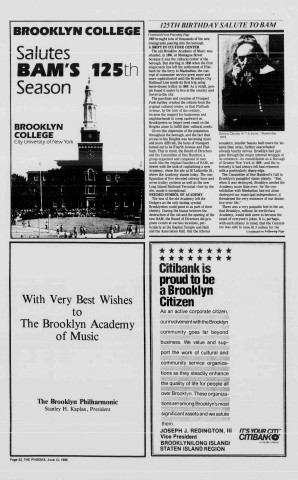
B R O O K L Y NC O L L E G ECity University of New YorkBROOKLYN COLLEGEC - J . , 4- ^ r -o a ! U L C ^BAM S 125thSeason 'With Very Best WishestoThe Brooklyn Academy of MusicThe Brooklyn PhilharmonicStanley H . K aplan, President125TH BIRTHDA YSALUTE TO BAMContinued From Preceding Page1909 brought tens of thousands of the newimmigrants pouring into the borough.A SHIFT IN CULTURE CENTERThe old Brooklyn Academy of Music wassituated, in 1860, at Montague Streetbecause it was the cultural center of theborough. But starting in 1830 when the firststagecoach line left the settlement of Flatbush for the ferry to Manhattan, the concept of commuter service grew more andmore sophisticated until the Brooklyn CityRailroad Line made its first trip usinghorse-drawn trolley in 1860. As a result, people found it easier to live in the country andtravel to the city.The purchase and creation of ProspectPark further created the schism from theoriginal cultural center, so that FlatbushAvenue, by the turn of the century,became the magnet for businesses andneighborhoods to creep eastward on.Brooklynites no longer need count on theHeights alone to fulfill their cultural needs.Given this dispersion of the populationthroughout the borough, and the fact thataccess to the Heights was becoming moreand more difficult, the locus of transportturned out to be Fourth Avenue and Flatbush. This in mind, the Board of Directorsand the Committee of One Hundred, agroup organized and composed of menmuch like the original founders of BAM, endowed with the task of capitalizing a newAcademy, chose the site at 30 Lafayette St.,where the Academy stands today. The configuration of five elevated subway lines andseven trolley systems as well as the newLong Island Railroad Terminal close by thesite, made it exceptional.NEEDED SYMBOL OF ACADEMYThe loss of the old Academy left theDodgers as the only lasting symbolBrooklynites could point to as part of theiridentity. During the hiatus between thedestruction of the old and the opening of thenew BAM, the Board of Directors did program events at various locations, particularly at the Baptist Temple and Halland the Association Hall. But the inferiorEnrico C aruso in %u201c La Juive,\1919.acoustics, smaller houses built more for lectures than arias, further exacerbatedalready touchy nerves. Brooklyn had justgone through the major internal struggle ofits existence%u2014its consolidation as a Boroughof Greater New York in 1898%u2014and the inferiority it had always felt had returnedwith a particularly sharp edge.The Committee of One Hundred%u2019s Call toBrooklyn%u2019s pamphlet states plainly: %u201cBut,when it was destroyed, Brooklyn needed theAcademy more than ever: for the consolidation with Manhattan had not alonedestroyed our municipal independence, itthreatened the very existence of our distinctive civic life.%u201dThere was a very palpable feel in the air,that Brooklyn, without its world-classAcademy, would sink anew to become thebrunt of everyone%u2019s jokes. It is, perhaps,with such infamy in mind, that the Committee was able to raise $1.3 million for theContinued on Following Page%u2605 %u2605 %u2605 %u2605 %u2605 %u2605 %u2605 %u2605%u2605 %u2605 %u2605 %u2605 %u2605 %u2605 %u2605 %u2605Citibank isproud to bea BrooklynCitizenAs an active corporate citizen,our involvement with the Brooklyncom m unity goes far beyondbusiness. We value and support the work of cultural andcom m unity service organiza-%u25a0 * WmXmmtions as they steadily enhance%u25a0 %u25a0 . %u25a0 %u25a0 %u25a0the quality of life for people all^ fg ||over Brooklyn. These organizations are among Brooklyn%u2019s mostsignificant assets and we salutethem.JOSEPH J. REDINGTON. IllVice PresidentBROOKLYN/LONG ISLAND/STATEN ISLAND REGIONr r s Y O U R n r r rCiTiSAN<%u00a9** CITICORP COMPANYPage 22, TH E PH O E N IX , June 12, 1986


