


Page 204 - Demo
P. 204
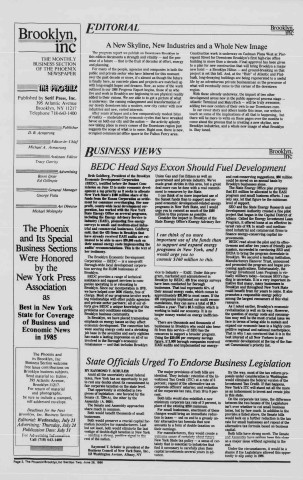
THE MONTHLY BUSINESS SECTION OF THE PHOENIX NEWSPAPERmPublished by Serif Press, Inc.395 Atlantic Avenue Brooklyn, NY 11217 Telephone 718-643-1400s PublisherD. B. Armstrong! Editor-in- ChiefMichael A. Armstrong%u2014%u2014%u2014 Assistant EditorTracy Garrity4 Jt~* ,v.Binni IpcarEd Gillespiemmmmmmmmmm General ManagerGeorge FialaDlPfjQfQ fMichael MolanphyThe Phoenix and Its Special Business Sections Were Honored by theNew York Press Association asBest in New YorkState for Coverageof Business andEconomic Newsin 1985The Phoenix and its Brooklyn, Inc Business Section welcome free lance contributions on Brooklyn business subjects. Send material to: Editor,395 Atlantic Avenue, Brooklyn 11217.For return of material and photographs, be sure to include a stamped, self-addressed envelope.Deadlines for the NextBrooklyn, Inc. Business Section:Editorial: Wednesday, July 23Advertising: Thursday, July 24Publication Date: July 31* j %u00bb__* ___f u%u00ab a u v c i u a m ^ l i u u i u i a u u i iCall (718) 643-1400ED ITO RIAL BrooklA New Skyline, New Industries and a Whole New ImageR iv n ,J n cThe progress report publish nn Downtown Rronklvn in this edition documents a strength and vitality %u2014 and the promise of a future - that is the fruit of decades of effort, energy and planning.For many of the people, agencies and companies in both the public and private sector who have labored for this moment over the past decade or more, it%u2019s almost as though the future is finally here, as concrete plans and projects are matched up with long-sought hopes and dreams. Now, as some of the work outlined in our 1986 Progress Report begins, those of us who live and work in Brooklyn are beginning to see physical reality added to their visions. We are able to to get a picture of what is underway: the coming enlargement and transformation of our dowdy downtown into a modern, new city center with new industries and new, varied interests.After years of hopes and a few comparatively modest bites of reality %u2014 moderated by economic cycles that have wreaked havoc on both our city and the nation %u2014 the activity aplenty now taking place in every comer of the Downtown region just suggests the scope of what is to come. Right now, there is new, occupied commercial office space in the Fulton Ferry area.Construction work is underway on Cadman Plaza West at Pierrepont Street for Downtown Brooklyn%u2019s first high-rise office building in more than a decade. Final approval has been given to a plan for new construction that will bring Brooklyn a major new hotel %u2014 a Brooklyn Hilton %u2014 and ground-breaking on that project is set this fall. And, at the %u201cHub%u201d of Atlantic and Flatbush, long-decaying buildings are being regenerated to a useful life by an adventurous private businessman as the precursor of what will eventually come to this comer of the downtown region.With these already underway, the impact of two other development areas now in the public approval process stage %u2014 Atlantic Terminal and MetroTech %u2014 will be truly awesome, adding two new centers of their own to our Downtown core.In our cover story and others inside this issue, our writers touch on some of the implications of all that is happening, but there will be more to write on these pages over the months to come about the process that is creating a new skyline, new Brooklyn industries, and a whole new image of what Brooklyn is. Stay tuned.BUSINESS VIEWSBEDC Head Says Exxon Should Fuel DevelopmentancBeth Goldberg, President of the BrooklynEconomic Development Corporation(BEDC), testified before the Sunset Commission on June 13 to make economic development a top priority as it seeks to allocateNew York State%u2019s $110 million share of thefunds from the Exxon Corporation as settlement for consumer overcharging. Her nonprofit, county-wide local development corporation, has worked with the New YorkState Energy Office on several programs,including the Energy Advisory Service toIndustry (EASI), promoting free energysurveys to small- and medium-sized industrial and commercial businesses. Goldbergsaid, that the 423 firms in Brooklyn thathave already received EASI audits are estimated to be able to save $20,000 each ontheir annual energy costs implementing theaudits%u2019 recommendations. This is the text ofher testimony.The Brooklyn Economic DevelopmentCorporation %u2014 BEDC %u2014 is a non-profitBorough-wide local development corporation serving the 33,000 businesses ofBrooklyn.BEDC provides a range of technicalassistance and support services to companies operating in or relocating toBrooklyn. Since our incorporation in 1979,we have helped over 5000 clients, free ofcharge. Most of our programs involve working relationships with other public agenciesand private sector partners; all of our efforts give BEDC a unique knowledge of theproblems and conditions existing in theBrooklyn business community.In Brooklyn, we have placed tremendousemphasis on energy issues as they affecteconomic development. The connection between soaring energy costs and a shrinkingjob base in the seventies and early eightieshas made a lasting impression on all of usinvolved in the Borough%u2019s economicrenaissance %u2014 and thst includes BrooklynUnion Gas and Con Edison as well asgovernment and private industry. We%u2019vemade great strides in this area, but a greatdeal more can be done with a real commitment to resources by the State.I can think of no more important use ofthe Sunset funds than to support and expand economic development-related energyprograms in New York State, and I wouldurge you to commit as much of the $160million to this purpose as possible.Consider the impact in Brooklyn of theState Energy Office%u2019s Energy Advisory SerI can think of no moreimportant use o f the funds thanto support and expand energyprograms in New York, and Iwould urge you tocommit $160 million to this.vice to Industry - EASI. Under this program, marketed and administered inBrooklyn by BEDC, 425 free energy surveyshave been conducted for Boroughbusinesses. That toal represents 45% oftheir annual energy costs, which comes toapproximately $20,000 in most cases. If the425 companies implement our audit recommendations, they can save a total of $8.5million a year. That%u2019s $8.5 million which isworking to build our economy. It is nolonger money wasted on energy inefficiency.There are thousands and thousands ofbusinesses in Brooklyn who could also benefit from this service%u2014if SEO has theresources to support a broader program.Using the $20,000 per company savingsfigure, if 3,000 borough companies receivedEASI audits and implemented our energyand cost-conserving suggestions, $60 millioncould be saved on an annual basis byBrooklyn businesses alone.The State Energy Office plan proposesthat $11 million be allocated to file EASIprogram and small business efforts. I canonly say, let that figure be the minimumlevel of support.SEO and the State Energy Research andDevelopment Authority created a fine pilotproject that began in the Capital District ofAlbany. Called the Energy Investment LoanProgram, it offered loans at an effective interest rate of 9% to small- and mediumsized industrial and commercial firms tofinance energy-conserving capital improvements.BEDC read about the pilot and its effectiveness and after two years of friendly persuasion, succeeded in convincing SEO andERDA to bring the program downstate toBrooklyn. We secured a lending institution,Manufacturers Hanover Trust, announcedand promoted the program and began processing applications. Unfortunately, theEnergy Investment Loan Program is virtually stillborn today%u2014because SEO%u2019s funding is uncertain. It is a very important initiative that many, many businesses inBrooklyn and throughout New York Statecould benefit from for years to come. It alsopromotes a responsible energy policyamong the largest consumers of this vitalresource.As I noted earlier, Brooklyn%u2019s economicrevitalization is well on its way. However,the question of energy costs and consumption may well be the most crucial issue weface in terms of being able to sustain andexpand our economic base in a highly competitive regional and national marketplace.That is why I am convinced that it is in thebest interest of all New Yorkers to puteconomic development at the top of the Sunset Commission%u2019s priority list.State Officials Urged To Endorse Business LegislationBY RAYMOND T. SCHUIJERAmid all the uncertainty about federaltaxes, New York has an opportunity to putto rest any doubts about its commitment tofair corporate taxation on the state level.That opportunity is embodied in twopieces of legislation - one favored by theSenate (S. 7294-A), the other by theAssembly (A. 9000).The Senate and Assembly approachesshare much in common.Both would benefit thousands of smallbusinesses.Both would preserve a crucial capital formation incentive for manufacturers. Lastbut not least, both would eliminate the lastvestige of double-digit taxation in New York%u2014 ?. f t r o r . \ly to iliu o cnrrnal t n f lmrest of the nation.Raymond T. Schuler is president of theBusiness Council of New York State, Inc.,152 Washington Avenue, Albany, NYThe major provisions of both bills areidentical. They include: retention of the Investment Tax Credit (ITC) at a rate of 5percent; repeal of the alternative tax oncorporate officers%u2019 salaries; and reductionof the corporate tax rate, from 10 to 9 percent.Both bills would also establish a newminimum corporate tax rate of 3 percent, inplace of the existing $250 minimum.For small businesses, enactment of thesechanges would bring an immediate reduction in taxes %u2014 ind an end to a grossly unfair alternative tax formula that nowamounts to a form of double taxation ontheir earnings.For manufacturers, they would create aW elcome n A o K a h I ( n f iio ANew York State tax policy''- a sense of certainty that is essential to industries thatfind it necessary to carefully plan theircapital investments several years in advance.By the way, most of the tax reform proposals under consideration in Washingtonwould eliminate the federal version of theInvestment Tax Credit. If that happens,New York%u2019s ITC will stand out all the moreas an inducement to invest and create jobsin this state.On the corporate tax issue, the differencebetween the two houses of the Legislatureisn%u2019t over whether to cut small businesstaxes, but by how much. In addition to theprovisions listed above, the Senate billswould tack on a further reduction in the taxrate for small businesses and repeal of thealternative tax formula based on businesscapital.Both bills have strong merit. The Senate%u2122d ASSCmbly hsv? hoon thiQ r>1n%u00abnon a major issue without agreeing in theend.Under file circumstances, it would be ashame if the Legislature allowed this opportunity to slip away in 1986.Page 2, The Phoenlx/Brooklyn.lnc Section Two, June 26, 1986


