


Page 212 - Demo
P. 212
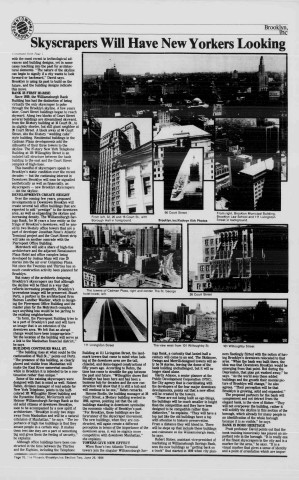
Brooklyn,IncSkyscrapers Will Have New Yorkers LookingC o n tin u e d f r o m Page iwith the most recent in technological advances and building designs, yet in somecases reaching into the past for architectural elements. %u201cThe nature of the skylinecan begin to signify if a city wants to lookforward or backward,%u201d David says.Brooklyn is using its past to build on thefuture, and the building designs indicatethis move.BANK IS FIRST HI-RISESince 1929, the Williamsburgh BankBuilding has had the distinction of beingvirtually the only skyscraper to pokethrough the Brooklyn skyline. A few yearslater, Court Street buildings began to reachskyward. Along two blocks of Court Streetseveral buildings are streamlined skyward,from the 35-story building at 16 Court St., toits slightly shorter, but still giant neighbor at26 Court Street. A block away at 66 CourtStreet, sits the 32-story %u201cwedding cake%u201dstyle building. Residential buildings in theCadman Plaza developments add thesilhouette of their three towers to theskyline. The 27-story New York TelephoneBuilding at 101 Willoughby Street is anisolated tall structure between the bankbuilding to the east and the Court Streetcomplex of high-rises.This handful of skyscrapers speak toBrooklyn%u2019s static condition over the recentdecades %u2014 but the continuing interest inDowntown Brooklyn will soon be signalledaesthetically as well as financially, asskyscrapers %u2014 new Brooklyn skyscrapers%u2014 dot the skyline.DEVEIX)PMENTS CREATE HEIGHTOver the coming few years, proposeddevelopments in Downtown Brooklyn willcreate several tall office buildings that areexpected to add %u201cprestige%u201d to the downtownarea, as well as expanding the skyline andincreasing density. The Williamsburgh Savings Bank, for 50 years a lone entity on thefringe of Brooklyn%u2019s downtown, will be joined by two 24-story office towers that are apart of developer Jonathan Rose%u2019s AtlanticTerminal project and the Court Street stripwill take on another comrade with thePierrepont Office Building.Metrotech will add a share of high-risearchitecture and the adjacent RenaissancePlaza Hotel and office complex beingdeveloped by Joshua Muss will rise 29stories into the air over Columbus Plaza.Not since the Twenties and Thirties has somuch construction activity been planned forBrooklyn.But many of the architects designingBrooklyn%u2019s skyscrapers say that althoughthe skyline will be filled in a way thatreflects increasing prosperity, Brooklyn%u2019sbrownstone image will be preserved. StuartPertz, a partner in the architectural firmHaimes Lundber Waehler, which is designing the Pierrepont (Mice Building and themaster plan for the Metrotech complex,says anything less would be too jarring tothe existing neighborhoods.%u201cIn form, the Pierrepont Building tries tobe a part of Brooklyn%u2019s past and will havean image that is an extension of thedowntown area. We felt that an abruptchange would have been inappropriate.%u201dYet the location of the building will serve asa link to the Manhattan financial district,%u201dhe says.BUILDING CONTINUES WAIJ. ST.%u201cThe building rises at what could be thecontinuation of Wall St.,%u201d points out Pertz.%u201cThe presence of this building, so clearlyplaced and visible from Manhattan willmake the East River somewhat smallerwhile in Brooklyn it is intended to be a continuation rather than unique.%u201dSome of the existing skyscrapers weredesigned with that in mind as well. RobertRehm, division manager of real estate forNew York Telephone, points to the buffcolored 101 Willoughby Street building andthe Byzantine Halsey, McCormick andHelmer Williamsburgh Savings Bank as theold solid citizens of downtown Brooklyn,soon to be accompanied by a new spirit ofarchitecture. %u201cBrooklyn is only two stopsaway from Manhattan and will be a naturalextension of Manhattan,%u201d he says. %u201cThe importance of high rise buildings is that theyamaze people in a certain way. It makesthem teel UKe they are a part ot somethingbig and gives them the feeling of security,%u201dhe explains.Although office buildings have been constructed in the time between the Thirtiesand the Eighties, including the TelephoneFrom right, Brooklyn Municipal Building,Brooklyn Law School and 111 LivingstonStreet in background.From left, 32, 26 and 16 Court St., withBorough Hall in foreground.66 Court StreetBrooklyn, inc/Kathryn Kirk PhotosThe towers of Cadm an Plaza, right and center. The St. Georgehotel tower, left. 26 Court Street111 Livingston Street The view west from 101 W illoughby St. 101 W illoughby StreetBuilding at 111 Livingston Street, the landmark towers that come to mind when looking at the downtown area are the tall,chiseled, and dome-topped constructions offifty years ago. According to Rehm, thetime has come to straddle the gap betweenthe past and future. %u201cWilloughby shows thatBrooklyn has been here and has beer, abusiness hub for decades and the new construction will show that it is still a hub andwill continue to be one,%u201d Rehm remarks.Simone Sindin, the building manager at 26Court Street, a 28-story building erected in1925, agrees, pointing out that the oldbuildings standing in downtown symbolizethe economic vitality of Brooklyn%u2019s past.%u201cFor Brooklyn, these buildings are theforerunner of the skyscraper movement.The new buildings, when they are constructed, will again create a differentperception in terms of the importance of thedowntown area, n wiii be siigniiy morecompetitive with downtown Manhattan,%u201dshe explains.TOWERS GIVE NEW EFFECTWhen Rose%u2019s two Atlantic Terminaltowers join the singular Williamsburgh Savings Bank, a curiosity that lasted half acentury will come to an end. The Skidmore,Owings and Merrill-designed towers will only be 24 stories, leaving the dome of thebank building unchallenged, but it will nolonger stand alone.Hardy Adasco, a senior planner at thePublic Development Corporation (PDC),the City agency that is coordinating withthe developers of the four major downtowndevelopments, points out that a new effectwill be created by the towers.%u201cThese are not being built as ego things,the buildings will be much smaller in heightthan the competition and they have beendesigned to be compatible rather thandistinctive,%u201d he explains. %u201cThey will have atop just like the old buildings have a topwith attention to historic preservation.From a distance they will blend in. Therewill be steps up that include these buildingsand cuiminaie ai ine wiiiiamsburgh Bank,he says.Robert Stober, assistant vice-president ofmarketing at Williamsburgh Savings Bank,sees the new buildings as %u201cgetting back ona track%u201d that started in 1929 when city planners fleetingly flirted with the notion of having Brooklyn%u2019s downtown relocated to thatarea. %u201cWhen the bank was built there, theidea was that Downtown Brooklyn would beemerging from that point. But during theDepression, that plan got washed away,%u201d hesays. %u201cAs the world sees these addedbuildings and the growth their mental picture of Brooklyn will change,%u201d he alsoagrees. %u201cTheir perception will be thatBrooklyn is growing, solid and expanded.%u201dThe proposed partners for the bank willcomplement and not detract from theelegant bank, is the view of Stober. %u201cTheywill not overpower the building, rather itwill solidify the skyline in this section of theborough, which already for many people isan identification of the whole boroughbecause it is so visible,%u201d he says.BANK IS BORO HERITAGEPratt professor David points out that thebank Duiiaing msioncauy nas piayea an important role in the borough. %u201cIt is really oneof the finest skyscrapers in the city and is amarker for the area,%u201d he says. %u201cIt is avisual marker that gives a sense of identityand a point of orientation which are imporPage 10, e Phoenix/Brooklyn,Inc Section Two, June 26, 1986


