


Page 214 - Demo
P. 214
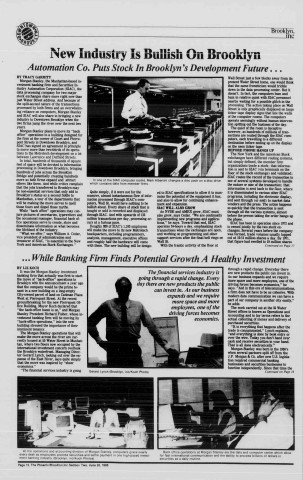
Brooklyn,____ incNew iiiuustry Is Bullish On BrooklynA u t o m a t i o n C o . P u t s S t o c k I n B r o o k l y n ' s D e v e l o p m e n t F u t u r e .In one of the SIAC com puter rooms, Mark Albertini changes a disc pack on a disc drivewhich contains data from m ember firms.BY TRACY GARRITYMorgan Stanley, the Manhattan-based investment banking firm and Securities Industry Automation Corporation (SIAC), thedata processing company for two majorstock exchanges share more right now thanjust Water Street address. And because ofthe split-second nature of the transactionsprocessed by both firms and an overwhelming reliance on computers, Morgan Stanleyand SIAC will also share in bringing a newindustry to Downtown Brooklyn when thetwo firms jump the river over the next twoyears.Morgan Stanley plans to move its %u201cbackoffice%u201d operations to a building designed forthe firm at the comer of Court and Pierrepont Streets in Downtown Brooklyn, andSIAC has signed an agreement in principleto move more than two-thirds of its operations to the Metrotech development on a lotbetween Lawrence and Duffield Streets.In total, hundreds of thousands of squarefeet of space will be devoted to informationprocessing in Downtown Brooklyn, bringinghundreds of jobs across the BrooklynBridge and potentially creating hundredsmore as both firms expand and attractothers like them. And while critics complainthat the jobs transferred to Brooklyn maybe non-essential services that only add toBrooklyn%u2019s status as a second fiddle toManhattan, a tour of the departments thatwill be making the move serves to quellthose fears and dispel those myths.While %u201cback office%u201d operations may conjure pictures of secretaries, typewriters andthe occasional manager, financial back office operations serve to create, store anddisseminate information on what becomesthe lifeblood of the industry.%u201cWhat we offer,%u201d says William A. Cedar,vice president of administration andtreasurer of SIAC, %u201cis essential to the NewYork and American Stock Exchanges.%u201dQuite simply, if it were not for themassive, almost instantaneous flow of information processed through SIAC%u2019s computers, Wall St. would have nothing to bebullish about. Every share of stock that isbought or sold is recorded and displayedthrough SIAC. And with upwards of 125million transactions per day, processing occurs at a furious pace.Roughly 800 of SIAC%u2019s 1,100 employeeswill make the move to its new Metrotechheadquarters, including programmers,analysts, management, executive officesand roughly half the hardware will comewith them. The new building will be designed to SIAC specifications to allow it to maximize the potential of the equipment it has,and also to allow for continuing enhancement and expansion.SIAC WILL ALSO GROWAs NYSE and AMEX grow, SIAC mustalso grow, says Cedar. %u201cWe are continuallyimplementing new programs and applications,%u201d he says. Toward that end, SIACoperates 24-hours a day, emphasizing stocktransactions when the exchanges are open,and working on programming and othersupport services after the final bell rings onWall St.With the frantic activity of the floor atWall Street just a few blocks away from itspresent Water Street home, one would thinkthat the same freneticism would trickledown to the data processing center. But itdoesn%u2019t. In fact, the computers hum andbuzz in relative quiet with SIAC personnelnearby waiting for a possible glitch in theprocessing. The action taking place on WallStreet is only graphically displayed on largeticker tape display signs that line the wallsof the computer rooms. The computersoperate seemingly without human intervention spitting out the business of the day.The quiet of the room is deceptivehowever, as hundreds of millions of transactions are routed through the SIAC computers, each travelling to a differentdestination before ending up on the displayon the neon ticker tape.BEFORE PHONE HANGS UPThe New York and the American Stockexhchanges have different routing systems,but simply defined, the member firmorganizations trade a stock; that information is sent to SIAC (via terminals on thefloor of the stock exchange) and validated;SIAC routes the record of the transaction toone of several systems developed to handlethe nature or size of the transaction; thatinformation is sent back to the floor, whereit is disseminated to various other SIACprograms, including the electronic display,and sent through (or sold) to market datavendors and the press. The action happensso quickly that the transaction is sentthrough all the various systems, almostbefore the person taking the order hangs upthe phone.SIAC has been in operation since 1972 andis owned jointly by the two stock exchanges. Several years before the companywas formed, trade volumes usually toppedout at 10-12 million shares a day. By 1971,that figure had swelled to 19 million sharesContinued on Page 17. . . W h i l e B a n k i n g F i r m F i n d s P o t e n t i a l G r o w t h A H e a l t h y I n v e s t m e n tBY LIZ KOCHIt was the Morgan Stanley investmentbanking firm that actually was first to startthe move of %u201cback-office%u201d operations toBrooklyn with the announcement a year agothat the company would be the prime tenant in a new building on a long-emptyCity-owned parcel of land on Cadman PlazaWest at Pierrepont Street. At the recentgroundbreaking for the new Pierrepont Office Building, Mayor Koch declared that%u201cthe back-office boom is on,%u201d and MorganStanley President Richard Fisher, whose investment banking firm will be moving its%u201cback-office operations,%u201d into the newbuilding stressed the importance of theirimminent tenancy.The Morgan Stanley operations that willmake the move across the river are currently housed at 55 Water Street in Manhattan, where two floors now occupied by theinternational investment concern overlookthe Brooklyn waterfront. Managing Director Gerard Lynch, looking out over the expanse of the East River, says quite simplythat the move was inspired by %u201csheereconomics.%u201d%u201cThe financial services industry is goingThe financial services industry isgoing through a rapid change. Everyday there are new products the publiccan invest in. As our businessexpands and we requiremore space and moreemployees, one o f thedriving forces becomeseconomics.Gerard Lynch (Brooklyn, inc/Koch Photo)through a rapid change. Everyday thereare new products the public can invest in.As our business expands and we requiremore space and more employees, one of thedriving forces becomes economics,%u201d hesays. %u201cAnd in this era of telecommunications,a firm does not have to be as cohesive. Withmodem data communication we can have apart of our company in another city easily,%u201dhe adds.The work carried out at the 55 WaterStreet offices is known as Operations andAccounting and in lay terms refers to theactual collecting of money and delivery ofpurchased securities.%u201cIt is everything that happens after thetrade is consummated,%u201d Lynch explains,%u201cand everything is done by book entry orover the wire. Today you don%u2019t hand overcash and receive securities in your hand.That is ail done electronically.%u201dMorgan Stanley was bom in the 1930%u2019swhen several partners split off from theJ.P. Morgan & Co. after new U.S. legislation required commercial bankingbusinesses and securities businesses tofunction independently. Since that time theContinued on Page 16At the operations and accounting division of Morgan Stanley, com puters grace nearlyevery desk as em ployees process securities and settle payment in one high-paced investment banking industry. (Brooklyn, inc/Koch Photos)Back office operations at Morgan Stanley are the data and com puter center which allowfor fast international com m unication and the ability to process billions of dollars insecurities as a daily routine.Page 12. The Phoenlx/Brooklyn.lnc Section Two, June 26, 1986


