


Page 260 - Demo
P. 260
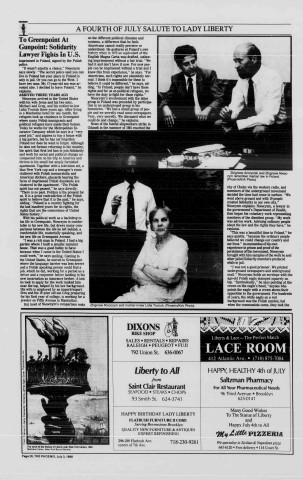
A FOURTH OF JULY SALUTE TO LADY LIBERTYTo Greenpoint AtGunpoint: SolidarityLawyer Fights In U.S.imprisoned in Poland, signed by the Polish police.%u201cIt wasn%u2019t exactly a choice,%u201d Nieoczym says slowly. %u2018\live in Poland but your place in Poland is only in jail. Or you can go to the West. I have two sons. My 17-year-old son was arrested also. I decided to leave Poland,%u201d he explains.ARRIVED THREE YEARS AGONieoczym arrived in the United States with his wife Irena and his two sons,Michael and Greg, and his mother-in-law Lidia Trociuk three years ago. After living in a Manhattan hotel for one month, the refugees took up residence in Greenpoint where many Polish immigrants and political refugees have made their homes. Today he works for the Metropolitan Insurance Company which he says is a %u201cvery good job,%u201d and aspires to buy a house with a big garden, but he has not forgotten Poland nor does he want to forget. Although he does not foresee returning to his country, the spirit that first led him to join Solidarity and work for social and political change accompanied him on his trip to America and thrives in his small but amply furnished apartment. Together with a television set, a blue New York cap and a teenager%u2019s room cluttered with Polish memorabilia and American stickers, placards bearing the faces of imprisoned Polish dissidents are clustered in the apartment. %u201cThe Polish spirit has not passed,%u201d he says directly. %u201cThere is no past. Politics is the present for us. It is a great contradiction of the Polish spirit to believe that it is the past,%u201d he says, adding, %u201cPoland is a country fighting for the last hundred years for its rights, the rights that are the cornerstone of United States history.%u201dWith his political work as a backdrop to his life in Greenpoint, Nieoczym is comfortable in his new life, but draws many comparisons between the life he left behind, a comfortable life, materially speaking, and his new life on Greenpoint Avenue.%u201cI was a rich man in Poland. I had a big garden where I built a smaller summer house. That was a good hobby to have because when I came to the United States I could work,%u201d he says smiling. Coming to the United States, he moved to Greenpoint where the language barrier was less severe and a Polish speaking person could find a job, which he did, working for a period as a driver and a carpenter before landing in his new incarnation as insurance broker. A test he took to apply for the work ranked him near the top, helped by his law background. His wife is employed by an import/export firm and his 19 year old son Greg preparing for his first year of college, is working for a jeweler on Fifth Avenue in Manhattan.But most of Nieoczym%u2019s comparison restson the different political climates and systems, a difference that he feels Americans cannot really perceive or understand. He gestures at Poland%u2019s own history when in 1475 an f>niiival%u00ab%u00bbnt. of the English Magna Carta was drafted, outlawing imprisonment without a fair trial. %u201cWe had it and don%u2019t have it now. For now people can be imprisoned without a trial and I know this from experience,%u201d he says. %u201cFor Americans, such rights are absolutely normal. I think it%u2019s impossible for them to believe it could be different,%u201d he says, adding, %u201cIn Poland, people don%u2019t have these rights and for us as political refugees, we have the duty to fight for those rights.%u201dNieocyzm%u2019s involvement with the labor group in Poland was preceded by participation in an underground group in his hometown. %u201cWe had a small group of people and we secretly read some newspapers. Very, very secretly. We discussed what we could do and change,%u201d he explains.News of the fateful shipworkers strike in Gdansk in the summer of 1981 reached theZbigniew Arczynski and Zbigniew Nieoczym remember martial law in Poland.(Phoenix/Kirk Photo)Zbigniew Nieoczym and mother-in-law Lidia Trociuk. (Phoenix/Kirk Photo)city of Chelm via the western radio, and members of the underground movement decided the time had come to surface. %u201cWe went above ground and with 10 people created Solidarity in our own city,%u201d Nieocyzm explains. Nieocyzm, a lawyer in the government%u2019s Department of Health, then began his voluntary work representing members of the dissident group. %u201cMy work was advice work. Advising ordinary people about the law and the rights they have,%u201d he explains.%u201cThis was a beautiful time in Poland,%u201d he says quietly, %u201cbecause the ordinary people believed we could change our country and our lives.%u201d As momentos of his own experience in prison and proof of the persistense of the movement, Nieocyzm brought with him samples of the work he and other jailed Soliarity members produced while in jail.%u201cI was not a good prisoner. We printed underground newspapers and underground mail.%u201d Niecoyzm holds an envelope with the age-old Polish eagle stamped squarely on top. %u201cSymbolically,%u201d he says pointing at the crown on the eagle%u2019s head, %u201canyone who paints the eagle with a crown shows thenopposition to the government. For hundreds of years, the white eagle on a red background was the Polish symbol, but when the communists came, they took theDIXONS / f tBIKE SHOP ^ %u00a7 8SALES %u2022 RENTALS %u2022 REPAIRS RALEIGH %u2022 PEUGEOT %u2022 FUJI792 U nion St. 636-0067*%u2022%u2022%u2022%u2022%u2022# %%u2022 V a V ^ V a V'**. v'%u00ab*. v if . 'O 'i '


