


Page 266 - Demo
P. 266
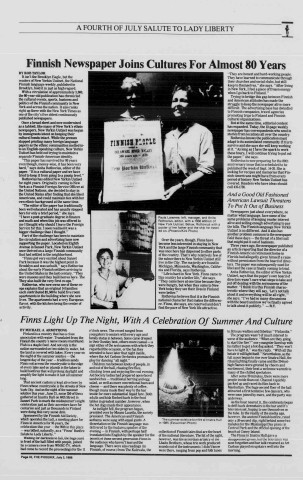
A FOURTH OF JULY SALUTE TO LADY LIBERTYFinnish Newspaper Joins Cultures For Almost 80 YearsBY ROB TAYLORIt isn%u2019t the Brooklyn Eagle, but the readers of New Yorkin Uutiset, the National Finnish language weekly, published in Brooklyn, hold it in just as high regard.With a circulation of approximately 3,000, the 80-year-old publication has chronicled the cultural events, sports, business and politics of the Finnish community in New York and across the nation. It also ranks right up there with the New York Times as one of the city%u2019s five oldest continuously published newspapers.Once a broad sheet and now modernized as a tabloid, like many of New York%u2019s ethnic newspapers, New Yorkin Uutiset was begun by immigrants intent on keeping their cultural bonds intact. While the presses stopped printing many foreign language papers as the ethnic communities melted into an English-speaking culture, New Yorkin Uutiset has held out trying to maintain a separate Finnish-American identity.%u2018 %u2018This paper has survived for 80 years even though, money-wise, it has been very hard,%u201d says Anita Rothovius, editor of the paper. %u201cIt is a cultural paper and we have tried to keep it from going to a gossip level.%u201d Rothovius has edited New Yorkin Uutiset for eight years. Originally coming to New York as a Finnish Foreign Service Officer at the United Nations, she decided to stay in the United States after finding that she liked Americans, and could maintain ties with her own ethnic background at the same time.%u201cThe editor of the paper has traditionally been well educated and has usually stopped here for only a brief period,%u201d she says.%u201c I have a post-graduate degree in finance and math and when this job was offered to me I thought why should I leave the Foreign Sendee for this. I soon realized it was a bigger challenge than I thought.%u201dPart of the challenge has teen to maintain the circulation and advertising base now supporting the paper. Located on Eighth Avenue in Sunset Park, New Yorkin Uutiset once thrived on a large Finnish community that had settled in the neighborhood.%u2018 %u2018 Finns got very excited about Sunset Park because it was the highest point in Brooklyn and was unbuilt,%u201d says Rothovius about the early Finnish settlers arriving in the United States in the last century. %u201cThey were masons and they built homes here. The They also built the very first co-ops.%u201d Rothovius, who now owns one of these coops explains that an original 14 families each contributed $2,300 to build five room apartments in the building where she now lives. The apartments had a very European flavor, with the kitchen being the center of activity.Paula Laramee, left, manager, and AnitaRothovius, editor, with a 1938 edition ofNew York Uutiset. Below, Rothovius with aposter of her father and the ship he traveled on. (Phoenix/Kirk Photo)Over the years, though, Finns have become less interested in staying in New York and the large Finnish community that was once here has dispersed to other parts of the country. That%u2019s why relatively few of the subscribers to New Yorkin Uutiset still live in the City. The majority are found in Michigan, Minnesota, Washington, California and Florida, says Rothovius.%u201cLife is hard in New York. Finns came to this country for a tetter life,%u201d she says. %u201cThey came here at one time because they were hungry, but when they come to New York today they see their lives in Finland were tetter.%u201dRothovius believes that it is the Finnish national character that makes the difference. Finns, she says, are reserved and don%u2019t find the pace of New York life attractive.%u201cThey are honest and hard-working people. They have learned to communicate through their churches and social clubs, but still keep to themselves,%u201d she says. %u201cAfter living in New York, I feel a piece of frozen energy when I go back to Finland.%u201dTrying to bridge this gap between Finnish and American attitudes has made the struggle to keep the newspaper alive more difficult. The advertising base has dwindled to Finnish companies, travel agencies promoting trips to Finland and Finnish cultural organizations.But at the same time, editorial content has expanded. Today, the 12-page weekly newspaper has correspondents who send in stories from locations all over the country.Rothovius knows the publication must adapt to its assimilated community if it is to survive and she says she will keep working at it. %u201cAs long as I have the spark to work these hours, I will continue trying to put out the paper,%u201d she says.Rothovius is now preparing for the 80th anniversary issue that is scheduled to be published the week of Sept. 14-20. She is looking for recipes and memories that Finnish-Americans might have from every period of history New Yorkin Uutiset has covered. Readers who have ideas should call 435-1736.A nd a Good Old FashionedAmerican Lawsuit ThreatensTo Put It Out o f BusinessNewspapers just about everywhere, no matter what language, face some of the same problems of keeping reader interest alive and selling enough advertising to pay the bills. The Finnish-language New Yorkin Uutiset is no different. And it also has another problem common to the newspaper field these days %u2014 the threat of a libel suit that might put it out of business.Three years ago, the newspaper published an article reporting that the director of a Finnish-American retirement home in Florida had allegedly given himself a raise without permission from the board of directors. The paper was subsequently sued for libel and the case is finally coming to trial.Anita Rothovius, the editor of New Yorkin Uutiset, says that the paper%u2019s own board of directors wasn%u2019t sure what steps to take and put off dealing with the seriousness of the matter. %u201cI think it is this Finnish characteristic where they will say, %u2018Let%u2019s not talk about it and everything will be all right,%u2019%u201d she says. %u201cI%u2019ve had so many discussions with the board and now we%u2019ve finally agreed to talk about it publicly. %u201d %u2014 R.T.Finns L ight Up The N ight, W ith A C elebration O f Sum m er A n d CultureBY MICHAEL A. ARMSTRONGFinland is a country that has a close association with water. Translated from the Finnish the country %u2019s name means marshland. Fish is a staple food. And not only is the nation surrounded on two sides by water, but the land is covered with lakes. Every year on the night of the summer solstice %u2014 the longest day of the year %u2014 tradition sends Finns out across the countryside to the edge of every lake and on islands in the lakes to build bonfires that will prolong daylight and amplify the light to make it last all summer long._ TTiat ancient custom is kept alive here by Finns whose countryside is the streets of New York Qty. And on the night erf the summer solstice this year, June 21, some 250 of them gathered at Imatra Hall on 40th Street in Sunset Park to mark the midsummer%u2019s night celebration just as their ancestors have for centuries and just as thousands in Finland were doing this very same date.Sponsored by the Finnish Aid Society, which operates the hall, a meeting place for Finns in America for 95 years, the celebration this year the 95th in this place %u2014 was billed, naturally, as a %u201cFinns%u2019 Bonfire Salute to Lady Liberty.%u201dwaiting tor aanmess to tail, tne huge yard in front of the hall filled with people, joined by a camera crew from WNBC-TV, which had come to record the proceedings for the 11o%u2019clock news. The crowd ranged from youngsters to seniors with every age and family status in between. Some came dressed in their Sunday test, others more casual %u2014 a sign either of the seriousness with which they regarded the occasion, or the fun they intended to have later that night inside, where the Art Carlson Orchestra promised to play for dancing %u201call night.%u201dChildren ran between knots of people, in and out of the hall, chasing fire flies, climbing trees and enjoying the cool evening. Aid Society ladies had prepared open-faced sandwiches %u2014 traditional herring and egg salad, as well as more conventional ham and cheese %u2014 and there was plenty of coffee, though many made their way to the bar inside for more substantial liquid fare. Both adults and kids flocked back to the food tables in greatest number, however, when the hot dogs made their appearance.As twilight fell, the program began, presided over by Mauno Laurila, the society president. The American and Finnish anthems were sung with equal gusto. A dissertation on the Finnish language was delivered by the featured speaker of the evening %u2014 in Finnish, with perhaps half translated into English by the speaker for the Denent oi inose second generation Finns in the audience who haven%u2019t learned the language. There were also readings (in Finnish, of course) from The Kalevala, theThe summer solstice bonfire at Imatra Hallin 1985. (Eeva-lnkeri Photo)collection of Finnish tales that are the heart of the national literature. The hit of the night, nowever, was me accoraian artistry oi tiie Lhaito Brothers, whose trio work produced sounds out of the instruments I didn%u2019t know were there, ranging from pop and folk tunesto Strauss waltzes and Sibelius%u2019 %u201cFinlandia.%u201dThe program wasn%u2019t of much interest to some of the audience. %u201cWhen are they going to start the fire?%u201d one youngster lined up with his father to get a hot dog asked. %u201cThey won%u2019t have to light it,%u201d was the reply. %u201cWith all this hot air it will light itself.%u201d Nevertheless, as the full moon began to rise over Imatra Hall, the ritual lighting finally came and the 20-foothigh flames were greeted by cheers and excitement, their heat a welcome warmth to many of the chilled spectators.After some 20 minutes, there were more people inside than out. Channel 4 quickly packed up and raced its film back to Manhattan. The huge second floor of the hail attracted a first tentative few dancers, who were soon joined by more, and the party was underway.As the hour neared 11, the celebrants began to drift back downstairs to the bar and it%u2019s television set, hoping to see themselves on the tube. In the reality of the media age, however, the ancient Finnish bonfire, rated oniy a 20-second clip, right behind some two minutes for the Mississippi Day picnic in Centra! Park and the official opening of the beach at Coney Island.The Finns in Imatra Hall gave aU l^ d jjp u u itc u g iim ii, u u i u ic tc lcv io iO u n a osoon forgotten and bar talk resumed as Art Carlson played on upstairs well into the morning.P%u00bbfl%u00ab 32, T H E PHOENIX, July 3,1986


