


Page 3 - Demo
P. 3
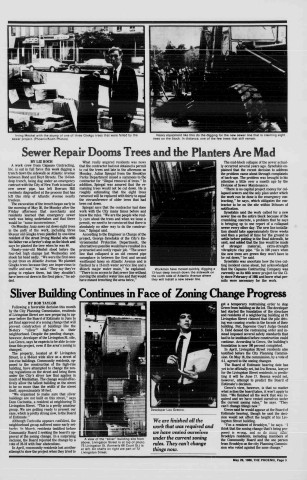
Irving Meshel with the stum p of one of three G inkgo trees that were felled by thesewer project. (Phoenix/Koch Photos)Heavy equipm ent like this do the digging for the new sew er line that is claim ing eighttrees on the block. In distance, one of the few trees that still rem ain.Sewer Repair Dooms Trees and the Planters Are MadBY LIZ KOCHA work crew from Capasso Contracting, Inc. is out in full force this week digging a trench down the sidewalk on Atlantic Avenue between Bond and Hoyt Streets. The 13-footdeep trench, being dug under an emergency contract with the City of New York to install a new sewer pipe, has left Boerum Hill residents disgruntled at the process that has left this strip of Atlantic Avenue nearly treeless.The excavation of the trench began early in the morning of May 26, the Monday after the Friday afternoon that merchants and residents learned that emergency sewer work was being undertaken and that there would be %u201csome inconvenience.%u201dOn Monday, buzz saws cut down eight trees in the path of the work, including three 50-year old Gingko trees planied by one-time resident of the street Irving Meshel who with his father ran a furrier%u2019s shop on the block and says he planted the tree when he was 40.Ninety-year-old Meshel stood before the four-foot high stumps last Wednesday and shook his head sadly. %u201cWe were the first ones to put trees on Atlantic Avenue. We planted Gingko trees because they are impervious to traffic and soot,%u201d he said. %u201cThey say they%u2019re going to replace them, but they shouldn%u2019t have been cut down in the first place,%u201d he added.What really angered residents was news that the contractor had not obtained a permit to cut the trees and late in the afternoon on Monday, Julius Spiegal from the Brooklyn Parks Department issued a summons to the contractor for %u201cillegal removal of trees.%u201d In addition, Spiegal was assured that the remaining trees would not be cut down. He is roughly estimating that the eight trees removed will be replaced with thirty to equal the circumference of older trees that had been cut down.Spiegal says that the contractor had done work with the City many times before and knew the rules. %u201cWe are the people who really care about the trees and when we issue a permit, we need to be convinced that there is absolutely no other way to do the construction,%u201d Spiegal said.According to the Engineer in Charge of the project, George Synefakis of the City%u2019s Environmental Protection Department, the alternatives possible would have resulted in a protracted and costly repair job. %u201cThe sewer line that collapsed is an old cement pipe someplace in between the first and second westbound lanes on Atlantic Avenue and is flanked by a 12-inch water service line and a 48-inch major water main,%u201d he explained. %u201cThere is no access to that sewer line without moving the smaller water line and that would have meant trenching the area twice,%u201dW orkm en have moved quickly, digging a13-foot deep trench down the sidew alk onthe north side of A tlantic Avenue wherethey will install a new sew er line.The mid-block collapse of the sewer actually occurred several years ago. Synefakis explained that the recent decision to address the problem came about through complaints of back-ups. The problem was brought to his attention a little over a month ago by the Division of Sewer Maintenance.%u201cThere is no capital project money for collapsed sewers and the only plan under which the work can be done is the emergency contracting,%u201d he says, which obligates the contractor to be on the site within 24-hours of notification.Synefakis said the work called for a new sewer line on the entire block because of the crumbling concrete, a problem that he says is bringing up to one report of a collapsed sewer every other day. The new line installation should take approximately three weeks and then a period of time for the ground to settle before putting in the final sidewalk, he said, and added that the line would be made of stronger material, extra-strength vitrophyte clay pipe. %u201cSo in 100 years when the new trees are grown they won%u2019t have to be cut down,%u201d he said.Synefakis was uncertain how the tree cutting incident came about, but acknowledged that the Capasso Contracting Company was currently on its 40th sewer project for the City since February of 1985 and knew what permits were necessary for the work.Sliver Building Continues in Face of Zoning Change Progressget a temporary restraining order to stop Greco from building on the lot. The developer had started the foundation of the structure and residents of a neighboring building at 75 Livingston Street claimed that the pile driving was causing cracks in the facade of their budding. But, Supreme Court Judge Gerald S. Held denied the restraining order and instead imposed several safety standards that had to be instituted before construction could continue. According to Greco, the building%u2019s foundation is now 100 percent completed.In April, Livingston Street residents also testified before the City Planning Commission. On May 16, the commission, by a vote of 4-1, agreed to the zoning changes.The Board of Estimate hearing date has yet to be officially set, but Ira Bezoza, lawyer for the Livingston Street residents, is predicting it will be June 17. Bezoza would not, however, attempt to predict the Board of Estimate%u2019s decision.Greco%u2019s view, however, is that no matter what action the board takes, it won%u2019t apply to him. %u201cWe finished all the work that was required and we have vested ourselves under the current zoning rules,%u201d he says. %u201cThey can%u2019t change things now.%u201dGreco said he would appear at the Board of Estimate hearing, though he said the decision would not affect the height of his Livingston Street building.%u201cI%u2019m a resident of Brooklyn,%u201d he says. %u201cI think that the zoning change that%u2019s being propwsttl IS wrung, dJHI SU UU m ail) uuiuBrooklyn residents, including members of the Community Board and the one person from Brooklyn on the city Planning Commission who voted against the zone change.%u201dBY ROB TAYLORFollowing a favorable decision this month by the City Planning Commission, residents of Livingston Street are now preparing to appear before the Board of Estimate in June to get final approval of a zoning change that will prevent construction of buildings like the 26-story %u201csliver%u201d high-rise in their neighborhood. Despite the pending change, however, developer of the Livingston St. site, Lou Greco, says he expects to be able to continue this project, even if the area%u2019s zoning is changed.The property, located at 67 Livingston Street, is a 25-feet wide slice on a street of low-rise buildings. Community residents, opposed to the construction of the high-rise building, have attempted to change the zoning regulations on the street and bring them under the City%u2019s sliver law that applies in much of Manhattan. The change would effectively allow the tallest building on the street to be no more than the width of the street itself, approximately 50 feet.%u201cWe organized to make sure that sliver buildings are not built on this street,%u201d says Dom Cucinotta, a resident at neighboring 75 Livingston Street. %u201cThis is a pretty amateur group. We are getting ready to present our case, which is pretty strong now, to the Board of Estimate.%u201dAlthough Cucinotta appears confident, the neighborhood group suffered some early setbacks Tn March, residents testified before Community Board 2 seeking the board%u2019s approval of the zoning change. In a surprising decision, the Board rejected the change by a vote of 23-10 with four' abstentions.In April, community residents lost another attempt to slow the project when they tried toDeveloper Lou Grecco.A view of the \above. Livingston Street is at top of photo.75 Livingston St. (form erly 66 Court St.) isat left. A ir shafts on right are part of 72Livingston Street.W e are finished all thework that was required andwe have vesieu ourselvesunder the current zoningrules. They can't changethings now.M ay 29,1986 , TH E PH O EN IX, Page 3


